Advice please on wiring diagram and wire labelling

chriss999

Well-Known Member
Joined
9 Oct 2012
Messages
5,836
Location
Devon, England
sailing-chinee.com
Hello all,
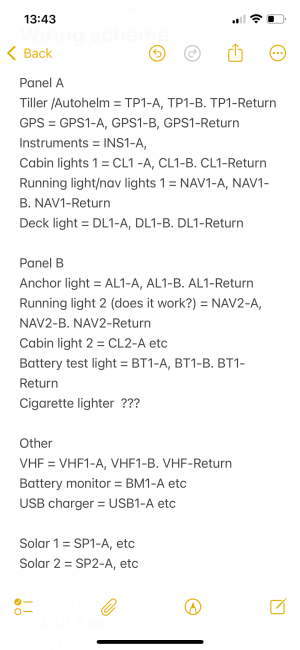
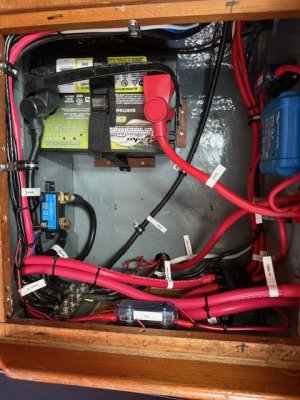
No electrical background myself, but I need to draw out the wiring of my Sadler 26, so I can understand which wires do what, where they are going, and to understand previous owner additions.
Part of this will be to label the wires, and I have got myself a Brother printer for that.

My question is, what are the options for a workable labelling convention? Eg:

Start at 0001 and go up incrementally, randomly allocating a number to each wire?

Name the wires from what they do, eg ‘Interior lights’, ‘Solar’, ‘Masthead nav’ etc?

Some combination? Or something else altogether?

I can see the advantage of the wire label saying what it is. But it could get unwieldy.

What has worked for you, please?
 
You might give each location in the boat a letter code and then each terminal within that a number, then label the cable with it's source and destination

Eg, maybe "A" is saloon and "AB" is the main switch panel and "AB13" is the terminal of one of the switches and the cable to it might be "AB13-KF07"
 
I've done this kind of thing a few times, and as you're without an electrical background, you have to make it understandable to yourself. When I've done this, I've found that it's best to start at the beginning, which is the battery usually, then work out from there.
Draft 1 won't be the final offering of course, but if you can combine the wiring diagram element's with the concept of the London Underground schematic, it'll come together.
I think that it's important to identify each wire that you have by colour, as well as by number of course. As you're labelling the wires as you go along, it's imperative to have accuracy, give each wire a separate number, and if it's going into a connector block, mark the connector number on your schematic as well as marking the actual connector itself with which end is connector #01 etc. It's really good news when you've got the ID of a wire clearly visible at both ends of the wire, at the place in connector where the schematic indicated it was going to be. Fault finding becomes infinitely easier with just that. Professionally, I've seen very expensive 6 figure mistakes caused by an error with that simple task.
That is critical.
Then add that to your diagram as you go along. You rightly say that it could become unwieldy if you ID the cable with too long a label, that's why you're using cable idents, so that you'll be able to refer back to the schematic which will evolve as you proceed.
It's quite normal to have a square for example, with "masthead tricolour" on it, then say 2 dots marking a connection, with 2 lines leading from those, each line numbered, coloured and named. Then simply continue the wires to (say) the switch where it comes from, and so on.
A boat like yours isn't going to require 4 figure ID's as there's not that huge a number of wires/lines, so keep it simple and easily identifiable.
Good luck, it's not tricky, but does have to be thorough and accurate, otherwise it's a waste of time.
 
Last edited:
The standard way of doing it in industry is typically something like

The first wire from the fuse box to a light switch might be labelled “A1A” at both ends.

The second piece of wire from the light switch to the first light fitting would be labelled A1B at both ends.

The third piece of wire from the first light fitting to the second would be labelled A1C at both ends and so on.

You can typically label both the positive and negative wire the same because the colour will differentiate them.

The second wire from the fuse board to the light switch might be A2A, and then from the light switch to the light A2B.

The third wire from the fuse box to the bilge pump switch might be B1A or M1A (M signifying motor if you wanted to).

I typically avoid trying to make the letters mean anything because it always gets messy at some point.

This way is convenient because if you are fault finding a circuit, you can easily trace it all the way through its length just by remembering the first couple of letters.
 
Whilst codes and numbers are more robust for a complete picture - at 3am in the rain as you are trying to find why something is not working you'll wish that the "critical" systems were easier to trace with "English" descriptions. I'm sure you don't need to go full sentences - M/H LT, FWD CAB LT, A-PILOT, etc
 
The risk, of course, is that without wiring nearly from scratch, that something is that you mislabel something, perhaps because you missed a hidden connection. Then you really can't trust the labeling, so you are not any better off.

No guessing, which means you can't just go by what comes on. Best to not label anything where there is any question at all, or to leave a hyphen or comma at the end. For example, it's fine to list what is on a wire, but don't assume there isn't a dead end hanging somewhere.
 
Last edited:
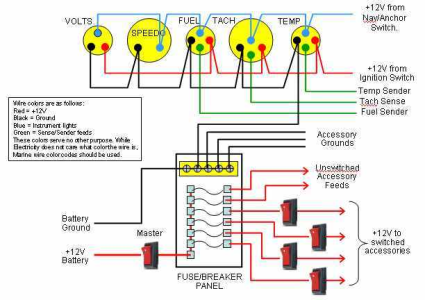
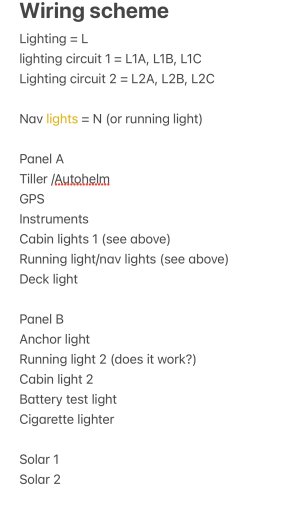
What I'd had in mind is something along these lines (plagarised from a USA MoBo?), but with the wires physically labelled, and annotated onto the schematic.
1760535535795.png
 
Hello all,
No electrical background myself, but I need to draw out the wiring of my Sadler 26, so I can understand which wires do what, where they are going, and to understand previous owner additions.
Part of this will be to label the wires, and I have got myself a Brother printer for that.

My question is, what are the options for a workable labelling convention? Eg:

Start at 0001 and go up incrementally, randomly allocating a number to each wire?

Name the wires from what they do, eg ‘Interior lights’, ‘Solar’, ‘Masthead nav’ etc?

Some combination? Or something else altogether?

I can see the advantage of the wire label saying what it is. But it could get unwieldy.

What has worked for you, please?
Good luck with it. If your 26 wiring was done as badly as my 34 it is a nightmare. No colour coding whatsoever, many wires embedded in the grp, nearly all of it hidden and inaccessible, some of mine seem to have screws driven though them when attaching the headlining beading. And of course the concept of ducting seems to have been unknown to the builders.
 
Tranona of thsi parish did some wiring recently & the pictures showed that it was a skilful job. Perhaps he may come along & comment on how he marked it up
For my 2 penorth my son gave me his brother printer & I started in the main supply cupboard labelling which wire was which. I though that after several hours I had done a good job. However, 2 weeks later I returned to find a heap of labels in the bottom of the cupboard- damp had got into the glue.
When I bought the boat it was next to sinking. But it had nice curtains & the wiring had really professional tags each with a small identification.
I believe that a GPO engineer was involved; but I never managed to nick any labels from my very few mates working for BT so was unable to try them for myself. If one could find a legal source these would be the best thing.
 
One tip I was given was to put some clear shrinkwrap on the wires, then whe you label them, put the shrinkwrap ober the label & heat it up so it seals around it.
This obviously only works if you are rewiring everything from scratch as I was.
Wish I had remembered that tip before I connected everything up :) as most of my labels ended up detaching themselves over time.
 
Post #17 is a very nice way of doing, however I've found that the labels always become illegible 'just' before I need to refer to them.
Post #16 items, put onto each end of the cable is the best choice by far, as well as being colour coded with an easy mnemonic, that's no longer socially acceptable.
Having a workable and easily understood schematic is the key, I believe, with the individual wires identified on both paper and in place.
 
Top