Advice on keel treatment

RadiumRob

Well-Known Member
Joined
20 Sep 2011
Messages
148
Location
Portland Marina
Visit site
Following on from the recent discussion on treatment of iron keels, I am after some advice on how to treat mine. The boat is to be slurry-blasted in a week or so, and I have the option of taking the keel back to bare metal. Given the earlier comments on the need to apply epoxy immediately afterwards, presumably this is something that should be done later in the year when the ambient temperature is higher.

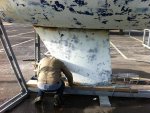
I have attached a couple of photos – one shows some superficial rust at the root and tip (which was very easily removed by with a wire brush and treated with Fertan), the other shows the site of a test scrape, presumably back to the underlying epoxy layer.

I’m quite keen to just remove the anti-fouling and leave the existing epoxy coating. Is this there a good reason to do more (other than because I can)?

Thanks,
 

Attachments

  • IMG_2060.jpg
    IMG_2060.jpg
    97.1 KB · Views: 0
  • P2210205.jpg
    P2210205.jpg
    89.9 KB · Views: 0
If you are happy to carry out minor repairs in the way that you have just done I see little benefit in blasting the whole of the keel. The majority of it appears to be in good condition. When I had mine blasted there was rust all over it and repairing was a major job each winter.
 
You could grind the rust patches back to bare metal and then apply two coats of zinc rich epoxy. Start at the top of the keel, grind then paint and continue working downwards. If you grind it it saves blasting costs. Yes it would be best to do it in Summer temperatures, if there is a Summer this year ;-)
 
Some things to remember when dealing with a cast iron keel:-

Cast iron is porous and often has pockets of contamination including casting sand.
Cast iron will also hold moisture and is best treated after drying it out.

The use any rotating tool like a grinder or brush is not the best as it will carry contaminants form area to the next as it rotates.

Grit blasting presents a clean medium that will carry contaminated material away, it also removes 'soft' spots that rotating tool pass over and just remove the high spots around it.

Cast iron will flash rust, it starts rusting the moment it's cleaned and familiar brown shadow can develop in minutes, so it's important to cover it as you go, rather do one side and paint it.

To form rust you need Iron, oxygen and moisture, remove any one of these and there will be no rust.

Good luck and fair winds. :)
 
Shot blasting is the way to go with old iron castings. As there is a possibility - use it. This is porous, rust got into metal creating even more 'pores'. May be it will need some chemical treatment to get all of rust from it - phosphoric acid (rust remover) always handy. There are 'self passivating" kinds (no need to wash them out with water) such will give you more time - as said above the stuff rusts right away, in seconds, so every help is worth it ;)
But check with instructions for paint system You use, in case.
Grinding often is just waste of time...
No reason to take good areas back to metal, just clean the rusting places and whatever looks suspicious, possibly failing already. Life expectancy of good epoxy anticorrosive treatment is 15-25 years so probably it's still sound, only needs refreshment - new coating of epoxy over existing old one. This will be easy while you make a covering in those places cleaned anyway.
 
Last edited:
Cast iron keel are massive so there's no danger of them disappearing overnight. Rusty patches are just unsightly - but only when the boats out of the water. I don't think I've ever seen a cast iron keel without rust unless it's been treated within a year. I think 'patch' treatment is the best option and is what I used on my Mirage. Localised blast cleaning would be best if you have the kit available followed by immediate zinc rich primer and something like Primocon before anti-fouling. In the absense of blasting equipment, wire brushing on an angle grinder can be used but be sure to wear overalls and goggles as the odd wire is shed. Follow with ZRP and Primocon as before.
Be prepared to repeat every year but hopefully on a smaller area. Alternatively, do nothing, slap on anti-fouling and enjoy your sailing.
 
Last edited:
I've had success repairing rusty patches by grinding back to clean metal, rinsing well with acid and water to remove embedded salt, drying with a heat gun, spraying on cold-galvanising zinc paint, then coating with multiple layers of zinc-epoxy.
 
Cast iron keel are massive so there's no danger of them disappearing overnight. Rusty patches are just unsightly - but only when the boats out of the water. I don't think I've ever seen a cast iron keel without rust unless it's been treated within a year. I think 'patch' treatment is the best option and is what I used on my Mirage. Localised blast cleaning would be best if you have the kit available followed by immediate zinc rich primer and something like Primocon before anti-fouling. In the absense of blasting equipment, wire brushing on an angle grinder can be used but be sure to wear overalls and goggles as the odd wire is shed. Follow with ZRP and Primocon as before.
Be prepared to repeat every year but hopefully on a smaller area. Alternatively, do nothing, slap on anti-fouling and enjoy your sailing.

The real problem of rust in keel is that it bubbles off the antifouling paint causing weed to grow at the rust point. olewill
 
Top