Advice on boat models for UK/Scandi cruise requested

The OP should decide where- in a multi-year cruise, he expects to spend more time, the UK or Scandinavia. Nobody has heavy bilge keel (ie the sort of 1980s UK boats that have been mentioned) in Scandinavia, it is pointless. If he buys a boat like that for one season in the UK and 3 in say the Baltic he is going to get fed up of being outsailed all the time by scandi fin keel boats he has never heard of. Given his expectations i’d be in the older long keeler/long fin camp, if he must buy in the UK. How about buying in Scandinavia and doing the UK afterward? If I was doing that i’d Seek out a Thuro 33- slightly tongue in cheek as this is a rare boat but great offshore and onshore for northern waters. Or maybe a contessa 36 if buying in UK. But as said almost anything will do what he wants, buy on condition and gut feel.
 
Why would you want a boat to be able to take to the ground in Scandinavia? There is a little tide here but not that much.

Size wise most boats seem to be 28-35 feet and the harbours and marinas here in Denmark seem built to cater for that range. We were looking for around a 35 ft boat, ended up with 36 which will do.Id not want bigger.

Id also be looking for:

a fixed rubbing strake like Halbergs etc have as you’ll almost certainly be using box berths

a pushpit designed for climbing off the front of the boat - you can buy a cheap bolt on bow platform here for little money and a lot of boats fit them. Various ladder options available so you can easily climb down to the shore.

holding tank

some form of cockpit shade...or rain cover.
 
Until the last three posts was all standard U.K. perspective without any Scandinavia consideration.

I certainly wouldn’t particularly choose bilge keel, or long keel, for West Scotland or Scandinavia. A robust and not too deep fin keel would be fine, and as many harbours are tight a long keel is a bit of a liability.

Ability to get ashore across the bow is essential for Scandinavia - ideally a split pulpit to ease access.
And perhaps buy a Rocna or similar for the bow - good holding for West Scotland and good bow step for Scandinavia.
Holding tank imperative, and shower worthwhile too - for after swimming for example.

Whilst all round hull protection is very useful for stern post moorings, canals etc, buying a hank of 30mm garden rope from CheapRopes.co.uk is a lot less expensive than buying a Halberg Rassy.

But in fact could do in almost any boat. As ever the most recent small Bavaria or Hanse that money can buy is probably far more practical than lots of older boats. Or if in doubt, a Westerly Fulmar can go anywhere with reasonable pace, fun and comfort - even if you need to glue up the headlining each week and find a way of getting off the bow (some s/s welding and a Rocna)
Happy cruising
 
Fantastic replies so far, thanks to all.

Just to elaborate on our plans: we expect to circumnavigate the UK & visit Scandinavia, so we expect more time in the UK than Scandinavia. We will live on the boat for the period (but very comfortable in small, basic set ups). In the dreary months we may well abandon the nautical lifestyle for some southern Spanish hiking.

If we live onboard through the winter, it would likely be in Southern England, but we'd anticipate a lot of cruising time in the North. This is why we are drawn to pilot houses / well protected steering positions.

That Hunter 27 is a great looking boat!

Cheers
 
Fantastic replies so far, thanks to all.

Just to elaborate on our plans: we expect to circumnavigate the UK & visit Scandinavia, so we expect more time in the UK than Scandinavia. We will live on the boat for the period (but very comfortable in small, basic set ups). In the dreary months we may well abandon the nautical lifestyle for some southern Spanish hiking.

If we live onboard through the winter, it would likely be in Southern England, but we'd anticipate a lot of cruising time in the North. This is why we are drawn to pilot houses / well protected steering positions.

That Hunter 27 is a great looking boat!

Cheers

Seastream 34 springs to mind with the ‘protected steering’ criteria and liveaboard-ability. Maybe a bit above budget for a good one, examples needing tlc a bit closer. Dunno about drying them out, don’t see why not. Beautiful boat though.
 
Last edited:
But in fact could do in almost any boat. As ever the most recent small Bavaria or Hanse that money can buy is probably far more practical than lots of older boats. Or if in doubt, a Westerly Fulmar can go anywhere with reasonable pace, fun and comfort - even if you need to glue up the headlining each week and find a way of getting off the bow (some s/s welding and a Rocna)
Happy cruising

A good suggestion. Most of the replies so far have majored older British boats with an emphasis on the long keeled variety. This is partly driven by the budget and partly reflecting the OPs current boat.

Once you get in the £30-40k range a whole load of other possibilities open up including a whole raft of modern boats in the 30-34' range around 20 years old, rather than 30-40. Generally will need less remedial and upgrading work and are much better than many older boats for living on board for extended periods. All are perfectly capable of doing the intended trip but probably more reliably and in greater comfort (at least in harbour).

Apart from the long passages across the north sea, most of a round Britain trip is a series of day sails, probably avoiding bad weather, so an old style boat suitable for long ocean passages is really not necessary.

If you read the many accounts of round Britain trips, unless seriously time constrained more time is spent in harbour than at sea, and up to 50% of time at sea is under motor. Well worth doing some research into what others have done. The subject is aired regularly in the magazines and there are books and blogs to look at so that you can get an idea of the different ways of tackling the project.
 
......have owned and lived on our Compass Northerner 28 for 2 years and have sailed / explored from Sydney north to Bowen (the north end of the tropical Whitsundays) and all the way South to Tasmania. A total distance of around 5000 nm. The Northerner 28 was designed in 1966, ours is a 1976 build. It is a classic glass boat of the period.

So, having decided what we want to do, a few design criteria.

1. Not deep draft....... We do like our current long keel and, no, it doesn't steer backwards! Our keel at 1.3m works well.

2. .........we've been pretty happy in mostly fair weather in a pretty small 28'. Good deck protection & a protected steering position, possibly a pilot house/hard dodger etc. ....

3. We don't want a big boat. We think no more than 32' but feel free to treat that as a flexible figure. As small as can meet our requirements. We have the use of a 10m berth, so that's an absolute top.

5. Seaworthy. Comfortable motion at sea.

6. Good cruising performance under sail. Reasonable cruising under power / motor sailing when necessary.

9. Protected rudder & prop.

10. Relatively easy to maintain - no lifting out the engine to replace a fuse.

A few possible nice to haves but not essential.

2. Good deck lockers.

3. Tiller steer.

4. An attractive boat shape and interior. We don't find modern boxy plastic boats beguiling.

Things we don't really need.

1. Shower

2. Fridge

3. Fancy stuff of any description

................. To give a flavour, three boats that have caught our eye are the Westerly Fulmar, LM30 and Contessa 26 (too small probably but cute & seaworthy).

Cheers


A Bavaria would be perfect if only we can ignore the OP's preferences.
 
A Bavaria would be perfect if only we can ignore the OP's preferences.

Ha, ha, excellent! I have sailed on a couple of Bavarias - the 42 match and the 44. Fine boats for their purpose, but couldn't ever be accused of being cute! I think that the 32 is the smallest?

One thing I really like about our small yacht (or "big dinghy ") is that we always put the sails up 'cos it's so easy. On the bigger boats, there often seems to be a discussion as to whether it's worth hoisting that big old main.
 
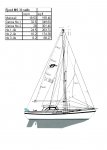
The Fjord MS33 might tick many of your wanted boxes, however most are 40 + years old and much would depend on how well the boat has been maintained and your willingness to modernise. Can be purchased for between £15k to £30k. 10 m LOA.
Sailplan copy.JPG
 

Attachments

Last edited:
One thing I really like about our small yacht (or "big dinghy ") is that we always put the sails up 'cos it's so easy. On the bigger boats, there often seems to be a discussion as to whether it's worth hoisting that big old main.

Yes, there are several models called 30, 31, 32 from the late 90's, all very similar and suitable for what you want to do. Sail handling is not a problem whether you choose slab reefing or in mast as all controls are lead to the cockpit.

I appreciate your preferences, but only a very small minority of people have boats that meet them and all the others seem to get on fine with more modern boats which in general are easier to handle, more comfortable overall and potentially more reliable because they are newer.

As I suggested in a previous post, a circumnavigation of the UK is normally a series of day sails, managing the tides, negotiating headlands, and of course dealing with the variable weather. This means that unless you are determined to do it a short time, you spend as much time in harbour as at sea.

If you do want to stay within your original set of preferences, then consider a Victoria 30 which has the style and just about all the features you list plus a little less cramped than older type boats. Comfortably in your budget there is an excellent one for sale in Lymington with Ancasta.com You would have to like pinkish upholstery though!
 
Last edited:
Can I add another name to the list? A Rival 32 or 34 would eminently suit your plans and would fit in with the style of boat you are used to. A 32 can be found in budget, a 34 a bit more. Internally they are as good as identical, but the 34 has more stowage, is faster and prettier. They will all be at least 30 years old, so you would have to look at the condition they are in, but they were built very strongly.
Personally I would not bother with bilge keels. As has been argued they are pointless in Scandinavia and on my own trip round Britain I have never felt a bilge keeler would have been preferable.
 
Hi,
I have recently bought a HP27 and am very happy with her although so far have only done a relatively short passage from Largs up to Inverness. She is extremely solid and feels very planted in the water. The twin keel version will allow you to take the ground and she is well set up for single handing if that is a consideration. The inside steering position is a great bonus for those days when the other option is huddling in the cockpit getting wet & miserable. I am 5'11 and there is plenty of standing room in the cabin. Two berths forward and a further two starboard aft. I find the self-tacking jib a bit useless downwind, on the other hand she sails nicely downwind on the main alone. Cruising speed on the engine (14HP Nanni 2-cyl Diesel) is around 4kts and she uses 1L/Hr. The Hunter Association have a wealth of knowledge and good folks willing to help. https://www.hunterassociation.org.uk/

Good luck in your search

Rich
 
For the OP (and anyone else interested) there is a long article in the new PBO this month on exactly this subject.
 
Thanks Tranona, we arrive in Devizes tomorrow - first stop WHSmiths for PBO!

Just up the road from us in Poole, but you may not find PBO in their WH Smiths, but try Tescos. Good location for trawling the south coast looking for boats though.

BTW was discussing "round britain" with my sailmaker this morning while trying out my new cruising chute. He did it last year in a MG/Contessa 27 with wife and dog. Took the "normal" 3 months, but opined he would have loved to have my boat instead. Key things were space and potentially shorter passage times which make managing tidal gates and headlands easier. 50-60 miles in daylight hours is easier with a faster boat.

As you will see from the article, and many other sources on the subject there are many different ways of doing the trip and you adjust your plans to suit your circumstances or boat, or choose your boat to match your desired cruising strategy.

Good luck with your search.
 
The thing that sticks out in the OP's list is the protected helm. Maybe influenced by memories of UK weather being somewhat less pleasant than down in Oz?
There are a few ways to interpret this requirement, and a few approaches to achieving it. You could go to one extreme and have a second inside steering position, which generally means a motor sailor. Or you could have a wheel stuck at the back of an aft cockpit, but with the steering controlled by autopilot from down below.

Would it be acceptable to go for a middle ground? A conventional steering setup but tucked under a sprayhood, rather than perched at the stern? Obviously not as complete shelter as a full wheelhouse, but a pretty common arrangement, especially on older boats.
 
The thing that sticks out in the OP's list is the protected helm. Maybe influenced by memories of UK weather being somewhat less pleasant than down in Oz?
There are a few ways to interpret this requirement, and a few approaches to achieving it. You could go to one extreme and have a second inside steering position, which generally means a motor sailor. Or you could have a wheel stuck at the back of an aft cockpit, but with the steering controlled by autopilot from down below.

Would it be acceptable to go for a middle ground? A conventional steering setup but tucked under a sprayhood, rather than perched at the stern? Obviously not as complete shelter as a full wheelhouse, but a pretty common arrangement, especially on older boats.

A Seadog 30 then.

Actually not such a bad idea
 
The thing that sticks out in the OP's list is the protected helm. Maybe influenced by memories of UK weather being somewhat less pleasant than down in Oz?
There are a few ways to interpret this requirement, and a few approaches to achieving it. You could go to one extreme and have a second inside steering position, which generally means a motor sailor. Or you could have a wheel stuck at the back of an aft cockpit, but with the steering controlled by autopilot from down below.

Would it be acceptable to go for a middle ground? A conventional steering setup but tucked under a sprayhood, rather than perched at the stern? Obviously not as complete shelter as a full wheelhouse, but a pretty common arrangement, especially on older boats.

I don't see anywhere he wants a protected helm. Protected rudder yes.
 
I don't see anywhere he wants a protected helm. Protected rudder yes.

It's there in the first post:

Good deck protection & a protected steering position, possibly a pilot house/hard dodger etc.

IMHO, this requirement combined with a preference for tiller steering suggests a very attainable old fashioned cockpit layout where you can hunker down under a sprayhood.

Did anyone mention a Co32 yet? Resale is important so that would be top of my list.
 
Top