Advice about changing a prop shaft seal

Which shaft seal would you fit?


  • Total voters
    22

Crinan12

Well-Known Member
Joined
6 Mar 2019
Messages
606
Visit site
Hi. I am going to change my 16 year old manecraft deep sea seal. From reading other posts Volvo, tides marine or a PSS seem to be the ones people go for.

Is this a straightforward enough job? Do I need any special tools? I live 2 and a half hours away from my boat so want to make sure I have everything with me.

I was hoping the shaft unbolts easily and you just draw it out from the coupling, fit the new seal and re attach the shaft. If I'm reading other posts correctly I don't need to do any re-alignment work.

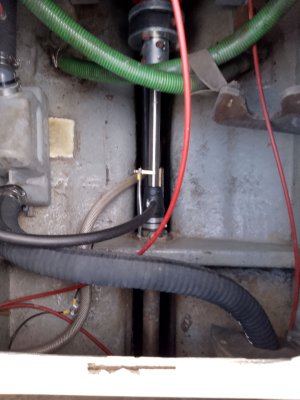
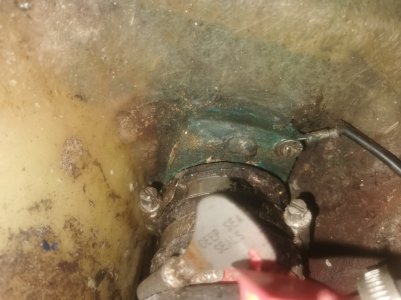
As per the photo my existing seal has 2 rubber tubes coming from it, one which terminates in the cabin (water sometimes comes out of it if engine revved hard) and the other one I think goes out of the hull above the waterline and water comes out of that as well.

I have a 1inch prop shaft.

Access to the seal is from the side and a bit of a pain but I can reach it.

Any advice about this job would be appreciated as I'm not sure about it.

Thank you
 

Attachments

  • Resizer_16982532895413.jpeg
    Resizer_16982532895413.jpeg
    460.5 KB · Views: 56
  • Resizer_16982532891621.jpeg
    Resizer_16982532891621.jpeg
    752.6 KB · Views: 54
Last edited:
First question: Is the boat out of water, as more messy and risky if afloat, or even if on tidal drying out pad.

Second question: can you withdraw prop shaft enough with prop and rudder in place, or do you need to remove prop with puller, or remove rudder
 
Yes 2 relevant questions.

Boat out of water yes.

I don't know to be honest. I'll need to look into it. I'll ask on seamaster forum and see if anyone has done it and knows if enough clearance.

Thanks
 
It might be dictated by which one is the best fit. This means what available room you have and what size shaft and stern tube combination you have. The condition of the shaft will also be important (no scoring or wear marks). All three that you have suggested will do the job.
 
It might be dictated by which one is the best fit. This means what available room you have and what size shaft and stern tube combination you have. The condition of the shaft will also be important (no scoring or wear marks). All three that you have suggested will do the job.
When you say what room I have, do you mean room on the shaft?
Thanks
 
When you say what room I have, do you mean room on the shaft?
Thanks
Yes the space you have between the stern tube and gearbox coupling/intermediate coupling (if you have one).
We changed ours last year from a stuffing box to a dripless. Our shaft was worn where the old packing had been. It wouldn't have allowed the dripless to have got a good seal so the shaft was replaced. We also struggled as the shaft was 30mm but the stern tube was a bit of an odd size. Luckily the Volvo gland fitted no problem in the end.
 
From where the shaft goes into the coupling to the end of the existing seal that fits onto the stern tube is 200mm

Maybe I'm best removing the existing seal so I can get a better look at the condition of the shaft etc
Thanks
 
You also need to consider the room around the seal itself. I fitted a PSS seal in a Sadler 29: there was limited room between the shaft and the hull, where it emerged, and some of the GRP needed to be ground out to give it room.

And you need to be able to back the shaft out far enough that you can extract the old and insert the new seal over the shaft. The rudder might get in the way.
 
From where the shaft goes into the coupling to the end of the existing seal that fits onto the stern tube is 200mm

Maybe I'm best removing the existing seal so I can get a better look at the condition of the shaft etc
Thanks
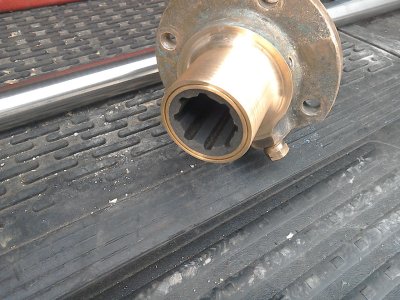
That is fairly tight and as suggested you may be limited in your choice. The most obvious replacement is the Volvo type but choose the Radice version that has a vent and a greasing point. This is 110mm long which will fit provided you can pull the shaft back far enough to slide it over the tube. However the constraint is that for a 1" shaft the tube has to be 42mm. It is not clear from your photo what the end of the stern tube looks like, but if it is a removable bronze housing you may be able to machine it as I have done to take the Radice seal See photos of the machined housing and the final installation. You may not need the water feed depending on the boat - not needed on a sailing boat or a displacement motor boat, but you will need the air vent taken well above the waterline so that water does not come out as you say it does now. You can see my vent pipe which goes forward and up inside the bridge deck.

The next best alternative is the Tides Marine One Seal which is a bit longer but has a much wider choice of tube sizes (and is twice the price!). You don't really have enough room for a PSS which is 155mm installed length, even more expensive and really requires a positive water feed to keep the faces well lubricated.

The alternatives are shown in here
lakesterngear.co.uk/catalogue.pdf

Hope this helps
 

Attachments

  • IMG_20220901_130010.jpg
    IMG_20220901_130010.jpg
    244.4 KB · Views: 38
  • IMG_20231016_165203.jpg
    IMG_20231016_165203.jpg
    277.9 KB · Views: 36
Thanks v useful.

My manecraft deep sea seal is approx 145mm so maybe the PSS would fit if the volvo wasn't suitable ?
I can't get in to measure the stern tube properly but rough measurements with my callipers suggest 47mm
Thanks
 

Attachments

  • Resizer_16982739775361.jpeg
    Resizer_16982739775361.jpeg
    527 KB · Views: 41
I wouldn't get a Volvo one, but rather an Obitrade, which has a vent, so it doesn't need bleeding. It's what I wanted to use on my boat a few years ago, but the shaft was quite worn where the seal would go, so either I had to use a PSS or the Obitrade plus a new shaft. The PSS was cheaper
 
You don't really have enough room for a PSS which is 155mm installed length, even more expensive and really requires a positive water feed to keep the faces well lubricated.
Not so in my experience. I have an older version of the PSS, which has no vent/water feed tube. This means that the water lubrication is by the stern tube only, which also houses the cutless bearing. Still I have not in 18 years had any problems with the seal getting hot, which I suppose would be the case if the lubrication was not sufficient.
 
Not so in my experience. I have an older version of the PSS, which has no vent/water feed tube. This means that the water lubrication is by the stern tube only, which also houses the cutless bearing. Still I have not in 18 years had any problems with the seal getting hot, which I suppose would be the case if the lubrication was not sufficient.
It depends very much on the individual installation and there are several members here over the years who have added water cooling because of problems with poor water flow in through the stern tube cutless. The Contessa 32 is one such where the propeller is in a tight aperture and the cutless is inside the skeg. PSS now recommend a water feed in these sorts of situations. The OP already has a water feed for his current face seal so it would make sense to use if he install another face seal.

However he may find a simpler and cheaper lip seal such as Tides Marine a more appropriate fitting and it only needs a vent. Lip seals are far more tolerant in these situations than face seals as the seals are positively lubricated with grease.
 
Excellent site here for your perusal: Stern glands
Very good and informative, 'idiots guide' almost, about pretty much every shaft seal type we're going to see. It's of great interest to me as I had a potentially catastrophic failure of my stern tube, where the tube fractured at the stern bearing, which allowed a quantity of excess water to enter the boat whilst I was about to round Cape Wrath.
Suffice to say, I did a 180 and returned to Inverness!
The leak was controllable by pumping grease into the stuffing box, and became significant only when the engine was running due to the lack of support at the stern bearing allowing extra play on the seals, thus allowing water into the boat.
Once alongside, the leak disappeared and the boat was lifted out, where it became immediately obvious what the fault was, and how it could've gone very bad.
The whole assembly, stuffing box, stern tube and stern bearing were in the region of 60 years, constructed of bronze. I t appears to me that the stern tube had become brittle where it screwed into the stern bearing, which caused the failure.
The whole assembly is out of the boat now, whilst I decide which course to take when replacing it. A dripless seal: just a new stern tube or simply a like for like bronze stern tube, or a different material of the same?
 
Thanks i read the info on that website. It was interesting to see the 925's stern gland as that's the boat I have.

Actually tempted to just fit another manecraft deep sea seal because it's worked without any problem and it will be a straight swap. But it's just the volvo ones looks so simple in comparison.

Anyway I'll get the shaft off and have a look and decide. The volvo might not fit anyway.

Thanks
 
If the bronze housing at the end of the stern tube can be removed (and from the photo on Vyv's site it looks like it can) should be no problem to have it machined to take the RMTA seal The ID of the casting will likely be 30mm so plenty of wall thickness to have an OD of 42mm. The Manecraft is inordinately expensive and over complicated. When it came out originally there was a series of failures of the rubber bellows and not surprisingly it fell out of favour. The red tag is there to lock the faces together should there be a failure. Somewhat worrying thought that there needs to be provision for failure!

Lake Engineering did the machining shown in post#9 and supplied the RMTA seal at a cost less than half of a Manecraft or PSS. BTW you may not have a cutless inside your stern tube housing like mine which is necessary because the shaft is very long at over 1.6m, so ignore that.

Hope this helps
 
It depends very much on the individual installation and there are several members here over the years who have added water cooling because of problems with poor water flow in through the stern tube cutless. The Contessa 32 is one such where the propeller is in a tight aperture and the cutless is inside the skeg. PSS now recommend a water feed in these sorts of situations. The OP already has a water feed for his current face seal so it would make sense to use if he install another face seal.

However he may find a simpler and cheaper lip seal such as Tides Marine a more appropriate fitting and it only needs a vent. Lip seals are far more tolerant in these situations than face seals as the seals are positively lubricated with grease.
It is unclear to me whether the OP has a forced water feed or just a vent pipe to the present seal. If indeed he already has a forced water feed, as you indicate, then I see no reason to rule out the PSS, apart from the price possibly.
My propeller is also in a tight aperture, still no over heating. Perhaps the ID of the stern tube in relation to the shaft diameter has an influence, as the available water volume will depend on these numbers. My shaft is 25mm and the stern tube ID is 38,x mm.
 
I actually thought the red tag was a good idea, I quite like the idea of being able to seal it if it failed. But yeah have also read the view that it is worrying that it even has one.

I have a forced water feed (i think). There is a Y piece on the deep sea seal and a rubber hose goes from the seal into a pipe coming out from the back of the heat exchanger. The other pipe is a breather which is open ended at terminates by the companionway hatch.

Thanks
 
It is unclear to me whether the OP has a forced water feed or just a vent pipe to the present seal. If indeed he already has a forced water feed, as you indicate, then I see no reason to rule out the PSS, apart from the price possibly.
My propeller is also in a tight aperture, still no over heating. Perhaps the ID of the stern tube in relation to the shaft diameter has an influence, as the available water volume will depend on these numbers. My shaft is 25mm and the stern tube ID is 38,x mm.
Yes, as he says there is already a water feed from the engine. While face seals are very attractive in their original applications, adapting them to work consistently and reliably on small boat shafts has been a bit tortuous, as those like me who were around and involved when they first came out will remember. The failures of rubber bellows was one example as was the criticality of maintaining a consistent pressure on the faces given the shaft movements fore and aft. The cost in terms of engineering and materials to achieve this has resulted in what to my mind is an over complicated and expensive product that still does not resolve the basic issue of faces sticking together during long periods of inactivity common on leisure boats.

The only functional advantage is that they don't run on the shaft unlike lip seals. The downside is that failure (although rare) can be catastrophic whereas lip seals wear slowly if at all and give good warning through drips. For low power low speed installations like our little yachts it is difficult to justify anything more complicated than the simple moulded rubber "Volvo" type seal if it can be fitted. Not surprising that nearly all the builders who still fit shaft drives to their smaller yachts and mobos use this type of seal. Effective, compact, reliable, long lasting, easy to replace if necessary and low cost (one third the price of a face seal).
 

Other threads that may be of interest

Top