Advice about changing a prop shaft seal

Which shaft seal would you fit?


  • Total voters
    22
I replaced my Manecraft seal with a new Manecraft seal about three years ago as the cutless bearing needed replacing.
(Check out their website). I do not know how long the original had been on the boat, but probably more than 20 years up to 27 years if fitted as original. The original had not given any problems during the ten years I had used it. Regarding comment above by @Tranona the boat had been ashore for two plus years when I bought her and no problem after this period of none use.

Mine has two vent pipes, one taking water from just after the raw water pump so forced lubrication of seal and cutless bearing. Second pipe extends above the waterline as an air vent so no need of burping.

Examining the old seal it could well have safely served for quite a few more years.

I also tried the red tag after removal and it did work and seal against the shaft. I fail to see why people find the red tag worrying It is no different to the advise to carry softwood tapered plugs for all through hulls, preferably one kept next to each fitting.

While you have the shaft detached might be a good time to fully draw it and replace the cutless, or other, stern tube bearing.
 
Yes, as he says there is already a water feed from the engine. While face seals are very attractive in their original applications, adapting them to work consistently and reliably on small boat shafts has been a bit tortuous, as those like me who were around and involved when they first came out will remember. The failures of rubber bellows was one example as was the criticality of maintaining a consistent pressure on the faces given the shaft movements fore and aft. The cost in terms of engineering and materials to achieve this has resulted in what to my mind is an over complicated and expensive product that still does not resolve the basic issue of faces sticking together during long periods of inactivity common on leisure boats.

The only functional advantage is that they don't run on the shaft unlike lip seals. The downside is that failure (although rare) can be catastrophic whereas lip seals wear slowly if at all and give good warning through drips. For low power low speed installations like our little yachts it is difficult to justify anything more complicated than the simple moulded rubber "Volvo" type seal if it can be fitted. Not surprising that nearly all the builders who still fit shaft drives to their smaller yachts and mobos use this type of seal. Effective, compact, reliable, long lasting, easy to replace if necessary and low cost (one third the price of a face seal).
Just out of interest what were their original applications?

Thanks
 
I replaced my Manecraft seal with a new Manecraft seal about three years ago as the cutless bearing needed replacing.
(Check out their website). I do not know how long the original had been on the boat, but probably more than 20 years up to 27 years if fitted as original. The original had not given any problems during the ten years I had used it. Regarding comment above by @Tranona the boat had been ashore for two plus years when I bought her and no problem after this period of none use.

Mine has two vent pipes, one taking water from just after the raw water pump so forced lubrication of seal and cutless bearing. Second pipe extends above the waterline as an air vent so no need of burping.

Examining the old seal it could well have safely served for quite a few more years.

I also tried the red tag after removal and it did work and seal against the shaft. I fail to see why people find the red tag worrying It is no different to the advise to carry softwood tapered plugs for all through hulls, preferably one kept next to each fitting.

While you have the shaft detached might be a good time to fully draw it and replace the cutless, or other, stern tube bearing.
Sounds like you have the same set up/experience as me
I would have happily fitted another manecraft deep sea seal but the considered opinion seems to be that they are inferior to others.
I agree about the red tag - lots of things have a fail safe.
 
but the considered opinion seems to be that they are inferior to others.
Considering what ; Quality, Reliability, or Price?? It did seem expensive, but with potentially a 20 year service life not so bad. I remember someone (possibly on this Forum) advising slipping two Volvo seals on to the shaft, to avoid pulling the shaft when the first needed replacing. Apparently, its simple to cut the worn one off and slide the unused one in to place.
 
Last edited:
Considering Quality, Reliability, or Price?? It did seem expensive, but with potentially a 20 year service life not so bad. I remember someone (possibly on this Forum) advising slipping two Volvo seals on to the shaft, to avoid pulling the shaft when the first needed replacing. Apparently, its simple to cut the worn one off and slide the unused one in to place.
Yeah all three really
But I'm just basing this on anecdotal posts I've read on the internet. The main accusation being that the bellows are not very robust.
I also read somewhere they have a nickname 'deep sea sinkers'!!

I'm not sure about a 20 year service life. The manufacturer says 5. Although mine is at 16 with no issues. I guess it's the same with loads of things, you could take a chance and it could last forever. But I'd worry something would happen. And if lived to tell the tale I wonder what the insurance would say if you claimed.

Thats a good tip about fitting 2 of the volvo seals! They are cheap enough as well!
 
I am saying 20 years based on my limited experience of buying a boat with one fitted. After removal I quoted the numbers on the two parts and asked the current supplier how old it was. They did not recognise them, which suggests they pre-dated the current manufacturing codes. Yes, the manufacturer does say they are cheap enough so replace every five years. Certainly the bellows of the one I removed and the new one appeared thick and robust. I had a bit of difficulty compressing to spec and holding while tightening it, though that was partly due to access and reach.

Did any of your sources give verified details of actual failures and sinkings? Or is it simply that an armchair expert came up with a snappy play on words?
 
Nothing verified no, it's really just forum posts I've been reading.

From what I gather they do seem quite uncommon compared with volvo, PSS etc. I don't know if that's down to cost, reliability or whatever. People certainly seem to like the simplicity of the volvo one.
 
Just out of interest what were their original applications?

Thanks
Trelleborg and SKF are the main manufacturers. Lots of information here
mechanical face seals - Google Suche
As ever the Wikipedia entry gives a good summary. As you will see the main application is sealing shafts in static applications from radial leakage. There is no expectation that shafts will move in any direction other than rotation.

This is of course very different from a boat prop shaft with flexible engine and largely unsupported shaft which is why the face seal requires mounting on flexible bellows so it is kept in contact concentrically with the shaft and can move fore and aft. In industrial applications the faces are always submerged and in most cases operate for a large proportion of their time. On the other hand boat applications, particularly on pleasure craft spend most of their time idle (typical usage between 50-100 hours a year) and many spend as much as half of their life with no water in at all. So common failures are stuck faces that can lead to bellows failure if not freed before starting, crevice corrosion of the stainless face and leakage because of compression problems with the bellows. Stuck faces can also occur if boats are left for long periods in the water without the shaft being turned, often associated with crevice corrosion.

Having said all that, properly installed and attention paid to ensure the faces are not stuck before usage, for example after layup, they are generally reliable. I know many people are happy with the, but as I said it just seems an overly complicated and expensive "solution" compared with a simple one piece rubber moulding.

As to the red tag. This is Psychological - this is an item that should not fail catastrophically and far from being a good thing is an admission that the device can fail and sink the boat. Just think of some installations where the seal is not accessible without taking half the boat apart. Other designs seal on the shaft and do not fail catastrophically (at least not the seals themselves). It is the hose/bellows that is the weak point and the bellows are only required because the seal is not on the shaft as it would be in the original application of the principle.
 
This is of course very different from a boat prop shaft with flexible engine and largely unsupported shaft which is why the face seal requires mounting on flexible bellows so it is kept in contact concentrically with the shaft and can move fore and aft.
Ah, this could explain my positive experience. Engine on soft feet with Aquadrive to fixed thrust bearing, so shaft does not wobble about and only slight fore and aft movement. Also, bronze, not stainless in Manecraft seals so no crevice corrosion.
 
Trelleborg and SKF are the main manufacturers. Lots of information here
mechanical face seals - Google Suche
As ever the Wikipedia entry gives a good summary. As you will see the main application is sealing shafts in static applications from radial leakage. There is no expectation that shafts will move in any direction other than rotation.
I would dispute that they are the main manufacturers but there are very many.

Refineries typically have about 2000 pumps. All of these other than fire pumps have mechanical seals. In addition today, or at least when I retired, gas compressors are increasingly fitted with them. They are not foolproof and some duties require sophisticated start procedures. Once running they are totally reliable.

But as you say, the axial alignment rarely varies.
 
Hi. I am going to change my 16 year old manecraft deep sea seal. From reading other posts Volvo, tides marine or a PSS seem to be the ones people go for.

Is this a straightforward enough job? Do I need any special tools? I live 2 and a half hours away from my boat so want to make sure I have everything with me.

I was hoping the shaft unbolts easily and you just draw it out from the coupling, fit the new seal and re attach the shaft. If I'm reading other posts correctly I don't need to do any re-alignment work.

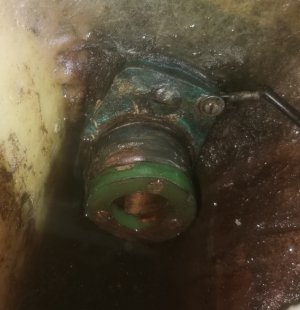
As per the photo my existing seal has 2 rubber tubes coming from it, one which terminates in the cabin (water sometimes comes out of it if engine revved hard) and the other one I think goes out of the hull above the waterline and water comes out of that as well.

I have a 1inch prop shaft.

Access to the seal is from the side and a bit of a pain but I can reach it.

Any advice about this job would be appreciated as I'm not sure about it.

Thank you
Re PSS, you need to figure out how you will compress it the required amount. I had to build a tool from plywood offcuts and threaded bar to go on shaft between pss and r&d coupling.
 
Ah, this could explain my positive experience. Engine on soft feet with Aquadrive to fixed thrust bearing, so shaft does not wobble about and only slight fore and aft movement. Also, bronze, not stainless in Manecraft seals so no crevice corrosion.
They work better with that kind of setup , particularly if the shaft is also supported by 2 bearings as that is much closer to the normal operating conditions in industrial applications. Indeed Manecraft make much larger seals for bigger (100mm+) shafts that are fixed. The design was from John Crane one of the many face seal manufacturers. In your setup the weak link, the bellows do nothing but hold the faces in compression.

As I said all along the weakness is the bellows - getting the compression right while also dealing with movement, particularly fore and aft, which can total as much as 12mm. This is where most of the early examples had problems. Remember one (now defunct) make which got the specification of the bellows wrong and suffered leaks as the faces parted. One memorable occasion on a fairly powerful 45' surfing on a wave and then dropping off. The force of water up the open stern tube pushed the faces apart such that water sprayed all over the engine compartment.
 
Not just me. I got the idea from someone else. By hand or with a lever i couldn't compress mine sufficiently to be in spec. Probs due to deep bilge and seal at arms length.
I have had a PSS since 2006. A couple of years ago I replaced the bellows. The replacement part felt significantly stiffer compared to the original, as I remember it. This time I also had to make a tool from threaded rod to get the compression right.
 
I've changed the PSS seals on my Turbo 36, and changed from stuffing box to PSS on my Corvette. I would rate the job on the Turbo 36 as amongst the most difficult tasks I have ever undertaken on any vessel ever, including some very difficult tasks on Type 42 Destroyers, but a lot simpler on the Corvette due to both prior experience and better access.

This task is on my to do list for my Grand Banks, where working access to the shafts and seals is excellent.

I have a write up on the process on my Turbo 36 - PM me if this might be of interest.

PSS every time for me.
 
Have just removed my prop shaft (amazingly it was very straightforward) and measured my stern tube, which is 50mm. There is a green plastic thing screwed to it which is the same diameter.

My prop shaft is 1 inch

My stern tube size rules out the volvo/ radice rmta/obitrade ones

So I can go for a tides marine, a PSS or another manecraft deep sea seal.

I had been hoping to get a Volvo type one because they are cheap and look simple but never mind.

Thanks to everyone for helping me with this.
 

Attachments

  • Resizer_16991319836241.jpeg
    Resizer_16991319836241.jpeg
    254.3 KB · Views: 9
Good idea to check the stern tube bearing for wear, probably cutless with your existing type of seal. If in doubt replace it while the shaft is out.
 

Other threads that may be of interest

Top