Adaptations to Dory

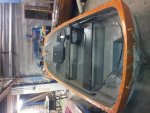
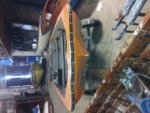
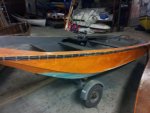
My club/voluntary sail-training organisation is in a very impoverished state as it is rising phoenix-like from the ashes of a previous organisation. Being in need of an additional safety-boat we have fortunately been donated one in serious need of TLC, by a generous Sea Scout Troop. I, hopefully, have managed to attach some photos of it.
I have somehow found myself leading the project to renovate it and make some adaptations to it : a more comprehensive fender/rubbing-strake around the gunwales and the addition of some beefy cleats to allow the towing alongside of two 19ft keelboats and to allow towing astern possibly more than that number.
As far as I can see, the rubbing strake will be fairly straightforward around most of the gunwale, but the fine sections in the bow area will present some problems.
Regarding the cleats, which will need to be very robustly fixed; while I think that the forward ones could be mounted on the small decks at the bow by cutting access holes in the vertical walls below, cutting away the foam and inserting backing pads, patching over afterwards. I have no idea how an acceptable arrangement can be achieved at the stern. One of my concerns, considering it's low freeboard, is to do the work in such a way that water will not get into the foam core subsequently.
Suggestions/advice anyone?(I've posted on this forum because it's in the interest of sail-training.)
 

Attachments
  • 2014-11-04 11.15.27 Dory Photo1.jpg
    2014-11-04 11.15.27 Dory Photo1.jpg
    87.7 KB · Views: 0
  • 2014-11-04 11.15.45 Dory Photo 2.jpg
    2014-11-04 11.15.45 Dory Photo 2.jpg
    89.3 KB · Views: 0
  • 2014-11-04 11.15.12 Dory Photo 3.jpg
    2014-11-04 11.15.12 Dory Photo 3.jpg
    88 KB · Views: 0
Last edited:
Can you check with the makers where any existing backing pads are?

I run a very similar boat which has a cleat in the centre at the front (with a heavy wooden pad on top of the deck as well as underneath; this allows anchor / mark warps to be pulled on board without damaging the rubbing strake.) There are cleats on the inner surfaces of both quarters so presumably some padding there. You already have eyes for a towing bridle on the stern. The rubbing strake you have is not unlike the original in weight and there's not much to fix it to anyway. Towing alongside for any distance can be a bit of a pain anyway with dories because they are not the most directionally stable boats: why not just carry a couple of fenders for when you need to do this and the rubbing strake is insufficient?
 
Can you check with the makers where any existing backing pads are?

I run a very similar boat which has a cleat in the centre at the front (with a heavy wooden pad on top of the deck as well as underneath; this allows anchor / mark warps to be pulled on board without damaging the rubbing strake.) There are cleats on the inner surfaces of both quarters so presumably some padding there. You already have eyes for a towing bridle on the stern. The rubbing strake you have is not unlike the original in weight and there's not much to fix it to anyway. Towing alongside for any distance can be a bit of a pain anyway with dories because they are not the most directionally stable boats: why not just carry a couple of fenders for when you need to do this and the rubbing strake is insufficient?
I haven't physically seen this boat yet, just the photographs, so hadn't spotted the bow cleat. It might be possible to fit a bigger one there and a couple of fairleads on the gunwales. The towing bridle on our existing punt is strung between the after cleats, so the one on this boat wasn't immediately obvious to me, thanks for pointing it out. The email from the scout leader donating the boat mentions that it is foam- and wood -cored so perhaps the wood will be in the spots where cleats are required. The idea of a pad on the bow to take wear and tear of anchor and mark chain is excellent and I will use that, thanks Thistle!
Re rubbing strake/fendering: Our existing aluminium punt has large horizontal fenders permanently rigged all round, on s/s wire. With this, no time need be lost rigging fenders in situations where it's necessary to act quickly. It's also useful when 'Coming Alongside a Moored Boat Under Sail' exercises go wrong, and hanging fenders not adequate, so I was hoping to do something similar with this boat. With this in mind perhaps I could rig the fenders on eyebolts bolted through the topsides, using the technique whereby the hole is drilled, some of the core is removed, using a bent nail in a drill, and replaced with resin, then re-drilled to accept the bolt. Can anyone see any holes (so to speak :)) in this plan?
 
I [...] hadn't spotted the bow cleat. It might be possible to fit a bigger one there and a couple of fairleads on the gunwales. With this in mind perhaps I could rig the fenders on eyebolts bolted through the topsides, using the technique whereby the hole is drilled, some of the core is removed, using a bent nail in a drill, and replaced with resin, then re-drilled to accept the bolt. Can anyone see any holes (so to speak :)) in this plan?

Bow cleat: we have one but I can't see one on your boat.
Fairleads, eyebolts: probably a good idea to avoid adding anything to the topsides if it can be avoided; anything there gives more scope for folk to trip when moving on and off the boat and more things for sheets to catch on when you are alongside.
 
Bow cleat: we have one but I can't see one on your boat.
Fairleads, eyebolts: probably a good idea to avoid adding anything to the topsides if it can be avoided; anything there gives more scope for folk to trip when moving on and off the boat and more things for sheets to catch on when you are alongside.
I can see what appears to be a bow cleat when I zoom in on the picture, but I will know for sure when I collect the boat tonight
I take your point re the fairleads, but what I meant by the topsides is the vertical side of the boat. Now not sure if the same nomenclature is used in motorboats as is used in yachts:)
 
Top