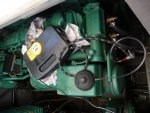
AD41B.....looking grim, views and advice welcome!

  • Thread starter Thread starter dpb
  • Start date Start date

dpb

Well-Known Member
Joined
14 Feb 2007
Messages
1,239
Location
Poole, Dorset
Visit site
AD41B.....looking grim, views and advice welcome! Update.

A great boating weekend was somewhat marred by some kind of mechanical failure on the way back to the berth. I am really not sure how to proceed on this one and would welcome any views and advice as to best way forward. I will try to be brief.

Engine AD41B
Cruising in at 3000rpm, took her up to maybe 3300 for last mile before harbour entrance, but not WOT.
After less than 30 seconds, unusual noise from the back, nothing dramatic, best described as rumbly clatter no louder than normal engine, just an extra sound.
Temp reading normal
Throttled back and once off the plane realised that the port engine had stopped.
Decided to try nothing until back on berth as not far to go.
Noticed however on the way back that the gear lever on the stopped engine seemed stuck, after a few minutes it would move from neutral to reverse but not forward.
At this point I figured a leg problem.
Once back on berth, checked leg, looked OK (havn’t raised and checked props), under the engine hatch all OK except for coolant in bilge which looks like it came from the filler overflow as it is splattered on the adjacent fresh water tank. Coolant level is low, (topped up that morning).
Gear lever now working normally.
Start the engine, fires straight away and sounds normal, engage forward and reverse gear, all seem working OK, oil pressure fine.
BUT.......smoke coming from crank breather, and the oil filler when removed, quite a lot of smoke. Not black, not really white so I suppose grey. My impression is that it is exhaust?
Tried revving a little in gear a couple of times, didn’t sound quite right but the boat was tied up so didn’t try too hard.
Oil in dipstick and under filler lid looks normal.
So, what next, I shant go through my theories now to keep the post short but they focus on piston / piston ring issue, head gasket or valves (which I adjusted recently). But I don’t get the cause to fit all the symptoms.
So what do you think?? (Me thinks I'll be calling a mechanic real soon!)
Thanks in advance!
 
Last edited:
Sounds like engine may have started to overheat, lost a bit of coolant before you throttled back, and once you put it in reverse it simply jammed in because you were still moving forward (Mine does that!)

Worth checking engine breathers, they may be causing fuming issue. Could also be head gasket or piston rings, but maybe something else...

I would change the oil, to eliminate any contamination, and also to check old oil for metal or liquids other than oil. Try the engine at that point, after checking breathers are clear, and if it still fumes get a compression test, and cooling system pressure test when off, and when running, which will show any leaks external or internal.

Then worry....:p
 
Perhaps you picked something up on the leg/props which restricted the intake and caused overheating? Lift the leg and ckeck props and the leg for any damage or anything that shouldn't be there. Is the raw water pumping okay? Check the raw water impeller?

.
 
Thanks for ideas so far, will do some initial investigation myself then get a machanic in to pressure test cooling system and do compression test (would have done them myself but by the time I have bought the gear I may as well pay a pro to do it who can give his diagbostic whist he is at it!)
Then we will see what is next.
Meanwhile we can continue to use the boat on one engine as this will clearly likely take a while to sort out.
Will add to this when I have more info incase its of interest.
 
If you have smoke from the breather I suspect a piston problem or rings damaged.

Also 41 is renowned for valve failure so I'd be taking the valve covers off and look for damaged springs, do a compression test and turn engine over by hand to feel if there is a tight spot on rotation, remove injectors and examine tips for damage .
 
Went down today to have another look and to follow up some of your points.
Leg and props are undamaged.
Raw water pump impellor as good as new......which it almost is!
Pressure checked the cooling system, using a tyre inflator some bits of hose and half a set of outboard 'earmuffs'
P1100334.jpg
Pumped up to 10 bar. It did drop to 8 bar after a few minutes but that could have been due to the pushed together bits of pipe I used and trouble getting a good seal on the cap.
So not totally conclusive but certainly no major leak or any sounds of air excaping anywhere.
Started her up and it is almost definately exhaust smoke.


Second video in separate post (only one per post apparently!)

Put hand over oil filler at tick over and 1500rpm and felt no pressure, compared with the other engine and could not feel any diference
Smoke also comes out the dip stick but no oil blown out.
Still no sign of water in oil.
Still struggling to corelate all the symptoms.

Arranging mechanic to carry out compression checks during next week so willl see then and let you know.
 
I hope you didn't pump up the cooling system to 10 bar thats 145 psi approx, you mean 10 psi.

Beside that you have a serious problem looking at the amount of crankcase compression coming out the filler cap and breather filter.

I'd start with a impression check then get the head off, in fact just get the head off and see which piston is damaged, either way its engine out to replace liner, piston and rings.

When disassemble the engine just chek the turbo first as I once had similar issue where the turbo shaft had snapped pushing exhaust gas straight across the body of the turbo into the cylinders. Before you strip down remove the alloy pipe from the turbo to the intercooler and run it up, you never know you might be lucky!!
 
Work Started

So I have started on this job now, having had some encouraging PM's from Batteryman (thank you), who has undertaken a similar job on his boat without taking it out the water.
Had the local mechanic take a look with a view to getting him to do the compression checks and he suggested that as the head clearly has to come off anyway why bother paying him for the comp check.
So I have removed the turbo, heat exchanger, exhaust manifold, intercooler, thermostat housing and fuel lines and the engine now looks like this:

IMG_0274Small_zps11180d59.jpg


The work so far has been easier than expected, with each part removed creating better access to the rest!
The boat is still in the water and we go out in her on the one engine so use is not lost.

Whilst dismantling so far I decided that I would prefer to have a compression test done anyway as at least you know exactly what you are looking for, would hate to repair obvious piston damage and miss another one that was less obvious but still needed doing only to find there was still a problem on start up.

Was hoping to find an obvious reason for an overheat during dismantling but nothing serious found yet, for example only a few bits of crud in the heat exchanger.
Water pump bearing is not good and two of the bolts securing it are rounded so will wait till the engine is out to attack them.

Biggest problem so far is at the moment I cannot remove the injectors, they move when wiggled but cant pull them out. I will see if I can buy the VP tool or see if I can make one myself.

So the plan now is to do the compression test, then take the head off to confirm the cause and take it from there.

Meanwhile I have a garage full of carefully grouped engine parts that are being cleaned, rust treated and painted, having found a one coat high temp engine enamel in a green that is close to VP green. It is supplied by a traction engine restoration supplies company!!

So closer to finding out the cause but not there yet...will post when I know.
 
If you can get the injectors out, you don't need a proper compression tester to diagnose major damage. Something rubbery on the end of a stick will tell you what's going on.
 
Well I may have found the cause.
During the week I have been checking and cleaning the parts that I have removed.
One of the small diameter pipes I had is blocked. Turned out that this is the air vent pipe that runs between the turbo and the heat exchanger header tank.
Now I often thought the cooling system on that engine might have had an air lock as sometimes it would run a little warm and then cool down if we got chucked about in rough water.
So maybe I have had an air lock at the turbo caused by the vent being blocked and on the day of demise when I opened the throttles right up the cooling system just didn't have enough flow.
Back to the job in hand, I am still determined to carry out a compression test before going further but those injectors take some shifting.
With my home made puller I managed to get three of them out today. But then it started to fail so I need to modify it a little.
Even with the puller I still had to find a way of twisting the injector a little whilst it was in tension using a spanner and stilsons.
Have to be careful as it is easy to damage the flange where the diesel return pipes fix. I think one of the three removed is too damaged now.
Also I doubt that I will be able to remove the rear most injector insitu as it is just under the rear deck so I cant get the puller on it.
Still at least I am making progress..........slowly!
 
Looking at your pic its easier to remove the rocker covers, underneath housing etc to give better access so you can get grips on the injector, you can also remove the stud that screws into the head by buying a cheap stud extractor which will allow the the injector to be turned through 360 degrees, you also can buy from any dealer the correct injector puller which also holds in place the very important copper sleeve that the injector sits in, loosen the sleeve at your own peril and you will get a cylinder full of coolant as it damages the o rings that seal it to the cast head, which in turn means renewing them which costs£££.

I'd be pressure testing the head before you refit it now you have done this, you will also be looking at a new injector body as you have damaged the leak off pipe thread, the tool is about £12.

What happened to your engineer, has he not given you any free advise? I'd be very careful on the next steps of strip down.

Have you removed the turbo yet and examined it? , also I would be after injector removal be turning the engine over by hand to feel for any irregular spots in its rotation through two complete turns.
 
Thanks for further advice.
I was aware of the need not to pull the liner with the injector so took that into account, wish I'd thought of extracting the stud though as turning the injectors was the hard part, will try that on the others....seems a bit obvious now!!.
Best online price for the extractor tool I saw was about £60+ with postage so didn't ask the Volvo dealer! I will try a couple on Monday.
Turbo seems OK, no damage, turns free, no play on shafts.
Engineer just recommended horsing in and taking the head off.
Plan forward is:
Complete injector removal (will be getting them refurbed)
Carry out comp test
Then, assumingthere are low comps, remove head.

Then we will see!
 
I'm still voting for you to do a compression test.

Plenty of WD40 on the injectors and a bit of working back and forth with a spanner will get them free, it just takes a while.
 
Injectors Out and Compression Tested

At last, all injectors removed and compression test carried out.
Presumably the injectors on a well serviced engine are relatively easy to pull but these weren’t.
The cheapest puller I could find was £50 or so, so I kept with my home made version,:

IMG_0285_zps16a5ed54.jpg

Had to make sure the sleeves were not disturbed.
Also seems to be as important to turn the injectors as pull them, and using a spanner across the fuel return flange is not a good idea as this damages the flange.
Far better remove the adjacent hold down stud and bracket to get a spanner on the flat part of the injector..thanks Volvopaul...and removing the adjacent head bolt made it easier still!
One injector would not shift even though it was free enough to rotate it by hand. When it did eventually come out, it fell apart as it came clear of the head, the nozzle casing was split and I think it was the nozzle that was stuck whilst the body rotated.
The injector that I couldn’t get the puller on to due to being under the rear deck luckily came out by just rotating with a spanner.
Anyway they are all out and this is what they look like:

IMG_0295_zps31819792.jpg


Whether an injector specialist can do anything remains to be seen.
Will let you know what they say.

So on to the compression test, and true to form, none of the fittings included in my ebay purchased set seemed made for this particular application but it was fairly easy to put together something that worked:

IMG_0287_zpsbfce56cb.jpg

And the results?

Cylinders 2 to 6 all reached 250lbs per sq in
Cylinder 1.............................nothing.

Quoted required compression 355.

However my test was on a cold engine that hadn’t been run for a couple of months, I did wonder how a test on a warm engine could ever be done given the work up to get a test on once you have stopped the engine!

Internet wisdom seems to be that cold tests can show 30% less than spec figures which would make my good ones ok, but more significantly I think they were all near identical figures which is good.

So there I am...one bad number 1 cylinder.

Did a quick check of that cylinder’s valves under the rocker cover, nothing looks wrong and the clearances are normal.

Pretty sure it needs a new piston and liner.

So next step?

Well the head is coming off.......just got to make up my mind whether to do that before or after I take the engine out
 
Top