
Accurate Battery Testing.

At a discharge of 1 Amp the capacity would be about 150 Ah - this is a know figure from other websites

Ooh I don't like that! I'd be interested to see your references for that. Generally speaking, a 20hr discharge is sufficiently slow for effectively full chemical conversion of the active material and you would not expect to take out more than the nominal 20hr capacity by discharging slower. At least for ordinary batteries like these, maybe you are talking about solar system batteries designed around several days duty.
Peukert is all very well but often misunderstood. It helps to put in the word accessible, e.g. "At a discharge of 10 Amps the ACCESSIBLE capacity would only be about 75 Ah - this figure is an estimate!"
Chemical capacity has not disappeared, it's just that at the higher rate, you haven't been able to access it. The battery is not flat; if you reduced the current at this point to 5A, you would be able to get (most of) the other 25Ah out of it. (This also means that after the 10A discharge to cutoff, you only need to recharge by 75Ah plus losses, maybe 95Ah total, not the 120Ah you would need after a full discharge at 5A for 20 hrs.)
Similarly you don't create extra chemical capacity by discharging slower, so where would that extra 50Ah at 1A come from? In a traditional flooded battery, the limiting component is the +ve active material; there is always a surplus of -ve material and of acid. In an AGM, the limiting component is the acid or the -ve material, usually very closely balanced; there will be a surplus of +ve active material.

Edit - here's a graph from Lifeline showing that you can drag out just under 115% at 120hrs. I would suggest it would be very unwise to do so.
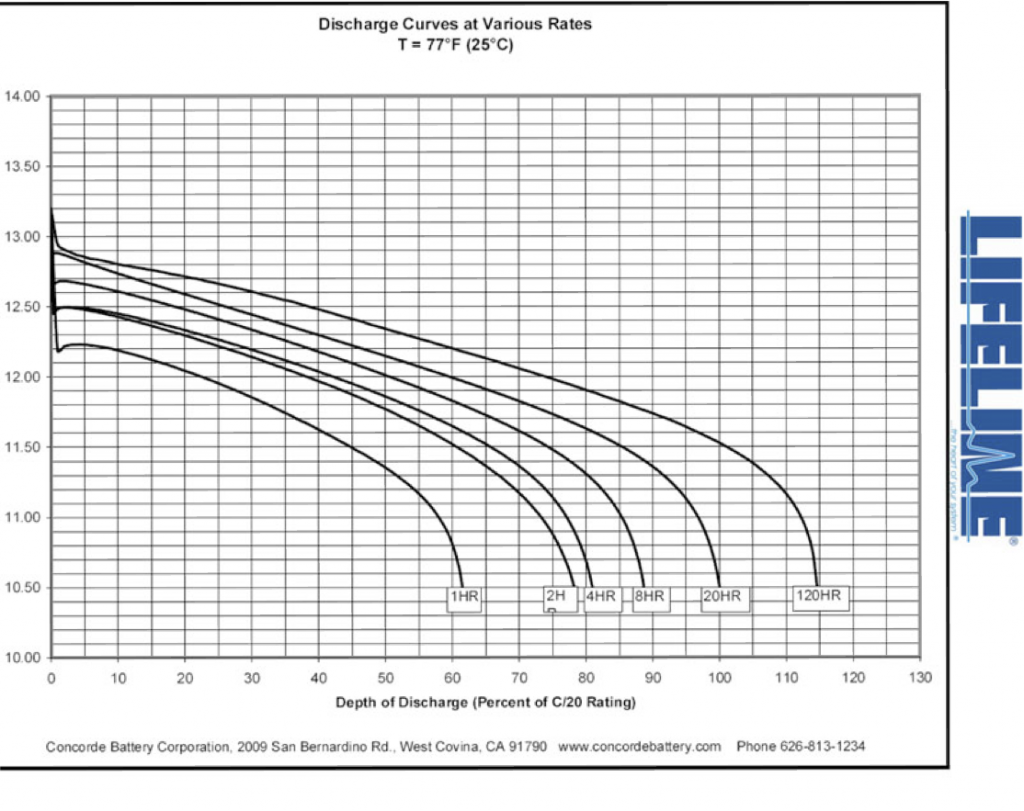
Lifeline-Discharge3.png
 
Last edited:
Although I was aware that you can't tell the state of a battery's charge with a volt meter I have installed voltmeters (12V/24V. Now I am wondering: Looking at Sailorman's table above. could I check the gauge and if it reads (say) 12.35V then assume the battery has a 60% charge (i.e. needs charging)?
This may be of interest..

http://www.arttec.net/Solar_Mower/4_Electrical/Battery Charging.pdf

Not a way to get too much accuracy in the real world on a boat while onboard as having no load on the battery to let the voltage stabilize is not easy .

But those tables will at least give a hint of how things are under load.

State_of_charge_chart_6C13EB1D-A780-00E9-63BECE9816554B5B.png
 
Ooh I don't like that! I'd be interested to see your references for that......
My figures come from Peukert's formula which you can calculate for yourself. The Lifeline graphs assume a Peukert's of about 1.12 whereas wet Lead Acid use a value of about 1.3. This is a logarithmic formula so the small difference in Peukert's value makes a big difference to the accessible Ah capacity.

The SmartGauge site has a mind-bending article for anyone who is really interested!

http://www.smartgauge.co.uk/peukert.html

I don't think discussing the chemistry helps - all I'm quoting is the effect of Peukert's empirical formula. This is clearly demonstrated by Lifeline's curves which shows that at a discharge much lower than the 20 hour rate - i.e. taking about 1 amp instead of 5 amps for your 100Ah battery, then it will take about 100 hrs to do this to not 20.

You could say a 100Ah battery means it will give 1 amp for 100 hours or 100 amps for 1 hour. Neither of these is true because of Peukert's law. At a discharge of 100 amps the 100 Ah battery only has about 60Ah capacity, at 1 amp it has about 115Ah.

The whole point is you NEVER discharge 100%, but by having a larger house bank, like I do, if I draw an average current that is 5 times smaller than the 20 hour rate for the bank then the effective ACCESSIBLE Ah capacity is higher. What this means in practice, not just theory, is that with a larger bank you may not draw down to 50% before charging, but say only 70%. This means the Life Cycle of your bank is much longer than if you always discharge down to 50% before recharging. It also means that if you do always discharge down to 50% at an average of only 1 amp then you will have taken out 75Ah from you accessable 150Ah capacity, so you will have longer in between charging. I hope this clarifies the situation.

My Lifeline AGMs have lasted 10 years, partly because of Peukert's law.


So you didn't stay up all night keeping the current constant then?

There was 5% difference from the current at the start and at the end - but there was over 50% difference in the current you should have been using to do a 20 hour test!

A 100ah battery's capacity is true only at the 20 hour rate - it will discharge at a constant 5 amps for 20 hrs.

At a discharge of 1 Amp the capacity would be about 150 Ah - this is a know figure from other websites
At a discharge of 10 Amps the capacity would only be about 75 Ah - this figure is an estimate!

These figures show the principal of Peukert's law - if someone wants do the actual calculation then please correct these figures.

So your test at a discharge of 2.2 amps would have given an Ah capacity of about 125 Ah???

Your test should have ended at a battery voltage of 10.5v at which time the Ahs drawn out would have been less than 40Ah. If you took a shorter time to get to 10.5v then that is an indication of the loss of capacity.

You are also assuming that your battery monitor is accurate - but it does confirm roughly an average of 2 amps for 20 hours = 40Ah. It should have taken out 125Ah but has maybe only taken out 35Ah after 20 hours! Taking the battery down to 9.6v is not good for it, but these very rough figures do suggest that it may well be past it's useful life!

I would be interested to see your test repeated at a 5 amp draw down to 10.5v @ a temperature of 25C.


This thread has long ago overtaken my level of knowledge and interest.

As I said in post 12, I am now only really interested in the possibility of it lasting another season, I think it might. If it failed almost totally it would probably be inconvenient, not a disaster.

The discharge rate I picked was the one I would be using in practice. In summer temperatures the battery may well put out 50Amp hours and that will do for me.
 
I think there really isn't much difference between us and it's not worth pursuing this much further (and everyone else has lost interest!)
I'm well aware of Peukert's formula. I'm glad you call it that; it isn't a Law, there is no science behind it and it doesn't govern any behaviour. It's just a mathematical model of observed behaviour and has imperfections and is subject to boundary conditions. It makes assumptions about diffusion and resistance in a normal operating range but (as I understand it) doesn't cope with running out of active material or electrolyte. This is a boundary condition. (In any case you should never take a battery to that state if you want it to last!)
I've probably sized several hundreds of batteries for various duties and have never used Peukert to do it. I've always had full sets of measured performance curves. These normally only went to 12hrs and you wouldn't take account of any capacity increase beyond that, for the health of the battery. In truth I don't think I ever sized anything beyond 24hrs at which the difference wouldn't be a lot anyway.
The 1.3 factor you mention would be the sort of number for thick plate industrial flooded cells with heavy separation and limited high rate output and maybe you would take practical account of it in very long duration situations e.g. solar with a week's cover. That's outside my experience. I'm assuming the OP here is talking about "leisure" type batteries, basically thin plate automotive, I don't believe 1.3 will be appropriate for those, maybe more like 1.15. In any case whether the answer for the 1A rate is 115% or 150% of the C20 capacity you shouldn't make use of it in a practical discharge because it will be damaging as you well know.

You can't ignore the chemistry. A L/A battery is a chemical device. It doesn't store electricity. You could regard Peukert as describing the reaction dynamics.

I'm not sure I understand your point in your penultimate paragraph. When manufacturers are brave enough to give you a life against depth of cycle curve, it's invariably against nominal capacity. You can't use Peukert to improve that, which is what I think you're trying to do. Your batteries have lasted a long time because you bought expensive thick (by AGM standards) plate ones, you don't over discharge them and you take care to charge and maintain them properly. I don't think you need to thank Dr Peukert!

Going back to discharge testing (and I think Peukert only came up because of your preference for rate adjusted against time adjusted tests) you might find this of interest http://www.battcon.com/PapersFinal2014/6 Chhajer Paper 2014 Final.pdf

I have the feeling rate adjusted is preferred in the US and time adjusted in UK.


My figures come from Peukert's formula which you can calculate for yourself. The Lifeline graphs assume a Peukert's of about 1.12 whereas wet Lead Acid use a value of about 1.3. This is a logarithmic formula so the small difference in Peukert's value makes a big difference to the accessible Ah capacity.

The SmartGauge site has a mind-bending article for anyone who is really interested!

http://www.smartgauge.co.uk/peukert.html

I don't think discussing the chemistry helps - all I'm quoting is the effect of Peukert's empirical formula. This is clearly demonstrated by Lifeline's curves which shows that at a discharge much lower than the 20 hour rate - i.e. taking about 1 amp instead of 5 amps for your 100Ah battery, then it will take about 100 hrs to do this to not 20.

You could say a 100Ah battery means it will give 1 amp for 100 hours or 100 amps for 1 hour. Neither of these is true because of Peukert's law. At a discharge of 100 amps the 100 Ah battery only has about 60Ah capacity, at 1 amp it has about 115Ah.

The whole point is you NEVER discharge 100%, but by having a larger house bank, like I do, if I draw an average current that is 5 times smaller than the 20 hour rate for the bank then the effective ACCESSIBLE Ah capacity is higher. What this means in practice, not just theory, is that with a larger bank you may not draw down to 50% before charging, but say only 70%. This means the Life Cycle of your bank is much longer than if you always discharge down to 50% before recharging. It also means that if you do always discharge down to 50% at an average of only 1 amp then you will have taken out 75Ah from you accessable 150Ah capacity, so you will have longer in between charging. I hope this clarifies the situation.

My Lifeline AGMs have lasted 10 years, partly because of Peukert's law.


I think there really isn't much difference between us and it's not worth pursuing this much further (and everyone else has lost interest!)....
The 1.3 factor you mention would be the sort of number for thick plate industrial flooded cells ....That's outside my experience.

I'm not sure I understand your point in your penultimate paragraph. When manufacturers are brave enough to give you a life against depth of cycle curve, it's invariably against nominal capacity. You can't use Peukert to improve that.....
There are still a lot of viewers here - but now I have lost interest!

I assume the OP is talking about Deep Cycle batteries here - Peukert constant 1.25-1.3 , but this changes with age!!!!!

I'm sorry if you didn't understand my last paragraph. If you take out 50Ah at a discharge rate of 20 amps you will be below 50% SoC. If you take out 50Ah at a discharge rate of 1 amp you may well be at about 75% SoC. These are rough figures but will mean a lower current draw will give you a longer life cycle - which is why my Lifeline's have lasted so well.

Sorry I didn't bother to fully read your link!!!!!
 
How can a 'constant' change with age?
There are still a lot of viewers here - but now I have lost interest!

I assume the OP is talking about Deep Cycle batteries here - Peukert constant 1.25-1.3 , but this changes with age!!!!!

I'm sorry if you didn't understand my last paragraph. If you take out 50Ah at a discharge rate of 20 amps you will be below 50% SoC. If you take out 50Ah at a discharge rate of 1 amp you may well be at about 75% SoC. These are rough figures but will mean a lower current draw will give you a longer life cycle - which is why my Lifeline's have lasted so well.

Sorry I didn't bother to fully read your link!!!!!
 
Further update on my knackered (possibly) battery:

After exhausting it pretty much I have charged it for 24 hours with my 4amp Aldi special. This has gone into float mode (.1amp charge) with the BM1 showing only c 40%ish charged on the histogram. (sounds about right)

Putting an old school charger onto it at 2amps starts the cells fizzing away, which can't be good.

So the battery seems to only accepting 50% of it's nominal 100 Amp hours

Does this sound right? I had expected that the battery would appear to accept a full charge and then fail to deliver it
 
So the battery seems to only accepting 50% of it's nominal 100 Amp hours

Does this sound right? I had expected that the battery would appear to accept a full charge and then fail to deliver it

You've taken about 40Ah out; to recharge you'll need to put around 45-50Ah back in, with the excess over what you've taken out being dissipated as heating and gassing.
I can't comment on what the BM1 says, not familiar with it.
 
That's interesting, thanks.

At least the upside of falling battery capacity is that it is quicker to recharge :nonchalance:

I am a bit stuck when it comes to case size but am on the trail of a new one now.
 
How can a 'constant' change with age?

It's not a constant in that sense. There is nothing absolute about it.
It is a coefficient which is set to make a mathematical model match observed behaviour. As the behaviour of the battery changes as it ages, so must the Peukert coefficient to continue to model it. The model is not precise anyway.
 
I assume the OP is talking about Deep Cycle batteries here - Peukert constant 1.25-1.3 , but this changes with age!!!!!

I'm sorry if you didn't understand my last paragraph. If you take out 50Ah at a discharge rate of 20 amps you will be below 50% SoC. If you take out 50Ah at a discharge rate of 1 amp you may well be at about 75% SoC. These are rough figures but will mean a lower current draw will give you a longer life cycle - which is why my Lifeline's have lasted so well.

Damn, wrote a reply and lost it.

OK, we have assumed differently about the OP's battery.

Re yr 2nd para above, I had understood what you meant but I don't believe it's valid. Depth of discharge is always taken against the nominal capacity not the Peukert adjusted available capacity. Ditto state of charge. Lifeline's own manual defines depth of discharge as "the portion of the capacity taken out during a discharge, expressed as a percent of the rated capacity." Rated capacity in Lifeline's specifications is the 20hr capacity. 50Ah out of a 100Ah rated battery is 50%, whatever current it's taken at. Consider the converse; if you do a 1 minute discharge to end voltage, for ease of calculation say (ambitiously) that might be 600A i.e. 10Ah, would you take that as a 100% depth of discharge and consider it to be at 0% state of charge?
 
Putting an old school charger onto it at 2amps starts the cells fizzing away, which can't be good.

So the battery seems to only accepting 50% of it's nominal 100 Amp hours

Does this sound right? I had expected that the battery would appear to accept a full charge and then fail to deliver it

That's why it's called surface charge, shows all the right voltages, but has little or only part capacity.

There are that many variables the idea of measuring an accurate ( 1 digit or less ) is impossible, battery build tolerance is bigger, besides why are you interested in that level of accuracy?, it's not going to effect your usage.

Brian
 
....Re yr 2nd para above, I had understood what you meant but I don't believe it's valid. Depth of discharge is always taken against the nominal capacity not the Peukert adjusted available capacity......
Yes they have to define it in a way that people understand - Peukert's estimated Ah capacity won't mean much to most people.

You say you are not familiar with the BM1 battery monitor, but all battery monitors take into account Peukert's Exponent or coefficient - or variable "constant" - for those with a sense of humour! Most BMs allow you to adjust this value but the cheap NASA uses an average value. So I have adjusted it myself in my post above, so my conclusions are correct.

So if you could take 600 amps out without melting the battery the BM will adjust the value taken out and deduct from the nominal battery capacity. It should do the same on charging and adjust for the charging efficiency. That's why you need to be able to adjust your BM with these values. My Lifeline Peukert's value is 1.12, a Flooded wet cell may be 1.25. My charging efficiency is 98% as against 85% or less for a flooded LA.

As stated earlier these "constants" change with the age of the battery, as does the nominal capacity, which is what can make BMs very inaccurate over time.
 
Top