
Plevier
Well-Known Member
At a discharge of 1 Amp the capacity would be about 150 Ah - this is a know figure from other websites
Ooh I don't like that! I'd be interested to see your references for that. Generally speaking, a 20hr discharge is sufficiently slow for effectively full chemical conversion of the active material and you would not expect to take out more than the nominal 20hr capacity by discharging slower. At least for ordinary batteries like these, maybe you are talking about solar system batteries designed around several days duty.
Peukert is all very well but often misunderstood. It helps to put in the word accessible, e.g. "At a discharge of 10 Amps the ACCESSIBLE capacity would only be about 75 Ah - this figure is an estimate!"
Chemical capacity has not disappeared, it's just that at the higher rate, you haven't been able to access it. The battery is not flat; if you reduced the current at this point to 5A, you would be able to get (most of) the other 25Ah out of it. (This also means that after the 10A discharge to cutoff, you only need to recharge by 75Ah plus losses, maybe 95Ah total, not the 120Ah you would need after a full discharge at 5A for 20 hrs.)
Similarly you don't create extra chemical capacity by discharging slower, so where would that extra 50Ah at 1A come from? In a traditional flooded battery, the limiting component is the +ve active material; there is always a surplus of -ve material and of acid. In an AGM, the limiting component is the acid or the -ve material, usually very closely balanced; there will be a surplus of +ve active material.
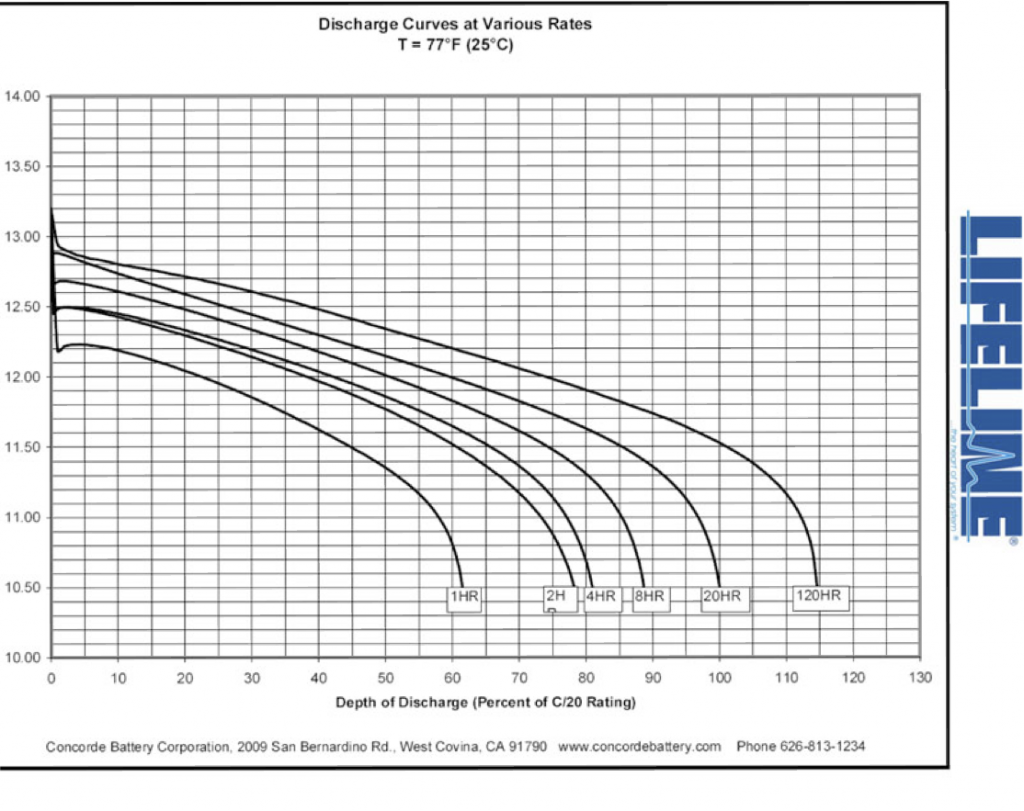
Edit - here's a graph from Lifeline showing that you can drag out just under 115% at 120hrs. I would suggest it would be very unwise to do so.
Last edited:


