A Williams Jet Rib Guide

I will be surprised if you can get custom tubes for less than what Williams sell them for but do let us know how you get on
Hi,
I got the engine running now. The starter was damaged. However, I am facing another issue now. The engine is running on one cylinder. the other cylinder runs fine when i swap connections. it seems that it is not getting any signal to start/run. I contacted Weber and they advised that it might be one of the fowling;
- Pressure Sensor
- Camshaft Sensor
- Wire harness
- ECU

They have advised me to buy the diagnostic tool which is really expensive for a private user. Any one is selling a used one?

I am hoping someone here faced this issue before and could help out.

thank you all.
 
No idea!

The traditional methods are to check for spark and fuel ( wet plug) and go from there.

I would add to their list coil packs and lamda sensor and temp sensor.

Remove all harness plugs clean and replace. They are packed with sensors and when the sensors play up all sorts of “random” things can happen - same with all electronic engines.

I am not sure what you swapped over and what did it did not happen

If your basic tests don’t show the problem then I would just call Williams. They will put the computer on it and fix as required which is honestly better than tearing you hair out.

If you don’t have a Williams deAler ask the local jet ski place. They all use the same / similar engines.
 
Just dropping a note to say what a help this thread has been. At a point where we were ready to get rid of our 285 due to it being a pain in the backside. Williams Balearics come yesterday to give ours a once over before we were going to put it up for sale.

Thanks to the info here, I asked for a chemical flush, seeing loads of calcium cleared, and two sensors replaced. Seems that the overheating issue is fixed and now she's running better than ever (touch wood). One run around the bay with the kids and the love is back, and suffice to say, not going up for sale. Let's see if I'm still this happy in a couple of weeks.

Thanks for all the info.
 
Hello!

What a great idea to create a forum for these tenders.
I have a 285 Williams Turbo Jet (build 2012) and now it has decided to have a seawater leak. The problem is that I can't locate the leak. After days of searching I still haven't found the leak and seems that it only leaks at high speeds. Does anyone have a suggestion where I should look. You can imagen me with my head inside the engine going 35+ knots, looking for the smalest of leaks, and trying not to total the boat on the rocks.

Otherwise super satisfied with the jet rib :)
 
LOL, if you are unsure of the answer to jrudge question, obviously you didn't keep your head inside the engine at 35+ knots long enough... :D :D :D
 
Do you mean sea water coming in to the bilge from the sea, or a sea water leak in the cooling circuit ?

All I know is that salt water is entering the bilge. But I think it’s from the raw water cooling loop.

Today when I swapped batteries I took the opportunity to have a closer look at the bottom left side of the engine. Then I noticed saltwater marks on the thick red hose from the exhaust. May be the outlet for the raw water cooling loop? I tried to take it off and have a look but the hose is stronger than me and will not let go. So tried to tighten it up, and have to order a replacement before I try other methods for removing it. Don’t won’t to make the boat unusable in the middle of the our summer holiday ;) without a replacement part.
 
The red hose injects sea water into the exhaust to cool it - hence downstream of that is rubber pipe.

They will come off easily with a bit of heat. Heat gun or hair dryer - preferably when not in the water!

It is secured by a jubilee clip. It comes from under the engine as I recall so will be a bugger to get to the other end

Remove it. Clean up and a bit of Vaseline and back together.

The tried and tested method of finding water is dry it all out and put talk on it and you can see the water lines. Simple to say but can be tricky to do on a Williams. Doing that one area should be ok
 
The red hose injects sea water into the exhaust to cool it - hence downstream of that is rubber pipe.

They will come off easily with a bit of heat. Heat gun or hair dryer - preferably when not in the water!

It is secured by a jubilee clip. It comes from under the engine as I recall so will be a bugger to get to the other end

Remove it. Clean up and a bit of Vaseline and back together.

The tried and tested method of finding water is dry it all out and put talk on it and you can see the water lines. Simple to say but can be tricky to do on a Williams. Doing that one area should be ok


Thank you for the tip, I’ll try it when I get the chance. We will do a few longer legs with the bigger boat so won’t get the opportunity to try it for a while. Good there are people with the knowledge to ask ?
 
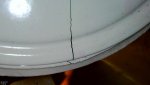
So finally I have found and fixed the water-leak. I found out that intercooler lid had crack and the water was coming out form there. I ordered a replacement form Weber USA and it came fast (32 hours from Washington State to Oslo Norway).
Attaching a photo of the lid: IMG_8873.JPG
 
Glad you found the issue, this could have been caused by overheating. We had issues with ours and had a chemical flush that removed a load of dried salt in the system. If you haven't had it done, I recommend doing it once a year, it made a big difference to ours.
 
Not something I had considered. Williams Balearics did it, was a pretty quick process, about 30 minutes or so. The chunks of salt that came out were surprising considering I always flushed through after use.
 
Hi everyone,
running a 2012 turbojet 385...don’t think the previous owner used it much in the recent years as I have been having a few issues that I have been able to solve. One I cant get my head around... when the jet is in the water,engine turns on after a few seconds, idles for 5-10 seconds then switches off. When out of the water and the fresh water hose is connected, engine turns on almost instantly and idles perfectly (without switching off).
I haven’t been able to look underneathinside the impeller to see if there are any blockages, I’ve hosed out the impeller grate quite thoroughly, didn’t notice anything come out...
Any ideas what else it may be?
 
10 seconds sounds a short time for it to detect overheat and shut down but cooling would be most likely given what you describe.

Is the towing valve open ? You can close it when towing to stop water entering cylinder. That stops all sea water flow.

If you put your hand on the exhaust manifold before it goes to the rubber turn it should be cool ish. It is water cooled. If hot there is no / reduced Sea water coolant flow.
 
since the impeller is turning and in the water has the resistance of the water, maybe simply the idle is too low and dies?
what if you start it in the water and step a bit on the accelerator (high idle sort of thing) will it still die?

V.
 
I‘d go for a normal rib, outboard, & prop guard for 1/4 of the price tbh. But then I’m from Yorkshire, and tight. :p
Agreed - not that you are from Yorkshire and tight though.

This thread just goes to prove my experience with jet powered boats.
They are expensive and always going wrong.
A nice conventional RIB with a conventional outboard will be FAR more reliable.
Think about it - even if you throw the outboard away every 3 seasons, you will still be way "in pocket".

I've had Jet RIBs and Jet Skis - they were all unreliable.
Great fun but really not worth the effort.
And manoeuvring a jet powered boat is a completely different story - most people rely on the tubes to stop them - i.e. crash.
With a conventional RIB, you can manoeuvre much more sedately - and not look a twit as you moor up.

Sorry, J - just my experience and thoughts.
 
  • Like
Reactions: MrB
10 seconds sounds a short time for it to detect overheat and shut down but cooling would be most likely given what you describe.

Is the towing valve open ? You can close it when towing to stop water entering cylinder. That stops all sea water flow.

If you put your hand on the exhaust manifold before it goes to the rubber turn it should be cool ish. It is water cooled. If hot there is no / reduced Sea water coolant flow.
Thanks Jrudge, i'll give this ago... sounds like this could be the problem... Thank you again.
 
Top