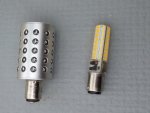
A warning about LED's ... especially near your VHF and AIS.

Thanks for posting. At a guess, I imagine that the LEDs on ships are perhaps larger and more powerful. Still, it is worth a check using the squelch instructions.
 
What a clown this gCaptain guy is. This is just the kind of unfortunate concern that his eager, half-informed ramblings will cause.

A Light Emitting Diode (LED) is a low-voltage, dc (direct current) lighting component. It has no way to emit radio frequency (rf) interference. It simply can’t do it. So what’s all the fuss about?

One cause on ships will be transforming mains voltage down to the low voltages used by LEDs. Modern 'switch mode' transformers don’t use wire coils around ferrite cores (because those are heavy and expensive to make) but chop the voltage on and off very fast, using the width of the pulses to control their output voltage. These units create rf interference.

A more common one will be from a now-popular variant, the 'buck converter', which converts one dc voltage to another - either to take a ship's 24V supply to the 12V required for most popular lighting units, or to control the brightness of the light itself. These use an inductor (basically a coil of wire) in their operation - and this, too, creates magnetic interference.

Another cause will be that modern LED lighting units employ an 'LED driver' circuit to regulate the power delivered to a bunch of LEDs. One application for this can be to deliver constant brightness as the electrical qualities of the LED itself vary with temperature. Some of these are 'switch mode' circuits, chopping up the voltage in time intervals, and this process releases rf interference.

(Incidentally, this interference can almost always be removed by placing a small tubular ferrite clip around the wires. You’ll have seen such a thing on the power cable behind your car or boat stereo, for example.)

But LEDs themselves don’t produce any rf interference. At all. So carry on illuminating your masthead and nav indicators with LEDs, and sleep well at night. (OK, not while you’re on watch!)
 
I agree that the squelch level check (assuming your VHF has a manual squelch knob) is worthwhile. I know the LEDs themselves can't cause any interference, but the electronic circuitry built into almost all of these LED bulbs potentially can, and has sometimes been reported to do so.
 
I agree that the squelch level check (assuming your VHF has a manual squelch knob) is worthwhile. I know the LEDs themselves can't cause any interference, but the electronic circuitry built into almost all of these LED bulbs potentially can, and has sometimes been reported to do so.

+1

I've had RF interference in the past from LED strip lights. Turned out to be a faulty driver unit.
 
What a clown this gCaptain guy is. This is just the kind of unfortunate concern that his eager, half-informed ramblings will cause.

A Light Emitting Diode (LED) is a low-voltage, dc (direct current) lighting component. It has no way to emit radio frequency (rf) interference. It simply can’t do it. So what’s all the fuss about?

As you yourself say, they require control circuitry and in many cases that is built into the bulb. I can certainly imagine poorly designed stuff there giving RF interference. In popular parlance, "LED" = "LED(s) and all associated/encapsulated electronics".
 
I've had this problem, rendering the Vhf useless when the tricolour was on. Had to revert to the filament bulb.

- W
Quite a common occurrence, over here I have been hearing people complaining about that during the last 5-10years, one of the reasons I still have the filament bulb; basically all LED manufacturers say to avoid RFI "install at least 1m from a vhf/ais antenna".. :(
 
Just tried the 'squelch test' on my boat, having both LED tri and anchor lights at the masthead - no increase in base noise so, on that test at least, it seemed ok. VHF antenna is about 1/2 metre from the light fitting
 
Looking at what is really going on -
A ham 144/433Mhz antenna down below(cos it was nearby) into a Fun Cube dongle pro plus receiver running in SDR sharp software definded radio.

Not near any lights >

fhziB8e.png


Even touching a bedazzled little round LED cluster didn't show any change in noise level.


About 3 feet from a bedazzled LED tube being turned off and on.
bZxa0L4.png


Masthead VHF / lights not wired up at the moment but did the same test a while ago and there was no extra noise visible from a nasa LED tricolour.
Anyone can do the same with a few quid on ebay for a RTL USB TV dongle, though not as sensitive as a fun cube dongle. https://www.rtl-sdr.com/
 
are there any led bulbs that have built in voltage conversion mains led bulbs ?
yes, lots
could they be culprits
At a mast head? not likely!
Marine LED bulbs will most likely have some power stabilisation and voltage reduction based on chopping the incoming 12/24V since 12V on a boat can be anywhere from 11V (nearly dead battery) to 14V (alternator giving it a bit o welly)
Cheapo choppers wont bother with RFI suppression, reputable ones will, thus the seppo coast guards asking for a list of devices that may be a problem.
 
Just run a check on my system, vhf arial at masthead with NASA Marine LED tricolour and mooring light combination.
No noticeable difference on recieve or transmit with navlight or mooring light on to when off. Arial is a ‘stubby’ only to 8” away from LED. On my previous boat I had the Lopolight nav/mooring LED combination for over 10 years and never had any problems.
 
Just tried the 'squelch test' on my boat, having both LED tri and anchor lights at the masthead - no increase in base noise so, on that test at least, it seemed ok. VHF antenna is about 1/2 metre from the light fitting

Ditto. Worth checking with the engine running as well.

I did find a problem with a cheap 12v to usb charger. It did raise the vhf noise level a touch.
 
Many LED bulbs use simple resistors to set the current through each LED. These will not generate RF noise.
Some DC LED bulbs and many 'mains' LED bulbs use switchmode converters, buit into the bulb. These can generate RF noise.
Many LED installations use a switch mode converter remote from the bulb, to provide a controlled voltage or current ot the bulbs. These are very likely to spread RF noise.
 
Top