A Man Who does not mince his words.

Allready posted. See Post 152

I know, but I restated it and provided a link as the source for the image I posted.

My speculation from the composite image is that I think I can see a sudden increase in vapour/gas emission from the aft starboard side of the saloon area and then a flame building inside immediately before the explosion. This may be consistent with damaged LiFePO4 batteries emitting gas (50%+ hydrogen) into the aft engine/battery space in sufficient quantity to (a) prevent ignition in that space (not enough oxygen left) and (b) push the battery gas mix into the accommodation where there was enough oxygen to create an explosive mix which was then ignited. But there are at least two big questions:

(a) what damaged the batteries enough to cause them to emit large quantities of flammable gas?

(b) what ignited the flammable gases?

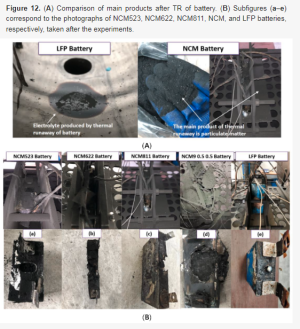
As I have said before, but will repeat, I am actively considering installing a LiFePO4 house battery in my boat (ie waiting for any official report not really an option unless I shelve the project for now), and in that process I would be foolish to ignore an alleged lithium possibly LiFePO4, possibly not, battery fire/explosion. At the same time I am also aware that it is probably the only recorded (literally) example of an alleged spontaneous lithium (possibly LiFePO4) fire explosion, with the only available example I have found of an actual LiFePO4 battery fire here, only achieved by giving it the vampire stake through the heart treatment (not something I plan on doing), and then causing a spark the same way. Even after forcing a LifePO4 battery using external heat into quasi-thermal runaway, a LiFePO4 (LFP) battery failed to explode/ignite (photo from the paper I posted a while back):
1756559892892.png

The quasi-thermal runaway leading to large quantities of flammable gas production which is then ignited does seem at least plausible, but at the same time the evidence suggests it is extremely rare, in fact n=1 to date, and even that one is far from proven to be have LiFePO4 as the definite culprit. I have to balance one extremely rare event, about which the full facts are not known, against the fact that to date, there appear to have been no other confirmed spontaneous LiFePO4 battery fires/explosions on boats, despite thousands (tens of thousands? hundreds of thousands?) of installations.

My hunch - and that is all it is for now - is that the narrowboat explosion/fire had some other as yet unknown factor that caused the incident. This is loosely based on a sense that if LiFePO4 batteries do spontaneously cause fires and explosions, how come we haven't seen more actually happen?
 
I can't be bothered to search or even watch the video posted by RunAgroundHard.

When some proper experts visit and view the boat and come up with a possible / lightly cause I will be more interested.

This follow up video quotes fire brigade confirming LifePO4 battery which exploded.

 
This follow up video quotes fire brigade confirming LifePO4 battery which exploded.

Yes or rather no, they have a get out of jail clause. They did not confirm the LifePO4 battery exploded. Here's what they actually said:

"Following a recent incident at Gayton Marina, Northamptonshire Fire and Rescue Service is reminding people of the potential fire risks that lithium-ion batteries can present.

Crews were called to the Marina on the morning of August 5 to tackle a fire that had engulfed the cabin of a canal boat.

Just moments before they were ready to start tackling the flames, the boat exploded. Thankfully there were no serious injuries, and crews were able to extinguish the fire.

The boat was fitted with Lithium Iron Phosphate batteries (LiFePO4) batteries, which are larger batteries typically used to power electric vehicles.

An investigation remains ongoing to determine what happened to the batteries to start the fire.

Area Manager Neil Sadler, of Northamptonshire Fire and Rescue Service, said: “Lithium-ion batteries come in all shapes and sizes and are used in everyday items we all own, so we want to remind people of the hazards they can sometimes pose.

“If they overheat or are punctured, crushed or overcharged, then they can release a flammable vapour which can ignite, burn or in some cases explode.

“Although we believe the fire was started by the batteries on this occasion, we do not know precisely why, and we are working with the owners of Gayton Marina while the investigation continues to fully understand what happened.""

"We believe" is not the same as we know, and the even state they "do not know precise why" (or rather how the batteries started the fire) which includes the possibility they didn't directly cause the fire. What if they just supplied the amps, something else did the burning/exploding?

Also note how they play rather fast and loose with ion and iron. No one has any doubt that some lithium ion batteries are potentially dangerous, but does that include all lithium ion batteries, including lithium iron (phosphate) batteries? Furthermore, the main thrust of the press release is the stock 'stay safe' message, not a forensic examination of what actually happened, because, as they admit, they don't actually know.

It is rather unfortunate that the terminology includes two terms that sound the same, but mean different things.

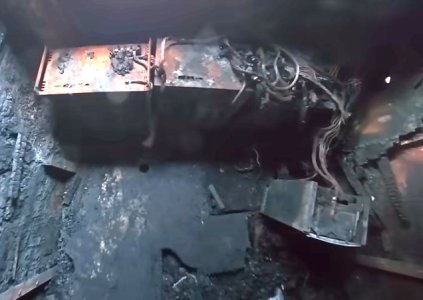
All that said, here are a couple of curve adjusted (to make the third battery more visible) screen grabs from the latest 'look inside' (how the hell did he get to do that???) video. Something does appear to have happened to the portmost battery which didn't happen to the other two. Or maybe the Medusa's head ended up where it is after falling there from somewhere else during or after the explosion.

Edit: sorry I forgot to add the photos, here they are:


batteries 2.jpg


batteries 3.jpg
 
Last edited:
Yes or rather no, they have a get out of jail clause. They did not confirm the LifePO4 battery exploded. Here's what they actually said:

"Following a recent incident at Gayton Marina, Northamptonshire Fire and Rescue Service is reminding people of the potential fire risks that lithium-ion batteries can present.

Crews were called to the Marina on the morning of August 5 to tackle a fire that had engulfed the cabin of a canal boat.

Just moments before they were ready to start tackling the flames, the boat exploded. Thankfully there were no serious injuries, and crews were able to extinguish the fire.

The boat was fitted with Lithium Iron Phosphate batteries (LiFePO4) batteries, which are larger batteries typically used to power electric vehicles.

An investigation remains ongoing to determine what happened to the batteries to start the fire.

Area Manager Neil Sadler, of Northamptonshire Fire and Rescue Service, said: “Lithium-ion batteries come in all shapes and sizes and are used in everyday items we all own, so we want to remind people of the hazards they can sometimes pose.

“If they overheat or are punctured, crushed or overcharged, then they can release a flammable vapour which can ignite, burn or in some cases explode.

“Although we believe the fire was started by the batteries on this occasion, we do not know precisely why, and we are working with the owners of Gayton Marina while the investigation continues to fully understand what happened.""

"We believe" is not the same as we know, and the even state they "do not know precise why" (or rather how the batteries started the fire) which includes the possibility they didn't directly cause the fire. What if they just supplied the amps, something else did the burning/exploding?

Also note how they play rather fast and loose with ion and iron. No one has any doubt that some lithium ion batteries are potentially dangerous, but does that include all lithium ion batteries, including lithium iron (phosphate) batteries? Furthermore, the main thrust of the press release is the stock 'stay safe' message, not a forensic examination of what actually happened, because, as they admit, they don't actually know.

It is rather unfortunate that the terminology includes two terms that sound the same, but mean different things.

All that said, here are a couple of curve adjusted (to make the third battery more visible) screen grabs from the latest 'look inside' (how the hell did he get to do that???) video. Something does appear to have happened to the portmost battery which didn't happen to the other two. Or maybe the Medusa's head ended up where it is after falling there from somewhere else during or after the explosion.

Edit: sorry I forgot to add the photos, here they are:


View attachment 198682


View attachment 198683
Since they look nothing like lifepo4 batteries I have seen, I suspect they are recycled lithium vehicle batteries, not lifepo4. These are certainly one of the more volatile lithium chemistries. The battery cases seem to be steel, with some sort of installation flange on the left battery. The right hand battery doesn't even seem to be the same type. Mixed batteries? Charging issues? None lifepo4, certainly far more to this than exploding lifepo4
 
I have never in my life heard of a hydrogen explosion from a LA battery. Perhaps some where where dozens of batteries are being charged at the same time with no ventilation it may have happened ? And the acid from a car battery caused a hole in my jumper, when I spilled some. It was uncomfortable on my fingers till I flushed and washed them
I had a lead acid battery exploded when my boat was on the hard in Curacao. The solar charger failed and over charged my 250Ah truck batteries. The 60kg battery was a pile of lead parts and plastic with acid everywhere.
 
Since they look nothing like lifepo4 batteries I have seen, I suspect they are recycled lithium vehicle batteries, not lifepo4.

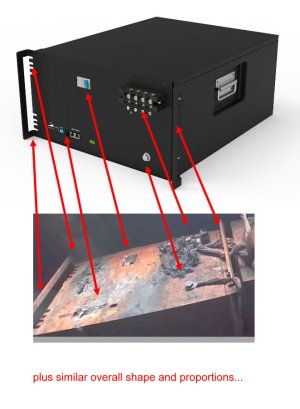
There is a suggestion they might be Ritar 48V Lithium Rackmount batteries, see here, and compare the images there with the ones I posted earlier of the ones in the narrow boat (the screen grabs from the video). I managed to persuade myself themiddle and starboardmost batteries might be one and the same. You do need to look very carefully. The third portmost battery is as they might say on Monty Python an ex-battery, and at this stage it is anyone's guess as to what it was.

The 60kg battery was a pile of lead parts and plastic with acid everywhere.

Lead acid batteries can certainly go bang, and it is possible (we simply don't know) that the third portmost battery was a lead acid battery. But if it was, it raises the question of what it (voltage unknown) was doing sitting next to the other two possibly 48V LiFePO4 batteries.

I rather fear we are stumped to know more about what actually happened until such time as the owner/operator and/or official investigators tell us more. Such things are likely to take some time, which is unfortunate not just for those who have already fitted LiFePO4 batteries, but also for those like me who are actively considering fitting such batteries. For now, my hunch remains that there were LiFePO4 batteries on board, but they were not the direct or even indirect cause of the fire/explosion. It may even turn out in the end that the incident dreadful as it was actually shows that LiFePO4 batteries are inherently safer than other battery chemistries (including lead acid) in so far as they can survive fire and explosion caused by some other fault.

Edit: sorry, forgot to add the Ritar battery link, now added
 
Last edited:
There is a suggestion they might be Ritar 48V Lithium Rackmount batteries, see here, and compare the images there with the ones I posted earlier of the ones in the narrow boat (the screen grabs from the video). I managed to persuade myself themiddle and starboardmost batteries might be one and the same. You do need to look very carefully. The third portmost battery is as they might say on Monty Python an ex-battery, and at this stage it is anyone's guess as to what it was.
The starboard and middle batteries are two separate things, clearly shown if you zoom in. It's also clear that whatever they are/were they did not explode.
 
It's also clear that whatever they are/were they did not explode.

I agree, that was the point I have just made, they survived the fire/explosion largely intact, suggesting they (whatever type they are) might be safer than some other battery types. What does a lead acid battery do when engulfed at the epicentre of a fire/explosion?
 
I agree, that was the point I have just made, they survived the fire/explosion largely intact, suggesting they (whatever type they are) might be safer than some other battery types. What does a lead acid battery do when engulfed at the epicentre of a fire/explosion?
In a fire in a car the LA battery melts, as a rule. I doubt that whatever is in the steel box will have faired any better.

Hard to tell what the melted mess is beside those two batteries, possibly LA, but hard to say. One thing that is 100% certain, those batteries, whatever they are, could not have produced enough hydrogen to create the explosion.
 
In a fire in a car the LA battery melts, as a rule. I doubt that whatever is in the steel box will have faired any better.

But whatever they are, they didn't melt. That was the point of my rhetorical question 'what does a lead acid battery do...?'

If they were LiFePO4 batteries, we know from the academic paper I linked to a while back that at temperatures above about 175 degrees C LiFePO4 batteries produce flammable gas. The paper suggests 0.6L/Ah (2 batteries x 200Ah x 0.569 = 228L of which ~54% is hydrogen and another 12% is other flammable gases ie perhaps ~150L of flammable gas in total. Whether that happened, and if it did, how much it may or may not have contributed to the fire, we do not yet know. In fact, we may never know.
 
There is a suggestion they might be Ritar 48V Lithium Rackmount batteries, see here, and compare the images there with the ones I posted earlier of the ones in the narrow boat (the screen grabs from the video). I managed to persuade myself themiddle and starboardmost batteries might be one and the same. You do need to look very carefully. The third portmost battery is as they might say on Monty Python an ex-battery, and at this stage it is anyone's guess as to what it was.


Lead acid batteries can certainly go bang, and it is possible (we simply don't know) that the third portmost battery was a lead acid battery. But if it was, it raises the question of what it (voltage unknown) was doing sitting next to the other two possibly 48V LiFePO4 batteries.

I rather fear we are stumped to know more about what actually happened until such time as the owner/operator and/or official investigators tell us more. Such things are likely to take some time, which is unfortunate not just for those who have already fitted LiFePO4 batteries, but also for those like me who are actively considering fitting such batteries. For now, my hunch remains that there were LiFePO4 batteries on board, but they were not the direct or even indirect cause of the fire/explosion. It may even turn out in the end that the incident dreadful as it was actually shows that LiFePO4 batteries are inherently safer than other battery chemistries (including lead acid) in so far as they can survive fire and explosion caused by some other fault.

Edit: sorry, forgot to add the Ritar battery link, now added
They don't look like rack mount batteries to me. Theyy are the wrong shape entirely. Too square. I think you are trying to blame lifepo4 because it suits your argument. They look nothing like rack batteries to me.
 
I think you are trying to blame lifepo4 because it suits your argument.

I am not sure you have read my posts. I don't have 'an argument', and I have certainly not blamed LiFePO4, if anything rather the opposite (which is why I suspect you haven't read my posts), I am instead trying to decide whether I wish to fit a LiFePO4 battery to my boat, to replace the current lead acid house battery. I am for my own peace of mind approaching this whole question with an open mind, ie I don't have an agenda.

I am going to do a side by side comparison of the Ritar batteries and those involved in the fire and will post the results shortly.

Edited to correct typos
 
Last edited:
I have never in my life heard of a hydrogen explosion from a LA battery. Perhaps some where where dozens of batteries are being charged at the same time with no ventilation it may have happened ? And the acid from a car battery caused a hole in my jumper, when I spilled some. It was uncomfortable on my fingers till I flushed and washed them
Well you will now
When I was a teenager my father sent me to his shed to get something. He had 2 knackered batteries on charge & whatever it was was stored just behing them. As I reached to get it I knocked a metal lead ladle & it shorted the terminals of one battery.
The battery immediately exploded & acid went into my face & eyes.
I ran blindly screaming from the shed & fortunately my mother grabbed me & dragged me into the kitchen & shoved my head into the washing up bowl. She then spun me round nearly breaking my back & turned both taps on into my face . One tap scalding me the other cold.
She then wrapped my face in a wet towel & took me to Orsett A & E 10 mins away, where they bound my eyes & treated the burnt skin . Next day she took me to Brentwood Nuffield where a private eye surgeon looked at my eyes & re covered them
A week later of complete blindness & constant moaning she took me back
She put her arm through mine told me to stop acting like a big girls blouse & marched me up the steps to the hospital
She sail "Door" & went through it. Now it was a double glass door so she went through the open half & marched me into the closed half & smashed my face slap into it. So I walked into the eye surgeons room with a massive nose bleed & my mum told me off for being so stupid & to stop moaning. But the specialist did say that her early actions had saved my sight
I just wish that she had done it without hurting me so much
The burns to my face around my cheeks,chin & forehead caused a lot of discomfort & a few spots were quite deep. The scars cleared quite quickly though
 
Last edited:
Well you will now
When I was a teenager my father sent me to his shed to get something. He had 2 knackered batteries on charge & whatever it was was stored just behing them. As I reached to get it I knocked a metal lead ladle & it shorted the terminals of one battery.
The battery immediately exploded & acid went into my face & eyes.
I ran blindly screaming from the shed & fortunately my mother grabbed me & dragged me into the kitchen & shoved my head into the washing up bowl. She then spun me round nearly breaking my back & turned both taps on into my face . One tap scalding me the other cold.
She then wrapped my face in a wet towel & took me to Orsett A & E 10 mins away, where they bound my eyes & treated the burnt skin . Next day she took me to Brentwood Nuffield where they looked at my eyes & re covered them
A week later of complete blindness & constant moaning she took me back
She put her arm through mine told me to stop acting like a big girls blouse & marched me up the steps to the hospital
She sail "Door" & went through it. Now it was a double glass door so she went through the open half & marched me into the closed half & smashed my face slap into it. So I walked into the eye surgeons room with a massive nose bleed & my mum told me off for being so stupid & to stop moaning. But the specialist did say that her early actions had saved my sight
I just wish that she had done it without hurting me so much
The burns to my face around my cheeks,chin & forehead caused a lot of discomfort & a few spots were quite deep. The scars cleared quite quickly though
Tough love!
 
Bet you dad was a bit scarce.....
He did not care
I had a 3phase electric shock once, that threw me off a metal table & across the workshop. The skin was hanging off my blackened hand like curtains.
I ran in panic & pain, to our house (alongside the works)where he was having breakfast to ask to be taken to A & E & he told me to wait until he had finished his breakfast. Our kitchen staff nearly fainted when she saw my hand & did the fastest breakfast table clear up ever to get him to move.
 
Boats with diesel engines and generators sail the oceans, and a defective alternator, leaking fuel or dodgy exhaust could be fatal.

Boats with gas cookers sail the oceans and a defect could be explosive.

Unless you want to sail the oceans with just canvas and hope you don’t get becalmed for so long your food/water runs out it’s a risk we take and design, maintenance and monitoring should minimise the risk.
Thank you for some calm sanity on this topic.
 
I’ve not done this but I think if you search the forum you’ll find more people with first hand experience of exploding LA batteries than LiFePO.
The fact you haven't heard about it doesn't mean it doesn't happen.

If you are saying that you are not aware that the mass media love to jump on any mention of EVs catching fire then you must have been living in a cave for the last 5 years. The reality is that all sorts of fires occur every day across the globe and very rarely get reported because they are simply so common and thus not newsworthy. In the case of EVs, the reality is (statistically speaking at least): 1/ ICEVs are 60 times more likely to catch fire (for whatever reason) than EVs, and 2/ Hybrids are 139 times more likely to catch fire than EVs (Tusker fleet data reveals the truth about EV fires). Such fires kill over 400 people in the US every year; 100 in the UK… How many of you those have you *ever* heard of?

As for lead acid batteries causing explosions I know of at least one myself. A friend had a Leyland Mini van whose 12 V battery sits on the floor behind the driver's seat underneath a projection of the rear load tray. One day having just started out first thing in the morning, he hit a pothole which caused the 12V battery to jump out of its tray (it was not properly secured!) and the 2 terminals shorted across the load tray edge reinforcing angle igniting the hydrogen gas that had accumulated in the few minutes after starting the engine causing a mild explosion which blew out his front windscreen. He showed me the pitting and shorting marks later the same day.
 
Top