
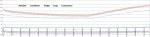
A chart of boat fridge temps and compressor cycles over time

Anthony

Well-Known Member
Joined
8 Sep 2003
Messages
1,041
Location
Western Australia
Visit site
Hi,

Having repaired my boat fridge recently I was nerdy enough to build a data logger (Arduino) and log various temps and the compressor motor cycles over time to check how well it was working, here is a representative chart of its typical operation:
fridge.JPG

The chart shows a time line from approx 8pm thru the night to 3pm the next afternoon (I have data for a few days but you get the idea).

From top to bottom the traces are:
Red: Condenser (the 'black metal thing' on the back of a fridge, this is where heat is transferred to the outside)
Dark blue: Ambient air temp outside of fridge (fridge was in free open space garage, may get different results when fitted in space in boat)
Green: Ambient fridge air temp (as measured in middle of fridge)
Light blue: Compressor cycle (on / off) - it is typically cycling every minute or two.
Purple: Evaporator (the plate in the fridge that gets cold)

The fridge controller measures the temp of the condenser plate and as you can see it does a reasonable'ish job of switching the compressor on and off to maintain that plate around -7 to -5 ish (control know was set to about middle of the range), however the average fridge temp clearly follows the outside ambient temp up and down, going from about -2 during the night to +2 in the afternoon. Obviously the fridge would benefit from better insulation (but no more room for it). The fridge was also empty, I might run it again with some food in there as I suspect food and drink would help dampen the swing of temps.

Anyway just thought you might be interested to see it, if there is any interest I'll log it again with food to see what difference it makes, or maybe everyone else is happy just drinking the beer from their fridge instead of worrying about how it works and I should go do the same... :very_drunk:

Ants
 
:cool:

Very, er, cool! :)

I did similar, replaced a bust thermostat with an arduino and add logging along the way.

fridge4th_zps8c809c0f.jpg


It's got a little lcd display now, what's interesting is just how much the duty cycle increases on a warm day.
 
It's interesting to see the duty cycle on the chart, mine's getting a bit rattly and whirry and I lie there at night timing the bleedin' thing rather than sleeping.
I'm thinking of extracting it with the aim of trying to work out if I can replace any worn-out parts. Do they need recharging at all like aircon units? Any fridge-servicing advice anyone?
I'm certainly not going to be buying a new one, have you seen the price, £££!!!
 
:cool:


I did similar, replaced a bust thermostat with an arduino and add logging along the way.

Phew, I was worried I was getting too nerdy, good to hear I am not the only one!

I'm going to add % duty cycle (I was think on a rolling last hour or so, based on X number of on and off cycles) and add an OLED display for when it goes back into the boat.I have it logging to an SD card at the moment so I might leave that in so can grab the raw data to compare as the problem was a small gas leak that made it inefficient (so to the other poster yes they can need re-gassing like any ac or fridge unit).

You mentioned a big increase in duty on a warm day, do you have a fan blowing over the condenser and some ventilation to enable that airflow? Apparently that can really help with efficiency, mine has one but its faulty so I am going to run the logging again with a new fan (its just a small 12v PC case type thing), and see what that does to duty cycle and temp and maybe put the fan under PID with the Arduino and see what adding 2 fans or a bigger fan does maybe under PWM control to keep the condenser temp low on warm days but not running full fan speed as the temp drops. The fridge thermostat is electronic and built into the main controlboard (that generates AC do drive the motor etc) but still tempted to interface it into the arduino for better temp regulation (but so many boat jobs and only so much boat time...).

Interestingly yours seems to cycle about every 15 mins compared to every couple of minutes on mine, but you are getting much larger ranges of temp on the evap plate than I do, although your fridge temp seems pretty stable. Would be interesting to see how your duty cycle % changes if you adjusted the upper and lower temp settings to keep the plate temp more closely regulated, are you driving the compressor switching from the plate temp or the ambient fridge temp?

Ants
 
I was on a friends boat that has a waeco coolbox. Great thing but noisy, we used to turn it off at night in the Med because it kept me awake. The contents were still cold in the morning.
The fridge in my caravan is completely silent - much better.
 
Phew, I was worried I was getting too nerdy, good to hear I am not the only one!

I'm going to add % duty cycle (I was think on a rolling last hour or so, based on X number of on and off cycles) and add an OLED display for when it goes back into the boat.I have it logging to an SD card at the moment so I might leave that in so can grab the raw data to compare as the problem was a small gas leak that made it inefficient (so to the other poster yes they can need re-gassing like any ac or fridge unit).

You mentioned a big increase in duty on a warm day, do you have a fan blowing over the condenser and some ventilation to enable that airflow? Apparently that can really help with efficiency, mine has one but its faulty so I am going to run the logging again with a new fan (its just a small 12v PC case type thing), and see what that does to duty cycle and temp and maybe put the fan under PID with the Arduino and see what adding 2 fans or a bigger fan does maybe under PWM control to keep the condenser temp low on warm days but not running full fan speed as the temp drops. The fridge thermostat is electronic and built into the main controlboard (that generates AC do drive the motor etc) but still tempted to interface it into the arduino for better temp regulation (but so many boat jobs and only so much boat time...).

Interestingly yours seems to cycle about every 15 mins compared to every couple of minutes on mine, but you are getting much larger ranges of temp on the evap plate than I do, although your fridge temp seems pretty stable. Would be interesting to see how your duty cycle % changes if you adjusted the upper and lower temp settings to keep the plate temp more closely regulated, are you driving the compressor switching from the plate temp or the ambient fridge temp?

Ants

If the fridge air temperature is constant with a 15 minute duty cycle then this is a good solution. 4 starts per hour compared to 30 is a huge difference and will impact on compressor/ motor life I would have thought. My own fridge runs the compressor for about 8 minutes then turns off for about 15 minutes. I have sat up at night to time it when I couldn't sleep.
This fridge is very well insulated and it was full of food when I timed its duty cycle
 
Phew, I was worried I was getting too nerdy, good to hear I am not the only one!
Arduinos are great :cool:


I'm going to add % duty cycle (I was think on a rolling last hour or so, based on X number of on and off cycles) and add an OLED display for when it goes back into the boat.
I did the duty cycle over the previous 2 hours, used a 4 line LCD screen, but I've played around with the little oled screens, dead cheap :)
I've got a bluetooth chip fitted as well, so you can alter the on/off temps using a mobile or tablet. Apparently you can upload sketches over bluetooth as well, would be handy. And download the data without having to get at the card.


You mentioned a big increase in duty on a warm day, do you have a fan blowing over the condenser and some ventilation to enable that airflow? Apparently that can really help with efficiency, mine has one but its faulty so I am going to run the logging again with a new fan (its just a small 12v PC case type thing), and see what that does to duty cycle and temp and maybe put the fan under PID with the Arduino and see what adding 2 fans or a bigger fan does maybe under PWM control to keep the condenser temp low on warm days but not running full fan speed as the temp drops. The fridge thermostat is electronic and built into the main controlboard (that generates AC do drive the motor etc) but still tempted to interface it into the arduino for better temp regulation (but so many boat jobs and only so much boat time...).

Interestingly yours seems to cycle about every 15 mins compared to every couple of minutes on mine, but you are getting much larger ranges of temp on the evap plate than I do, although your fridge temp seems pretty stable. Would be interesting to see how your duty cycle % changes if you adjusted the upper and lower temp settings to keep the plate temp more closely regulated, are you driving the compressor switching from the plate temp or the ambient fridge temp?
No fan yet, on the (big) list of must get round to doing :) That and maybe suck cooler air from the bilges.

Ambient temps are set to cycle between 3.5C & 5C

Enjoy, data is great :)
 
I would find a data logger like this very useful. I see that the Arduino website https://www.arduino.cc/en/Guide/HomePage describes the kit and procedures as 'easy to use'. Bearing in mind that my knowledge of things electronic is vitually zero, just how easy is it to build a system like this? Some user feedback would be much appreciated.

The wiring side is pretty easy, though you might find the software a bit daunting if you've never done any programming at all. But most of that is cut and paste with loads of help online.
I tentatively started some open source documentation a while ago for various projects but haven't really done much since, but a basic setup to log the likes of temp, voltage and current wouldn't be too hard to do, and all this stuff is so cheap on ebay.
 
If the fridge air temperature is constant with a 15 minute duty cycle then this is a good solution. 4 starts per hour compared to 30 is a huge difference and will impact on compressor/ motor life I would have thought. My own fridge runs the compressor for about 8 minutes then turns off for about 15 minutes. I have sat up at night to time it when I couldn't sleep.
This fridge is very well insulated and it was full of food when I timed its duty cycle

Yep I have similar experience to you.
I installed my Isotherm 85L fridge with Danfoss compressor last winter, and have been impressed with the results although adjusting the settings on the optional Smart Energy Controller has taken a few attempts to get it just right.
One thing the Smart Energy controller does is convert from measuring plate temp to fridge temp, and I think that does decerase cycling frequency considerably.
The extra 25mm of Kingspan I fitted all round the fridge must have helped things a bit too though.
It only seems to start up the compressor after the door has been opened.

The fridge uses about 5 Ah overnight, which I'm very pleased with.
 
I was once a bit peeved when a work colleague took the *iss out of me for being a yachting nerd (I was simply reading Yachting Monthly in my lunch break)
If he could see me now reading a thread on data logging (over BlueTooth) my fridges duty cycle, he would have a field day :)
I dont need to log my fridge duty cycle ... in Greece/Turkey the b*s*a*d runs all day (and night)
 
Yep I have similar experience to you.
I installed my Isotherm 85L fridge with Danfoss compressor last winter, and have been impressed with the results although adjusting the settings on the optional Smart Energy Controller has taken a few attempts to get it just right.
One thing the Smart Energy controller does is convert from measuring plate temp to fridge temp, and I think that does decerase cycling frequency considerably.
The extra 25mm of Kingspan I fitted all round the fridge must have helped things a bit too though.
It only seems to start up the compressor after the door has been opened.

The fridge uses about 5 Ah overnight, which I'm very pleased with.

We built our fridge using a s/s tub made to fit the space available. We have a minimum of 100mm of kingspan on the sides and 150mm on the bottom. The fridge is top opening and the oval evaporator plate is made into an 8 litre fridge. I mounted the oval plate so that a Perspex base plate with washable foam insulation forms the base of the freezer. The top opening has a closed cell foam lid to keep the cold air in the freezer. This works incredibly well and is economic to run. The fridge is only 85litres including the 8 litre freezer but is plenty large enough for two people onboard in the Caribbean and adequate for four of us crossing the Atlantic. We tend to keep the fridge full (which isn't hard with only 85l) and I think this has a good dampening effect on duty cycling due to the stored Coolth in the contents of the fridge. We have kept the freezer operational throughout our last six months in the Caribbean with no problem with power consumption.
 
Can anyone share how they monitor temp (which hardware) and compressor on/off with a 3.3 or 5v logic device?
 
Can anyone share how they monitor temp (which hardware) and compressor on/off with a 3.3 or 5v logic device?

For temperature these ds1820 sensors, fantastic, dead cheap, i2c data protocol so daisy chain lots together onto one pin (assuming your microcontroller does icc, don't they all now?) -
https://www.sparkfun.com/products/245
Ebay do waterproof.

In my case an arduino controls the compressor on/off so easy to log, but if monitoring only then probably a few choices - digital pin checking continuity of the thermostat ; measure the voltage somewhere on the fridge controller through a voltage divider (ebay do little divider boards), lots info on arduino /rasp Pi forums on Google.
 
measure the voltage somewhere on the fridge controller through a voltage divider (ebay do little divider boards), lots info on arduino /rasp Pi forums on Google.

sound advice, just a warning, I bought a couple of ebay voltage dividers, turned out that they wouldn't work for what I wanted them, then googled voltage divider calculator, got some nice online tools, added the values in the boxes and calculated what Rs I should buy to diy. Costed a few eurocents to built a few for various applications, well worth it. Thermosilicon, heatshrink and they are now part of the cable :D

V.
 
Top