
A £3.28 fix for a non working GPS puck.

ProDave

Well-Known Member
Joined
5 Sep 2010
Messages
16,238
Location
Alness / Black Isle Northern Scottish Highlands.
Visit site
I have am old Lowrance chartplotter that had been having intermittent communications issues with the GPS receiver then by the end of last season had become a permanent loss of communication.

This is a plotter that has what I call a "GPS receiver" and many call a GPS puck. It is a round thing on the coach roof that contains an antenna and GPS receiver and communicates that to the plotter over a dedicated NMEA cable. Taking the plotter home and opening up the plotter (as the only accessible point to make measurements) confirmed there was no NMEA data being sent from the GPS receiver.

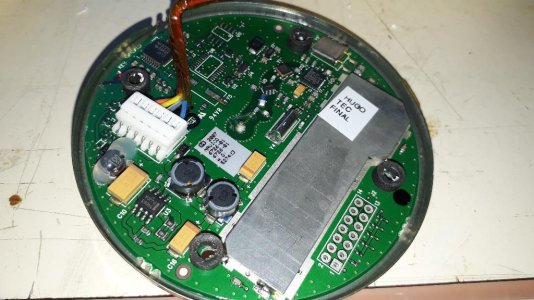
There are several version if this but ours is a LGC-12W. first issue, it seems impossible to open the unit, and nobody on the internet had found a way to open it. Well I did. The lid is glued on. To open it, you go around the visible joint with a sharp knife then start tapping at the joint with a chisel slowly working your way around and eventually you will break the glued seal and the lid will come off. Inside is a tin can and inside that is a circuit board. Here is a picture. Not much chance of making a repair to that.
Dismantling_3.jpg

So a replacement was needed. To buy the correct thing was about £80. If I had to pay that much I would rather put it towards a new plotter.

So the search was on for a cheaper alternative, and indeed there are many cheap GPS receivers / pucks to choose from.

I chose a NEO-6M GPS receiver module, and ordered one on ebay from China for the grand sum of £3.28. This link gives a good description of what the module does, stop reading when you get to the discussion about connecting it to an Arduino. In-Depth: Interface ublox NEO-6M GPS Module with Arduino

I chose this bare board option as I wanted to build it into the existing housing of the old failed one and hence continue using the cabling and connectors from the old one buried in the headlining of the boat.

The only immediate issue was the new one defaults to 9600 baud, but the plotter defaults to 4800 baud.

A month later it arrived and I connected it. I only connected power, ground, and TX (from the GPS) to RX (at the plotter)

I set the menu on the plotter to 9600 baud and turned it on. Nothing. I thought perhaps the adjustable baud rate only applied to the comms port on the plotter not the dedicated GPS port, so I set the comms port to "NMEA GPS INPUT" and 9600 baud and fitted a jumper wire in the plotter to connect my incoming signal to the comms port RX. Again nothing.

Some more head scratching and probing around with my oscilloscope, and i concluded the logic polarity of the NMEA signal from this GPS receiver was wrong. So I knocked up an inverter with a transistor, and now I had a working GPS signal into my plotter.

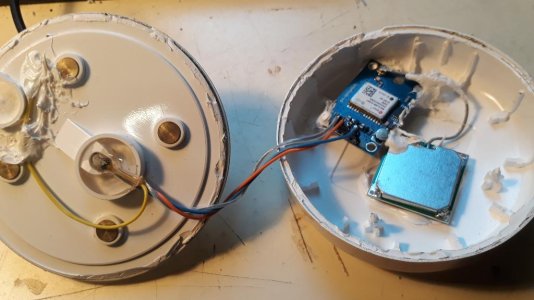
So i have tidied it all up. Mounted the receiver and it's aerial into the lid of the the original receiver
New_GPS_transplanted.jpg

And then glued the lid back on.

Inside the plotter, I made my logic inverter a little tidier

Inverter.jpg

And that is it. A working GPS signal again for total cost of £3.28 and outwardly nothing has changed, all the original cables and connectors are still in use and the receiver on the coach roof looks just like it always did.

I have to say the inverted logic thing with this particular GPS receiver is something I had not expected. And for that reason this is probably not the best choice of GPS receiver, there are others that are known to work without this inverted logic issue which might be better for most people.
 
Last edited:
I have am old Lowrance chartplotter that had been having intermittent communications issues with the GPS receiver then by the end of last season had become a permanent loss of communication.

This is a plotter that has what I call a "GPS receiver" and many call a GPS puck. It is a round thing on the coach roof that contains an antenna and GPS receiver and communicates that to the plotter over a dedicated NMEA cable. Taking the plotter home and opening up the plotter (as the only accessible point to make measurements) confirmed there was no NMEA data being sent from the GPS receiver.

There are several version if this but ours is a LGC-12W. first issue, it seems impossible to open the unit, and nobody on the internet had found a way to open it. Well I did. The lid is glued on. To open it, you go around the visible joint with a sharp knife then start tapping at the joint with a chisel slowly working your way around and eventually you will break the glued seal and the lid will come off. Inside is a tin can and inside that is a circuit board. Here is a picture. Not much chance of making a repair to that.

View attachment 187639

So a replacement was needed. To buy the correct thing was about £80. If I had to pay that much I would rather put it towards a new plotter.

So the search was on for a cheaper alternative, and indeed there are many cheap GPS receivers / pucks to choose from.

I chose a NEO-6M GPS receiver module, and ordered one on ebay from China for the grand sum of £3.28. This link gives a good description of what the module does, stop reading when you get to the discussion about connecting it to an Arduino. In-Depth: Interface ublox NEO-6M GPS Module with Arduino

I chose this bare board option as I wanted to build it into the existing housing of the old failed one and hence continue using the cabling and connectors from the old one buried in the headlining of the boat.

The only immediate issue was the new one defaults to 9600 baud, but the plotter defaults to 4800 baud.

A month later it arrived and I connected it. I only connected power, ground, and TX (from the GPS) to RX (at the plotter)

I set the menu on the plotter to 9600 baud and turned it on. Nothing. I thought perhaps the adjustable baud rate only applied to the comms port on the plotter not the dedicated GPS port, so I set the comms port to "NMEA GPS INPUT" and 9600 baud and fitted a jumper wire in the plotter to connect my incoming signal to the comms port RX. Again nothing.

Some more head scratching and probing around with my oscilloscope, and i concluded the logic polarity of the NMEA signal from this GPS receiver was wrong. So I knocked up an inverter with a transistor, and now I had a working GPS signal into my plotter.

So i have tidied it all up. Mounted the receiver and it's aerial into the lid of the the original receiver

View attachment 187640

And then glued the lid back on.

Inside the plotter, I made my logic inverter a little tidier

View attachment 187641

And that is it. A working GPS signal again for total cost of £3.28 and outwardly nothing has changed, all the original cables and connectors are still in use and the receiver on the coach roof looks just like it always did.

I have to say the inverted logic thing with this particular GPS receiver is something I had not expected. And for that reason this is probably not the best choice of GPS receiver, there are others that are known to work without this inverted logic issue which might be better for most people.
Proper PBO stuff. Well done.
 
I have am old Lowrance chartplotter that had been having intermittent communications issues with the GPS receiver then by the end of last season had become a permanent loss of communication.

This is a plotter that has what I call a "GPS receiver" and many call a GPS puck. It is a round thing on the coach roof that contains an antenna and GPS receiver and communicates that to the plotter over a dedicated NMEA cable. Taking the plotter home and opening up the plotter (as the only accessible point to make measurements) confirmed there was no NMEA data being sent from the GPS receiver.

There are several version if this but ours is a LGC-12W. first issue, it seems impossible to open the unit, and nobody on the internet had found a way to open it. Well I did. The lid is glued on. To open it, you go around the visible joint with a sharp knife then start tapping at the joint with a chisel slowly working your way around and eventually you will break the glued seal and the lid will come off. Inside is a tin can and inside that is a circuit board. Here is a picture. Not much chance of making a repair to that.

View attachment 187639

So a replacement was needed. To buy the correct thing was about £80. If I had to pay that much I would rather put it towards a new plotter.

So the search was on for a cheaper alternative, and indeed there are many cheap GPS receivers / pucks to choose from.

I chose a NEO-6M GPS receiver module, and ordered one on ebay from China for the grand sum of £3.28. This link gives a good description of what the module does, stop reading when you get to the discussion about connecting it to an Arduino. In-Depth: Interface ublox NEO-6M GPS Module with Arduino

I chose this bare board option as I wanted to build it into the existing housing of the old failed one and hence continue using the cabling and connectors from the old one buried in the headlining of the boat.

The only immediate issue was the new one defaults to 9600 baud, but the plotter defaults to 4800 baud.

A month later it arrived and I connected it. I only connected power, ground, and TX (from the GPS) to RX (at the plotter)

I set the menu on the plotter to 9600 baud and turned it on. Nothing. I thought perhaps the adjustable baud rate only applied to the comms port on the plotter not the dedicated GPS port, so I set the comms port to "NMEA GPS INPUT" and 9600 baud and fitted a jumper wire in the plotter to connect my incoming signal to the comms port RX. Again nothing.

Some more head scratching and probing around with my oscilloscope, and i concluded the logic polarity of the NMEA signal from this GPS receiver was wrong. So I knocked up an inverter with a transistor, and now I had a working GPS signal into my plotter.

So i have tidied it all up. Mounted the receiver and it's aerial into the lid of the the original receiver

View attachment 187640

And then glued the lid back on.

Inside the plotter, I made my logic inverter a little tidier

View attachment 187641

And that is it. A working GPS signal again for total cost of £3.28 and outwardly nothing has changed, all the original cables and connectors are still in use and the receiver on the coach roof looks just like it always did.

I have to say the inverted logic thing with this particular GPS receiver is something I had not expected. And for that reason this is probably not the best choice of GPS receiver, there are others that are known to work without this inverted logic issue which might be better for most people.
I bought a BN220 gps module to get gps data into my basic DSC vhf radio without having to have my plotter on all the time.
It has the same single ended rx and tx as your Neo module.
I set its baud rate to 4800 to match my vhf but while it would talk to my laptop through the UCentre software and a serial to USB board, it never worked with the VHF.
I will try making a cheap logic inverter and see if I get anywhere.
 
Last edited:
I have am old Lowrance chartplotter... that has what I call a "GPS receiver" and many call a GPS puck... To buy the correct thing was about £80...
Replacement OME antennas are a bit of a scam:
Our Garmin 128 had a mushroom type antenna which died while in Suriname and a replacement - not that we could source one locally - was quoted at about £120. Having made it from there to St Lucia using a handheld unit, we had a puck-type antenna delivered by friends to us there, which had been bought on Ebay for <£10 and which I think I'd got the recommendation for on this forum. Even when 'temporarily' located inside the cabin to test it out (it never did get moved) that Ebay puck provided a signal every bit as strong/stable as the original. I was so impressed that I bought a couple of spares (why wouldn't you at that price) when we next visited the UK; we never needed either, but the German lad who we passed one of them onto in Tonga was equally impressed.
 
I have to say the inverted logic thing with this particular GPS receiver is something I had not expected. And for that reason this is probably not the best choice of GPS receiver, there are others that are known to work without this inverted logic issue which might be better for most people.
Impressive.
But sadly the line "probing around with my oscilloscope" is a hint, if I needed one, that this kind of thing might not be a realisic aspiration for me.
 
And for that reason this is probably not the best choice of GPS receiver, there are others that are known to work without this inverted logic issue which might be better for most people.
Any advice which one. I'm in the process of replacing the gps module in my SH300 plotter. I have just tried the same board with no joy although it looks very similar to the old one and the chip is from the same manufacturer. Seems to be a myriad of programming options. I had assumed the original SH unit was using NMEA to communicate. Default band on the new one seems to be 9600.
 
I have had a couple of the Quescan puck ones from Ali Express for under £10 and they work fine even inside a GRP boat. They also do a mushroom one for about £20. You have to make sure it comes set to 4800 baud and 12v so check you get the options correct. The ones I used were 5v supply so I needed to add a 5v regulator. You will need to do some splicing on the cable to use the existing connector but you can probably find the wiring colour code somewhere. As long as you get the power wires correct you won't do any harm if the NMEA is reversed as it just won't work.
There are various serial reading programs available for a PC that you can use with a serial to USB converter to read the NMEA data and check it is working.
 
Top