3D printer, anyone made something genuinely useful ?

Re: Flexible filament - could make O rings or gaskets. Not sure about impeller

I am currently trying to make something useful with the help of Tudor Sailor ,with which I am eternally grateful
 
I might be able to answer than one after christmas!
I too have always fancied one but was not convinced the use it would get would make it worthwhile, but then I saw one in the black friday sales at a very low price so guess what I am getting for Christmas :)

I fully expect it to be pretty rubbish out of the box but it will be interesting to see what it will take to get useful results. I still don't know what I will actually make on it though ;)

A bit of a thread resurrection but my cheap 3d printer finally arrived. Over two months to swim from China but for less than £100 inc shipping I can't complain too much. (it is an Anet A8 if anyone is interested)
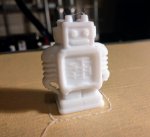
A couple of nights to assemble it then It printed this on completely default settings:
20180205_195721.jpg

Printing using PLA and about 30mm high.

Not perfect but then I forgot to attached the cooling fan nozzle so I am pretty impressed it didn't end up as a blob of molten plastic!

Time will tell how good it really is but it is way better quality than I expected for the money.....
 
Not bad...A8's are great starter machines...and plenty of upgrades available for them (many printable) to keep them going a long time as your needs may increase.

I've just built a delta printer...320mm diameter x 500mm height print area.....still not printed anything larger than about 10cm square yet though!

Am I right in thinking ASA is the only material that will really stand up to outside use on a boat? And then does anyone know what kind of lifespan to expect? I'm thinking things like backstay standoffs for HF antenna, and lower/upper holder for danbuoy.

Thanks, Ben
 
Since someone else has resurrected the thread, I'll chip in. Yes, we make many genuinely useful things with our printer - it is used for prototyping and short production runs of boxes and other components for the devices that we manufacture. It costs many thousands of pounds to get the tooling set up to manufacture injection moulded plastic boxes - any error in the design would result in a significant loss. I do the design myself on my PC, print off test units, assemble them and adjust the design as necessary so that, by the time we go to the plastic box manufacturer, we have confidence in our design and can give him a physical example of what we want.
 
Not bad...A8's are great starter machines...and plenty of upgrades available for them (many printable) to keep them going a long time as your needs may increase.

I've just built a delta printer...320mm diameter x 500mm height print area.....still not printed anything larger than about 10cm square yet though!

Am I right in thinking ASA is the only material that will really stand up to outside use on a boat? And then does anyone know what kind of lifespan to expect? I'm thinking things like backstay standoffs for HF antenna, and lower/upper holder for danbuoy.

Thanks, Ben

I am also interested in what people say about outdoor materials. I have read comments that say PLA is actually ok outside although it is not supposed to be UV resistant. For mounts etc though it might be a bit brittle?

This article does suggest that ASA is the best option though:https://rigid.ink/blogs/news/175845063-the-difference-between-abs-and-asa
 
I am also interested in what people say about outdoor materials. I have read comments that say PLA is actually ok outside although it is not supposed to be UV resistant. For mounts etc though it might be a bit brittle?

This article does suggest that ASA is the best option though:https://rigid.ink/blogs/news/175845063-the-difference-between-abs-and-asa

Isn't PLA biodegradable? I thought it was relatively easy to dissolve it - I seem to remember reading that it is sometimes used in 3d printing as an in-fill material in models that have significant overhangs to support the main structure on the basis that it is easy to dissolve it away.
 
Isn't PLA biodegradable? I thought it was relatively easy to dissolve it - I seem to remember reading that it is sometimes used in 3d printing as an in-fill material in models that have significant overhangs to support the main structure on the basis that it is easy to dissolve it away.

PLA is made from cellulose. It is biodegradable. However it is very hard and lasts several years in the outdoors in the Med. It certainly cannot be easily dissolved

In contrast PVA is basically the same as the glue in your glue stick. This is used as a support as it can be dissolved away. It is much more expensive than PLA. The goo that comes away is very stick - as it is glue! I was not so happy washing it down the sink. It took a long time to dissolve with simple immersion. It was easier to run it under a hot tap to loosen it.

I have tried ASA and it prints well. I have made some halyard retainers to go onto the shroud wire and hopefully they will last a long time.

TudorSailor
 
Since someone else has resurrected the thread, I'll chip in. Yes, we make many genuinely useful things with our printer - it is used for prototyping and short production runs of boxes and other components for the devices that we manufacture. It costs many thousands of pounds to get the tooling set up to manufacture injection moulded plastic boxes - any error in the design would result in a significant loss. I do the design myself on my PC, print off test units, assemble them and adjust the design as necessary so that, by the time we go to the plastic box manufacturer, we have confidence in our design and can give him a physical example of what we want.

Splendid!
 
PLA is made from cellulose. It is biodegradable. However it is very hard and lasts several years in the outdoors in the Med. It certainly cannot be easily dissolved

In contrast PVA is basically the same as the glue in your glue stick. This is used as a support as it can be dissolved away. It is much more expensive than PLA. The goo that comes away is very stick - as it is glue! I was not so happy washing it down the sink. It took a long time to dissolve with simple immersion. It was easier to run it under a hot tap to loosen it.

I have tried ASA and it prints well. I have made some halyard retainers to go onto the shroud wire and hopefully they will last a long time.

TudorSailor

That is good to hear. I have just stuck a bit of pla in water to see how it lasts but it sounds like I might have to wait a few years for any results ;)
I am also surprised how strong PLA is. I had heard it is weak and brittle and maybe it is compared to ABS etc but I just aborted a job and was left with a square 20mm square and 1.6mm thick. By hand I can bend it but not break it. When severely bent it shows stress marks so I suspect multiple bends will crack it but it is a lot better then I expected.
 
.. It was easier to run it under a hot tap to loosen it.

Don't try that with PLA .. yesterday I spent six hours printing a cover that was a ba' hair too tight and thought I could soften and stretch it with some boiling water. Instant 15% shrinkage.
 
I thought that I would resurrect this thread to show the progress that I have made with materials

I am using PLA for parts that remain indoors.
I use ASA for outdoor parts as it is UV resistant and generally weather-proof
I am using FlexFil which is a rubbery material for things that I want to be bendy and soft
I am using EasyWood for rings that have to look as if made from wood. It is actually PLA with wood

Here is a photo of some of the things that I have designed and made in the past 6 weeks!!!


Gimbal for aeropress
Floating keyrings (dual colour)
Holder for torch
Toothbrush and toothpaste holder
Covers for cockpit stereo speakers
Halyard shroud clip
Exhaust tube
Cutlery organisers
Rubbery covers for things in the cockpit floor

I hope that this shows that with a bit of time and enthusiasm, a 3D printer is very useful!

TudorSailor
 
I like the gimbal thingy but I had to Googy "aeropress" as I've never heard of it. ;)

Richard

Aeropress is the best way to get decent coffee when afloat. However, high risk of spillage when making coffee when underway. I would recommend using Kimbo espresso coffee

This is version no 1 that needed refining... I was in a gentle sea at the time but it shows the concept works

TudorSailor
 
Looks like a decent selection of boat related stuff. So far all I have managed boat related is some curtain hooks which we could not find in the right size!

how do you get on with printing ASA? I gather it needs fairly high temperatures for both hotend and bed?
 
One of the hi-tech bits of kit we used in the film restoration business used several precission parts which were manufactured using 3d printers. It was impressive watching the printer create the parts and I can confirm that they were as endurable as the older machined components.
 
Looks like a decent selection of boat related stuff. So far all I have managed boat related is some curtain hooks which we could not find in the right size!

how do you get on with printing ASA? I gather it needs fairly high temperatures for both hotend and bed?
ASA has proved to be quite easy to print. I am using an Ultimaker 3 printer. I have Buildmat on the plate to aid adhesion. I use ASA from FormFUtura. I use their instructions for the setting so 140 deg for the print head and 85 degrees for the bed.

TudorSailor
 
Top