3D printer, anyone made something genuinely useful ?

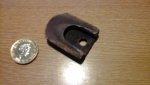
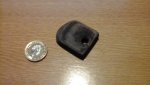
Richard's surface is flat. It may well have had some post print processing as well.

Apparently not. Son explained that the platten of the 3D printer is a polished metal surface so the articles produced have the same polished appearance. Perhaps the polished platten (is that the right word?) can be swapped for a matt finish or something but Son used it as he found it.

He suggested roughening up the black plastic surface with sandpaper but I'm happy with it as it is. The whole car is pretty shiny so why not the insert? :)

Richard
 
Put "plank" into a sentence Stu, almost any sentence, and out will pop a perfect description of Alan. ;)

I assume he's using this serious technical thread to air his inadequacies because all the aggressors on my "Traffic Police" thread on The Lounge have been well and truly battered by yours truly so he certainly isn't going to chance his arm over there. :)

Richard

If you want to justify driving like a prat, go ahead. :p
 
Since these printers lay down 'plastic' in layers, is there a weak potential shear failure waiting in the wings?
I can understand there may be strength, when pushing down onto several layers, but when pushing sideways across the layers, the strength will not be the same, bit like splitting wood along the grain.

The professional 3D printers don't all work by squirting molten plastic.
I used to use one which worked by firing lasers into a tub of liquid chemicals. Where the lasers crossed, the plastic was formed.
We could print things with moving parts.
We prototyped all sorts of brackets, adapters, casings. We also used it for short production runs of things which were complex shapes but didn't need to be very strong. One example was a former to hold a helical coil of wire in shape. If we wanted 500, it would have been worth making a mould for a normal plastic part, but we only wanted about 20, just printed them over night.

Classically, the DIY machines spend a lot of time making parts to replace bits of themselves worn out making the last lot of spares....
 
The professional 3D printers don't all work by squirting molten plastic.
I used to use one which worked by firing lasers into a tub of liquid chemicals. Where the lasers crossed, the plastic was formed.
We could print things with moving parts.
We prototyped all sorts of brackets, adapters, casings. We also used it for short production runs of things which were complex shapes but didn't need to be very strong. One example was a former to hold a helical coil of wire in shape. If we wanted 500, it would have been worth making a mould for a normal plastic part, but we only wanted about 20, just printed them over night.

Classically, the DIY machines spend a lot of time making parts to replace bits of themselves worn out making the last lot of spares....

I’m guessing you’re referring to Stereolithograhy (SLA) that uses a UV laser and UV curing resins? They’re starting to break into the DIY market now, but as you say, the materials are limited. They do however make parts with a much higher resolution, so perfect for patterns.

Personally I prefer selective laser sintering (SLS) for plastics, the surface finish is rougher, but if you know what you’re doing, you can get mechanical properties equal in all three directions. Probably won’t break into the DIY market for some time though.
 
They wouldn't let me near their precious new machine, I just asked them to make things!
I've seen some demo pieces like two working gears in a frame, all printed in one go.
Hi-tech netsuke.
 
Ahem, to return to the OP...

My son bought me a Wanhoe i3+ for my 60th.

Younger son bought me Simplify3D which is the slicer software and they jointly pointed me to Tinkercad, a simple, easy to use CAD site and Thingiverse which is a repository of designs that you can use freely or import into Tinkercad and modify, resize or whatever, even combining different designs to achieve your ends.

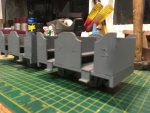
I have only printed in PLA filament but am blown away by the quality, toughness and versatility, in fact I have used it pretty nearly every day to make things from a spare part for an electric mirror mechanism on a VW Golf to a model train, to all sorts of custom boxes, brackets, iPad holder for the boat, phone holders for the cars, toothbrush holder, pumpkins that lit up with LED bulbs for Halloween etc etc.

The i3 retails for about £350 and is superb, I have printed over 4kgms of filament with only two failures so far.

I only use Rigid Ink filament and store it in an airtight container with silica gel to keep it dry.

image.jpgimage.jpg

So, useful? I would say so!

Steve
 
Last edited:
Can these 3D printers be used to make components in Tufnol? This sort of thing, for example:

View attachment 67766 View attachment 67767

I don't think so, Tufnol is a laminate material rather than a (melt-able) plastic that these things need. For Tufnol you would need to machine it from a block, eg on a cnc mill. You can also get small hobby cnc mills capable of doing stuff like tufnol at similar prices (eg £100s rather than £1000s).

edit: that said, that part looks very simple, probably easier to just manually machine it or even do it by hand.
 
Last edited:
Tufnol, no. But is there a reason the part needs to be Tufnol? The shape would be doable on a 3D printer.

You can print in Stainless Steel with the right machine!
 
There are machines that work with laminates, but Tufnol might be a bit 1970s.

TBH you could probably get a small machine shop to knock them out cheaper than they could be printed for
 
I have a lathe and can make it on that but I was interested to know if it could be done on one of these 3D printers. The original is tufnol but any hard plastic capable of standing up to UV would do.
 
To the OP....I have! I followed the trend and I bought an SLA printer with photo sensitive smelly chemicals. It was British made so I won’t mention the name of the firm as I have read some customers had limited success with it. I had none. I wasted a week and ruined a table with the chemical to produce a few unidentifiable blobs. However, ‘ never give up, never surrender’ so I sent it back and bought a creality 3D filament printer at a fraction of the price(300). I was printing in minutes.

It is not an easy, do it all solution(yet) because the printing takes so long and you have to monitor it for jams or filament running out etc etc. There are fixes to make it more autonomous like an internet camera, filament sensor and auto bed leveler but these take time to fit. The Creality is Chinese made and it really did work out of the box and has a reasonable print area. I have made lots of useful stuff and some quite useless; I am half way through a large scale RC Spitfire. I have made dinghy cleats and clips, coachroof fittings and moulds. I believe there is some special filament to use in moulds. Filament is getting better all the time. Nylon is a good choice for boating stuff because it is tough and durable. It is a very useful tool and at about 300gbp with filament from 10gbp for a 0.5kg roll, it is a lot more cost effective than some of my other tools. You do have to use a usb stick, the internet and a 3d modeling program if you want to design your own things. Shapr3D for iPad with an Apple Pencil is an easy start if you have never used one before.
 
If anybody has the same problem........

My son has designed and 3d printed a replacement plastic gear wheel used as part of the anchor chain counter on a fellow forumites windlass. Unfortunately I can't report on the effectiveness of the replacement as said forumites boat has not been out of its berth in the last 12 months to test it!
 
Top