James W
Well-Known Member
It’s not a Westerly this time around. I would have loved an Oceanlord, but finances wouldn’t allow.Are you thinking an Oceanlord?

It’s not a Westerly this time around. I would have loved an Oceanlord, but finances wouldn’t allow.Are you thinking an Oceanlord?


Big boats are not affected as much as small boats, so more leisure time to do things like that.What I notice most on larger boats is the distance to run from the cockpit to anywhere else. In particular the drinks cabinet...
Strangely the wettest boat I have crewed on was, IIRC, 65'. (May have been a bit less.) It just kept going at the same level regardless of the Channel chop.
I would strongly second the idea of getting any line ashore secured asap because once the current or wind starts to take a hand a human will be utterly underpowered.


And they're faster! And they have better accommodation.So true! Bigger boats have more inertia, so respond more slowly. They also tend to be more stable, so are safer to wander about on.


That's a great point, this is definitely a boat to be docked stern to the pontoon. Plenty of reverse practise needed when I get her home.Fenders are your friend - all round the boat so no stress - we have one across the anchor and two big balls at the stern so any mistakes are simply soft nudges. And if it’s a boat like most of the last 20 years that is designed with a step through stern and high topsides then don’t fight the design. Moor in reverse so the step back to the pontoon is at the same level and the wide stern is held in slow reverse against pontoon with fenders while you step off, drop a rope around the cleat at the stern then walk along the finger and take a midline to a mid finger cleat, then bow before putting engine into neutral.
Remember that you will get steerage way far quicker from a standstill if you go out forward and far easier to abandon an approach going from reverse to forward mostion. Coming in you have plenty of steerage anyway.
I don’t mention more sailing complexity as it will be such a great stable platform to work on but do remind crew that forces are far higher so safe winch work needed.

That what have I done feeling!
When aged 14, I sold my cadet and brought an old Merlin Rocket, my thought was, "what have I done!" But I went on to trade up to newer Merlins until I started winning racing, and sailing Merlin was just great fun.
After I graduated and a moved to Scotland I bought a Wayfarer and started cruising around the North of Scotland. On my first offshore cruise around Orkney, I had that "what Have I done feeling", my wife an I cruised the Wayfare for 13 years and enjoyed most of it.
We then traded up to a Jaguar 21, my first sail out of Stonehaven, gave me "that what have I done feeling", it seemed massive after the Wayfarer.
When I got to 50 I could afford to buy a bigger boat, this time a Parker 275, and again, sailing it up from Boston in April, I got the same old "what have I done feeling" much bigger loads, I really needed to use the sheet winches, but we soon got use to it and sailed it up and down the East Coast of Scotland and England for many years.
The next boat was a Dufour 40, quite a leap from the Parker, I sailed it up the west coast from Plymouth to Scotland and rounding Lands End, I got the same old "what have I done feeling" as we set course for Millford Haven, the Dufour proved to be fast and sea kindly boat.
Then when I fully retired I swapped the Dufour for a Southerly 46RS, a much heavier boat than the Dufour, and very comfortable to live on during the summer. As I sailed the Southerly west along the North Coast of Scotland single handed in April in a 25 knots plus ENE wind and had to gybe around Cape Wrath to go south, I got that familiar feeling of "what Have I done"
So from a cadet to a 16 ton Southerly, I've always been very apprehensive , but alway got over it quite quickly.
Now aged 73 , I'm quite happy sailing the Southerly single handed, although I am quite careful about taking on more than I can cope with.
My advice would be, go for it, if you don't push you'll finnish up sitting in an armchair, wishing you had.
How wonderful - we have exactly the same hull but different interior (42.2). Very seakindly but such a different order of reefing needed. Will take you anywhere.? ? ? ?
(Apologies for the drift (sic) but answering a direct question.)Big boats are not affected as much as small boats, so more leisure time to do things like that.
If well fendered both sides, what is the problem?
Why have I never thought of this? What a great idea!Standing in front of the wheel, facing aft, is handy in reverse. Then it really does feel like driving a car.

As discussed above, it has its drawbacks and is not a panacea. You also have to be careful that the first time you have to stop in a hurry you won't inadvertently give it more aft wellie because you are facing the control the wrong way.Why have I never thought of this? What a great idea!
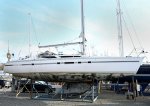
You will love it. Apart from the obvious difference in length, which is not that much but be aware until its automatic.In all likelihood, I'm going to pull the trigger on a 41 footer tomorrow. It's going to be a big step up from my Westerly Storm, but I'm excited and the family are going to love it!!
That said, I'll be the one sailing it most of the time and it's a far bigger boat, no matter how you look at it. It does have furling main and jib though, which helps. Can anyone offer any helpful hints and tips to making that step up? Berthing shouldn't too much of an issue, as my home port has space to make a few mistakes.....but there's no point having a bigger boat and being scared of it, so it would be great to hear your thoughts and experiences.
Thanks!
James