220v electric question

Talking to one and being able to do the job are two different things. 220VAC can and will kill you, or your wife, or one of your kids/grandkids. It isn't just about poking three wires into three terminals, it's the correct wire, in the correct terminal with correct circuit protection etc. Is the few quid you might save worth risking someone getting electrocuted ?
What you say is absolutely correct….however it also applies to changing a tire in the car or servicing an engine or doing a thru hull. This is a DIY forum where people share knowledge to empower others. And all warnings are vitally important. But why not share the knowledge….people come on this forum for medical advice…and legal
 
To be fair, in real terms, you can add a spur to a radial, and you can add a spur to a ring, what you're not supposed to do is add a spur to a spur.
If your protection device is capable of protecting the circuit, all will be fine.
If it's 13 or 16 amp, I'd not worry. Whats more important is that you make a good job of the work. (Good safe connections)
If it's a 32a breaker you need to be a lot more careful. The rules are designed so that....if you do something below par, which is ok because you 'knew' and would behave accordingly, the next person may not, and that's where the issues arise.
How can it be 32A , WITH 2.5 cable, On a radial.
 
I don't know if his wiring is all original, if the breakers are original, MCB's or RCBO's but if it's a 16A protection device with 2.5 mm cable it would suggest it's been done correctly and is possibly original. Thus safer to add a socket because at least the circuit is protected correctly.
However Paul is correct that we may have hit a limit of appropriate help for safety reasons.
I declined to comment on another electrical issue for the same, (it involved fault finding) but here I was thinking, adding 1 socket to an existing radial, in a convenient place was within DIY level if done with care.
 
I don't know if his wiring is all original, if the breakers are original, MCB's or RCBO's but if it's a 16A protection device with 2.5 mm cable it would suggest it's been done correctly and is possibly original. Thus safer to add a socket because at least the circuit is protected correctly.
However Paul is correct that we may have hit a limit of appropriate help for safety reasons.
I declined to comment on another electrical issue for the same, (it involved fault finding) but here I was thinking, adding 1 socket to an existing radial, in a convenient place was within DIY level if done with care.
All the electrics are original.....the only thing added has been a generator.
Originally I was planning to use an extension cord....but I thought that a socket was a more elegant solution
 
Going back a step, all the sockets on this circuit should be protected by a breaker for just that circuit - how many amps is it rated for? That will tell you what protection the circuit has. You will also probably have another breaker that protects the whole boat, that will probably have a larger rating. As long as you use the same gauge wire to connect the new socket to the existing circuit, the existing protection will be OK, providing it was OK to start with . Because it's a fairly new boat and you are the only owner, you can assume there are no other bodge jobs (apart from the fuel tank, passerelle, toilet filter etc 🤣 )
 
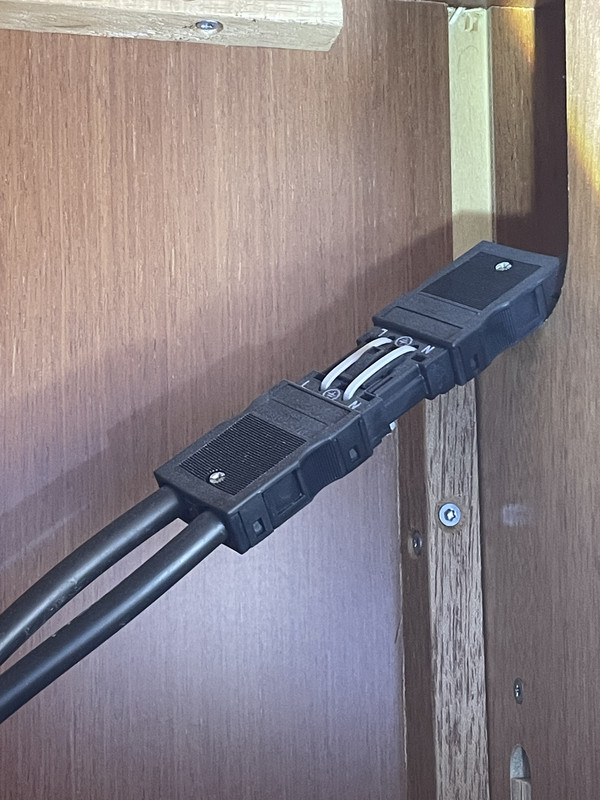
The connector I wanted to use is probably the one that goes to the next socket

If I was doing it I would likely just pull off the spare port on the Winsta and run a 2.5mm2 HO7RN-F cable to the new socket.

That would make it almost factory.

That connector will come apart if you snip the cable ties.

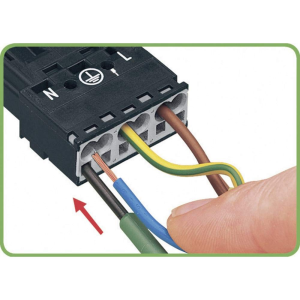
Inside it looks like this, you can just push your new wires into the spare ports.

The wago winsta connectors are really cool if you are a socket connoisseur

1776702831384.png
 
Last edited:
Going back a step, all the sockets on this circuit should be protected by a breaker for just that circuit - how many amps is it rated for? That will tell you what protection the circuit has. You will also probably have another breaker that protects the whole boat, that will probably have a larger rating. As long as you use the same gauge wire to connect the new socket to the existing circuit, the existing protection will be OK, providing it was OK to start with . Because it's a fairly new boat and you are the only owner, you can assume there are no other bodge jobs (apart from the fuel tank, passerelle, toilet filter etc 🤣 )
I see you are a connoisseur of my past exploits.....all became first class solutions by the way... I just took my time🤣😂. as I can do for this job.....if the forum got their heads out of their arses. Good information by the way
 
If I was doing it I would likely just pull off the spare port on the Winsta and run a 2.5mm2 HO7RN-F cable to the new socket.

That would make it almost factory.

That connector will come apart if you snip the cable ties.

Inside it looks like this, you can just push your new wires into the spare ports.

The wago winsta connectors are really cool if you are a socket connoisseur

View attachment 209648
That was what I was hoping for....thanks for that....and also the name of the connectors which will help in my research 👍
 
That was what I was hoping for....thanks for that....and also the name of the connectors which will help in my research 👍

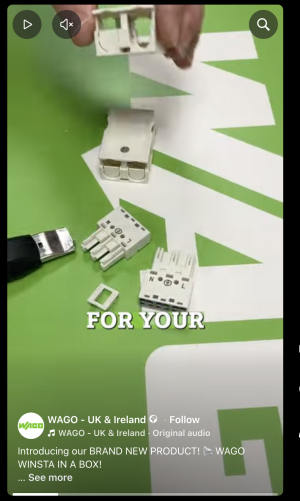
here you go
yours are the midis
you don't need the fancy tool, a suitable flat blade screwdriver will release them. the wires should be ferruled first ideally.

 
Have you extended the wiring @Bouba , used an extension lead or still giving detailed thought on the matter :D
I have been doing sporadic work on the boat…the extension cord has been in use for a while. Putting a socket in will probably happen soon…you will all be kept in the loop 😃
 
Top