2 v 3 HP.

Hull speed is hull speed ?
Ok. Perhaps that's it. !
Speeds achieved.
Johnson 2.5 HP , 10.1 kmph.
2 HP dt2 9.25 kmph.
Yamaha 3 Malta 8.7 kmph.
These differences are marginal but , but it's strange the biggest HP was the slowest. ?
 
Last edited:
Propeller pitch ... flat out both engines will move the same amount of water at the same speed. (Max rpm will be the same, propeller pitch will be the same.)

When you bring resistance into play, in displacement mode, the larger engine may manage a bit more speed on a heavily laden boat, otherwise, if both are capable of hull speed then they will both reach the same speed flat out. If one has enough power to get on the plane and the other not, then the difference will be dramatic, but usually, if you can't get on the plane, you can throttle back and still travel at almost the same speed, but with far better fuel economy. Climbing over the bow wave to get on the plane requires a large jump in engine power.
 
It is the propeller that moves the boat not the engine HP The trick with these low HP engines is getting the propeller matched to the engine and the boat. There is so little HP to play with and a mismatch can make a big difference in performance.

All of those speeds are above the theoretical hull speed of your dinghy and reflect the difference in thrust from the propeller on different engines.

You seem obsessed with speed on a boat/engine combination where speed is not the design objective. The differences are marginal and I expect you would find similar differences in 2 examples of the same model/hp engine. Equally changes in other variables - wind, weight/trim will likely show similar variations.
 
These differences are marginal but , but it's strange the biggest HP was the slowest. ?
But actually your speeds are all within 10% of the average. I'd be quite surprised if the measurement technique of someone throwing 3 different outboards on the back of a small inflatable was really robust enough to be certain which was really faster.
 
But actually your speeds are all within 10% of the average. I'd be quite surprised if the measurement technique of someone throwing 3 different outboards on the back of a small inflatable was really robust enough to be certain which was really faster.
Moving the owner’s backside a few inches might easily make more difference.
 
Are DT2's rated at the propeller rather than the flywheel.
Click image for larger versionName:    image.jpgViews:    647Size:    201.0 KBID:    89555

The first Tohatsu's had their horsepower rated at the prop - the 5hp was as good as a Mercury or Johnson 6hp - they also had stainless steel props
 
Are DT2's rated at the propeller rather than the flywheel.
Click image for larger versionName:    image.jpgViews:    647Size:    201.0 KBID:    89555

The first Tohatsu's had their horsepower rated at the prop - the 5hp was as good as a Mercury or Johnson 6hp - they also had stainless steel props
Rating hp at the prop is largely meaningless as a comparison unless both engines are measured the same way. So the Tohatsu may well have the same hp at the flywheel as the others. The model figures are only a guide to indicate what sort of boat they are suitable for. The figure that matters is thrust and that is a function of matching the propeller to the engine and gear ratio.
 
Rating hp at the prop is largely meaningless as a comparison unless both engines are measured the same way. So the Tohatsu may well have the same hp at the flywheel as the others. The model figures are only a guide to indicate what sort of boat they are suitable for. The figure that matters is thrust and that is a function of matching the propeller to the engine and gear ratio.
And the speed you expect the boat to achieve, of course. We’re talking about inflatables here, probably non planing. Theoretically you’d want peak power at 5-6kn, plus an allowance for slip. We have a 15 on our tri, with a 5.5in pitch. We are ‘geared’ by the prop to a max 8kn.
 
Rating hp at the prop is largely meaningless as a comparison unless both engines are measured the same way. So the Tohatsu may well have the same hp at the flywheel as the others. The model figures are only a guide to indicate what sort of boat they are suitable for. The figure that matters is thrust and that is a function of matching the propeller to the engine and gear ratio.
Of course
 
Ok. Perhaps that's it. !
Speeds achieved.
Johnson 2.5 HP , 10.1 kmph.
2 HP dt2 9.25 kmph.
Yamaha 3 Malta 8.7 kmph.
These differences are marginal but , but it's strange the biggest HP was the slowest. ?


So they all do about 5 knots, and I wonder if anyone could actually tell the difference without measuring it.

More to the point, does it actually matter, unless one is racing inflatables?

(I'd be more concerned about the relative weight of the different outboards for convenience in manhandling them, and whether or not they have a neutral and/or reverse.)
 
So they all do about 5 knots, and I wonder if anyone could actually tell the difference without measuring it.

More to the point, does it actually matter, unless one is racing inflatables?

(I'd be more concerned about the relative weight of the different outboards for convenience in manhandling them, and whether or not they have a neutral and/or reverse.)
The extra bit of speed enhances the experience on the water. Also better to have a bit more power with 2 up. I still don't understand how a 3 HP performs worse than a 2 HP. In car terms it's like a 1.5 litre performing poorer than a 1 litre. ! All the parameters were equal, wind, weight, etc.
 
The extra bit of speed enhances the experience on the water. Also better to have a bit more power with 2 up. I still don't understand how a 3 HP performs worse than a 2 HP. In car terms it's like a 1.5 litre performing poorer than a 1 litre. ! All the parameters were equal, wind, weight, etc.
We have already explained that the POTENTIAL hp of the powerhead is not a good guide to performance on a boat, particularly of this type of boat where speed is not important. It is the propeller that pushes the boat, not the engine, and there are engines with lower rated HP (or KW) such as some of the electric outboards that will outperform your 3hp outboard simply because their propeller is designed for these low speeds.

Not sure how one can get excited about 10kph, nor tell the difference between 9 and 10.

The comparisons between cars are equally nonsense . Not only are the power differences real but all things being equal but they show in the way the extra power is converted into speed.
 
. . .
I still don't understand how a 3 HP performs worse than a 2 HP. In car terms it's like a 1.5 litre performing poorer than a 1 litre. ! All the parameters were equal, wind, weight, etc.


It has already been explained that the gearing/size/pitch of the prop is critical. (For example, most 5hp or so outboards are expected to be driving small lightweight dinghies and ribs, but lower geared/propped versions (often with long shafts) are also sold for use driving small yachts.)

An outboard which has an over-pitched/geared prop for the particular boat & load may never reach the revs at which it develops its maximum power, and be beaten by an outboard with lower rated power which can.

Conversely, an under-pitched prop may exceed its peak power revs before a speed which a higher 'geared' but lower powered outboard can reach.

In car terms, a lower powered car may easily beat a higher powered car up a hill if the latter is labouring in top gear while the lower powered one has an appropriate lower gear selected, or if the higher powered one is stuck in first gear.

The extra bit of speed enhances the experience on the water.

If you can actually tell the difference between those speeds and that is important to you, then simply buy the fastest one and don't worry about the rated output.
 
The extra bit of speed enhances the experience on the water. Also better to have a bit more power with 2 up. I still don't understand how a 3 HP performs worse than a 2 HP. In car terms it's like a 1.5 litre performing poorer than a 1 litre. ! All the parameters were equal, wind, weight, etc.
Difference between a 1.5 litre VW and a 1litre Formula 3.
 
I can't blame Munster1967 for wondering about this, it's a foggy area to me, too. The fact that there are tiny and not-so-tiny outboards makes one hope that using the bigger one will inject some fun rather than just being better than rowing.

I was told by the engineers at Fairweather that my 3.5 two-stroke hadn't been revving properly when I took it in for servicing. I hadn't realised, I simply hadn't known how much grunt it ought to deliver. I hope I'm going to enjoy finding out, now it's fixed.

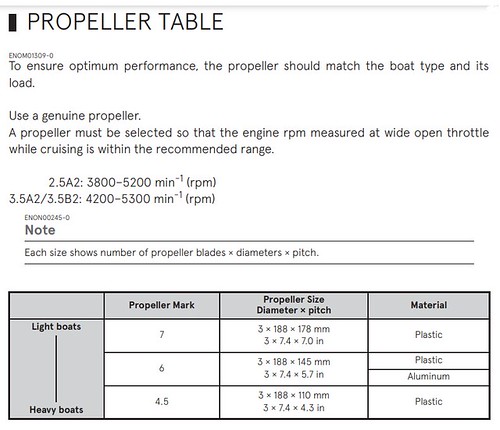
But looking at Tohatsu's propeller table (below) for their 3.5hp and 2.5hp two-strokes, and the similarity in their rev ranges, I wonder what sort and weight of hull (which might be considered suitable for such a small o/b) would actually reflect the extra power of the bigger motor, with higher speeds?

53969856980_b6248ee806.jpg


It sounds as if it's a case of less always being more. :cautious:
.
 
I can't blame Munster1967 for wondering about this, it's a foggy area to me, too. The fact that there are tiny and not-so-tiny outboards makes one hope that using the bigger one will inject some fun rather than just being better than rowing.

I was told by the engineers at Fairweather that my 3.5 two-stroke hadn't been revving properly when I took it in for servicing. I hadn't realised, I simply hadn't known how much grunt it ought to deliver. I hope I'm going to enjoy finding out, now it's fixed.

But looking at Tohatsu's propeller table (below) for their 3.5hp and 2.5hp two-strokes, and the similarity in their rev ranges, I wonder what sort and weight of hull (which might be considered suitable for such a small o/b) would actually reflect the extra power of the bigger motor, with higher speeds?

53969856980_b6248ee806.jpg


It sounds as if it's a case of less always being more. :cautious:
.
Thank you. For understanding my enquiry. 🙂
 

Other threads that may be of interest

Top