2 Stroke Outboard Best Practice?

Tim Good

Well-Known Member
Joined
26 Feb 2010
Messages
2,893
Location
Bristol
Visit site
Ok so I’m the proud new owner of a Yamaha 5hp 2 Stroke (5CMH). It’s in very good condition and want to keep it that way! Are there any things I should know about having never owned a 2 stroke before.

For example do I need to be anal about running the carb dry after each use?

Should I empty the tank entirely if leaving it laid up for more than 3 months?

What’s the best pre mix ratio?

Can I lie it down on both sides, unlike a 4 stroke?

Anything else?
 
Buy a service manual and some carburettor cleaner and watch a few vids on how to clean the carb . Yes you can lie it how you like if the fuel tap has been turned off . Ratio should be in owners manual or ask a dealer ? By all means empty tank in winter months as fuel goes off but always still seems to work ok in lawnmower so Hayters don’t mind it if mixed with normal fuel.
 
As above.
Don't bother running the carb dry after each use but there is a good chance it will gum up if you leave it over the winter. For long engine life use 50 to 1 even if it says 100 to 1.
 
Our outboard is in daily use for many months so different situation to occasional use. I don't run dry after every use, only if leaving for some weeks and then I flush it through with fresh water first. I've always left tanks with fuel in but made sure the fuel cap breather is closed. Most 2 strokes run well on 50:1 fuel mix and I never followed the 100:1 which Yamaha suggest for some engines. As ashtead suggests, get the manual.
 
Ok so I’m the proud new owner of a Yamaha 5hp 2 Stroke (5CMH). It’s in very good condition and want to keep it that way! Are there any things I should know about having never owned a 2 stroke before.
For example do I need to be anal about running the carb dry after each use?
Should I empty the tank entirely if leaving it laid up for more than 3 months?
What’s the best pre mix ratio?
Can I lie it down on both sides, unlike a 4 stroke?
Anything else?

Firstly get yourself an owners manual.

This one applies to your engine I believe: YAMAHA 5C OWNER'S MANUAL Pdf Download.

You do not need to run the carb dry after every use but it is not a bad idea if you are not going to use again for several days and certainly if it might not be used again for several weeks, For long periods of non use drain it completely via the drain plug if that is possible.

Petrol keeps best in full, airtight metal cans in a cool place. The object being to minimise contact with air, exposure to light and loss of the more volatile fractions. (Refueller , who is the forum fuels expert will agree with this)
Empty the tank when laying up.
I always filter petrol which has been stored for more than a few months and mix it 50:50 with fresh before using it.

ITYWF that the fuel mixture specified is 100:1 but that is hardly enough oil. 50: is usually recommended for engines which will be used commercially or worked hard. If it runs happily on 50:1 use that mix. If you find it tends to foul the spark plug if used gently / at slow speeds try 75:1.
Use a TCW3 2 stroke outboard engine oil. Any brand certified as TCW3 will be fine. Quicksilver is readily available in chandlers. No need to use a high performance oil.

You can lay it down any way except upside down but best not resting on the gear shift lever.

Before you use it drain and refill the gearbox with an outboard gear oil . If the old oil is milky or there are any signs of water the gearbox seals probably need replacing.

Also change the water pump impeller unless you know for certain that it has been changed recently.

The owners manual describes most of the routine servicing but there is a workshop manual at http://www.boatinfo.no/lib/yamaha/manuals/1984-1996yamaha.html#/0 which you may find useful for tasks not described in the owners manual.
 
I have always used 2 strokes, but unlike others I always run the carb dry. I turn the fuel off 100 or so yds from landing point then leave the engine running until it stutters to a stop. I've never used any carb cleaner.
I mix my fuel accurately 3ltrs at a time 100:1 and have never in 40 years had a fuel / starting problem.
I never worry about old mixed fuel, just give it a good shake before filling the tank.
No problem laying engine down on sides or plug down, but at home I leave the engine stood upright on its skeg.
 
BTW if you are looking to get some practice in for 2 stroke carb cleaning I’m sure many forumites would welcome the offer . I did wonder if anyone offered a day course on 2 stroke outboards?
 
IMO running the carb dry is a bad idea. It's not the same as draining the carb when being stored. You will always have some fuel left in there. Easy test. Run the carb dry, then take it apart. I bet you end up with fuel covered hands and a small mess to clean up.

Having less fuel in the carb is more likely to lead to evaporation and it getting gummed up.

My Yamaha also calls for 100:1 mix. Interestingly the engine had made for some 30 years without changes. So it was designed for 50:1. Obviously it can handle 100:1 no problem but I err on the side of caution and use about 75:1
 
OK ... most of above I can agree with ....

Here's my GoTo and I have five 2str outboards that run sweet as anything even though three of them are 1980's ...

1. If I am using the o/bd frequently that day ... say fishing on the river ... I use the stop button and don't bother about carb being full.
2. If I am not using the engine frequently that day and expect it to sit till next day or more - I always run the carb dry. I have too many examples of pulling that start cord till blisters on hands from carb left full at end of run. I turn of the fuel or pull the fuel pipe of if a separate tank. Leave engine running at mod fast idle ... let it stop on its own. When restarting few squeezes of the fuel bulb till its hard ... 2 or 3 pulls on cord and I'm away.
3. Fuel ? As VicS says above ... airtight container in cool dark place is best storage. The worst enemies of gasoline are :
Heat
Oxygen
Light
4. As regards old fuel left in tank ? I have never had trouble with this and my engines with integral tanks often sit all winter with a small amount in their tanks. All I do is mix fresh fuel in with it and away they go. I am of the opinion that most people have trouble with old fuel - not from the fuel - but leaving carbs with fuel in.
5. I use 50:1 in all my o/bds and I make sure its TW rated for water cooled engines. TA if air cooled. This is not such a problem now as most brands of 2T oil have a dual version .... I ignore the odd 100:1 basically as they were to counter the pressure to stop 2str's trying to make them more environmentally acceptable ...
6. I lay my 2str's down anyway they 'fall' literally except upside down prop above engine of course !!

I love my 2str's ...... cannot imagine ever wanting a 4str ....

2str lighter, more compact ... easier for me in my old age !!
 
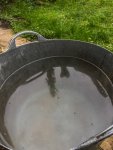
So based on advice I’ve filled a bucket and run it up to use up any fuel in the carb. Look at the bucket of water! Horrible!

Is this normal for all 2 strokes!
 

Attachments

  • 234E005A-70D0-40B3-8944-A4355953B6E1.jpeg
    234E005A-70D0-40B3-8944-A4355953B6E1.jpeg
    138.6 KB · Views: 33
oil film on water is TOTALLY normal . I would be more worried if it wasn't there as that means there is NOT enough oil in the system and you are damaging the engine.
I too have used a lot of 2 strokes particularly Yamaha / MARINER 5C'S . if used daily just press just the stop button, remove fuel line and cap fuel point at the engine.

If to be left 2 -3 days remove fuel line just off shore but stop on button after 10 sec or so.

Longer than that remove fuel line and run it till it stops.

I will store fuel over winter ( even in Norway ) but like to add fresh to the tank at the start of the season.

Regards Clive
 
Just a word on starting. I never pull the cord hard. I use full choke, leaver to start position then it normally (from empty carb) takes about 6-7 gentle pulls for the fuel to get through and start. The first 3 pulls are quite difficult whilst waiting for the bore to lubricate then the pull becomes quite smooth.
 
So based on advice I’ve filled a bucket and run it up to use up any fuel in the carb. Look at the bucket of water! Horrible!

Is this normal for all 2 strokes!
I wouldn't run the thing under no load to use up fuel. That may lead to plug fouling. I think it's better to simply turn off the fuel before you reach your destination. It's enough to reduce the amount of fuel in the carb. Carry a paddle and learn how far your boat goes at say 1/3 throttle before it conks out.
Learn how to drain and clean the carb.
Drain it if you expect to store it for more than a couple of weeks.
Drain it and let a little fuel run through if the damned thing won't start. Collect the fuel that runs out in a container, I use a foil tray, and look for water or gunge.
Buy a spare spark plug and carry it with a few tools.
 
I'm curious about the idea that leaving the carburettor full may lead to less evaporation and gumming up as in #9. Personally, I think that the advantage of having an empty chamber and being able to lay the motor down makes running it dry an easier option. I no longer have a 2-stroke, but I became very adept at judging the point of approach to our home pontoon where I could turn the fuel off. Since this was only needed when leaving the boat each weekend, it was always the same spot.
 
I'm curious about the idea that leaving the carburettor full may lead to less evaporation and gumming up as in #9. ...
There may be something in it, if leaving the motor unused for just a short time. The fuel in the carb will lose the same mass of volatiles, but what remains will mix with fresh fuel OK when you turn the tap back on. A thin layer of fuel at the bottom of the carb would have dried out completely? Leaving a varnish which doesn't dissolve easily? Maybe..

I've always thought the best thing is to use the engine frequently. If it was running 3 days ago, it will run today.
 
There may be something in it, if leaving the motor unused for just a short time. The fuel in the carb will lose the same mass of volatiles, but what remains will mix with fresh fuel OK when you turn the tap back on. A thin layer of fuel at the bottom of the carb would have dried out completely? Leaving a varnish which doesn't dissolve easily? Maybe..

I've always thought the best thing is to use the engine frequently. If it was running 3 days ago, it will run today.
I think that part of the suggestion was also that the smaller volume of air above the fuel would actually lead to less evaporation, as well as reducing the risk of drying out.
 
Hi! I’m new here (and from Belgium), please be kind with me (and some approximations in my English) ;)
I usually run the carb dry, unless I use it again in the same day. And if I forget to dry, I must admit I can’t run it easily the next day...
I was surprised nobody talk about fuel quality and ethanol share. But it seems that’s that E10 fuel (i.e. fuel with 10% ethanol instead of usual 5%) is not yet common in the United Kingdom. Right?
I must say that I have much more problems with E10 fuel, perhaps also because my engine is old (2002). As in Belgium or France you have the choice between 95E10 and 98E5 fuel, I choose the second one every time it possible.
 
Last edited:
Top