
1999 johnson/tohatsu not cooling

stu9000

Well-Known Member
Joined
8 Mar 2008
Messages
930
Location
near kingston upon thames, surrey
Visit site
Hi
I am getting to know this outboard well.
1999 johnson J2REEC. 99
I think this tohatsu is the same. I'm looking at the 2.5 version without a gear shift, not the 3.5 with a gear shift.
https://www.tohatsuoutboardparts.co...2.5A2-3.5A2-3.5B2 (1998) - (002N21040-3).pdf
She starts beautifully but only spits out water intermittently, which becomes steam, so I'm assuming there is a blocked channel.
I changed the Impeller behind the prop as seen in te fig 6 diagram on p27
Poking with a wire at the top didn't help so I took the cylinder head off to clean out the water jacket. Quite pleased with my efforts as I had to. Drill out a broken bolt and managed it without drama.
It was fairly salted up so I was hopeful, but I I'm still not getting a good flow.

The thin pipe no 15 looks like a possible choke point but I have sheared the head off bolt 17.
Any tips on clearing this pipe without taking the whole leg to bits?
Thanks
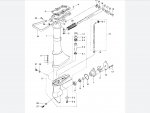


Screenshot_20200207-232004.jpg
 
On the 2 strokes that I've done, cleaning the channels around the cylinder is only half the story. The waterways in the crankcase/leg joint are almost as hot and so fur up nearly as much as the (hotter) cylinder head area. The pipe is normally cold and far less susceptible to the evaporation which is what leaves the salt etc behind. How bad was the stuff around the cylinder? 1/2 full or more?
 
Hi
I am getting to know this outboard well.
1999 johnson J2REEC. 99
I think this tohatsu is the same. I'm looking at the 2.5 version without a gear shift, not the 3.5 with a gear shift.

Thanks

I think you will find that it will be necessary to remove the power head from the exhaust housing to clean the water channels between them. You may be able to flush the water tube through without removing it.

There is no need to look at Tohatsu parts diagrams.
You will find the official parts diagrams and lists for J2REEC on the BRP parts website http://epc.brp.com/Index.aspx?lang=E&s1=3a91a7cb-3169-4d1f-bcdc-118fb3dd2202
(Select Johnson from the drop down list , then 1999, then 2hp and finally the model number)
This will give you the correct part numbers, but always quote the model number when ordering parts

The engine should be covered by the (Seloc) workshop manual on the Boatinfo website Boatinfo - 1990-2001 Evinrude Service manual
 
Last edited:
Hi
Not too familiar witr this particular model and maybe not so sure it’s the same as the thoatsu either. That’s a merc engine for sure. Haven’t heard of Johnson having anything to do with merc. May be wrong though. All I do know is that some of these smaller engines of that nature don’t produce a steady stream out the tell tale like that of anything expected from like a 4hp and upwards. They tend to show a interrupted dribble at best and usually have the most of their cooling water flow exit below the water line. That said, steam and lots of it is never clever. Worth considering the above though. Feel for excessive heat on the head and you’ll know what’s going on.
 
Hi
Not too familiar witr this particular model and maybe not so sure it’s the same as the thoatsu either. That’s a merc engine for sure. Haven’t heard of Johnson having anything to do with merc. May be wrong though. All I do know is that some of these smaller engines of that nature don’t produce a steady stream out the tell tale like that of anything expected from like a 4hp and upwards. They tend to show a interrupted dribble at best and usually have the most of their cooling water flow exit below the water line. That said, steam and lots of it is never clever. Worth considering the above though. Feel for excessive heat on the head and you’ll know what’s going on.
Mercury and Johnsons are both basically Tohatsu. Look at the parts diagrams and you'll see they are the same with perhaps just a few minor differences,

Steam as you say is never clever. Steam instead of water from the tell tale is a sure indication of overheating due to lack of water flow.
 
On the 2 strokes that I've done, cleaning the channels around the cylinder is only half the story. The waterways in the crankcase/leg joint are almost as hot and so fur up nearly as much as the (hotter) cylinder head area. The pipe is normally cold and far less susceptible to the evaporation which is what leaves the salt etc behind. How bad was the stuff around the cylinder? 1/2 full or more?
Cylinder jacket was pretty bad. Not 100% clogged but not far off. Half full. Clearly i need to have a good look at the leg today.
 
I think you will find that it will be necessary to remove the power head from the exhaust housing to clean the water channels between them. You may be able to flush the water tube through without removing it.

There is no need to look at Tohatsu parts diagrams.
You will find the official parts diagrams and lists for J2REEC on the BRP parts website http://epc.brp.com/Index.aspx?lang=E&s1=3a91a7cb-3169-4d1f-bcdc-118fb3dd2202
(Select Johnson from the drop down list , then 1999, then 2hp and finally the model number)
This will give you the correct part numbers, but always quote the model number when ordering parts

The engine should be covered by the (Seloc) workshop manual on the Boatinfo website Boatinfo - 1990-2001 Evinrude Service manual

Much appreciated Vic.
 
Cylinder jacket was pretty bad. Not 100% clogged but not far off. Half full. Clearly i need to have a good look at the leg today.
Prepare for more snapped bolts, but 'cracking' them and working back and forth a few degrees can help break down the corrosion that's gripping them, as can easing or thin oil as soon as you can get it in.
 
I had exactly the problem you have got, on my Mercury 2.5hp 2 stroke. Steam from the tell tale but no water stream a couple of weeks ago.
As you have done I managed to take the cylinder head off and clean the water channels which were almost completely blocked. I was expecting to see a good flow after doing this but still only steam. I managed to take the leg off after shearing one bolt (5.6 I think in the diagram). I then blew up the water pipe (15) with an air compressor which obviously dislodged something as after reassembly all working well with a good flow of water from the tell tale.
So it would appear that pipe 15 is a likely blockage point.
Hopefully you have enough thread left on bolt 17 to unscrew it - putting two nuts on the thread tightened together worked for me after heating the thread with a blow lamp.
Good luck - its very satisfying seeing that stream of water again!!
 
Last edited:
Spent all day on it today.
Several snapped bolts that had to be drilled out, blow torched, sworn at, rethreaded and so on.
But I got it working.
I had to drop the lower part of the leg and then squirted hose water through from the hole in the side of the jacket.
As you say Coveman. Very satisfying.

Thanks for the tips.
 
Last edited:
What ever happened to the old ways of sticking the outboard minus prop in a big bucket of Fernox Central Heating Descaler / cleaner ?

Only asking ....

But OP's post has reminded me of a Johnson Twin I bought many years ago that days after buying (2nd hand) - the water tell tale stopped and nothing I could do to get it going again. Gave it to Fareham Outboards - they found the waterways in the leg had corroded and literally fallen away as powder. We considered inserting a pipe to replace ... but in the end I sold it as spares.
 
What ever happened to the old ways of sticking the outboard minus prop in a big bucket of Fernox Central Heating Descaler / cleaner ?

Only asking ....

But OP's post has reminded me of a Johnson Twin I bought many years ago that days after buying (2nd hand) - the water tell tale stopped and nothing I could do to get it going again. Gave it to Fareham Outboards - they found the waterways in the leg had corroded and literally fallen away as powder. We considered inserting a pipe to replace ... but in the end I sold it as spares.
Fernox is Sulphamic acid, outboard engine parts are generally an alloy with a high Aluminium content. I wouldn't use it in mine.
 
Fernox is Sulphamic acid, outboard engine parts are generally an alloy with a high Aluminium content. I wouldn't use it in mine.


You may question it ... but it was a commonly used method to descale waterways in outboards in the past ... with a generous run in fresh water after to clear the descaler itself out.
You think that all domestic boilers are Cast Iron ??
 
  • Like
Reactions: RMC
You may question it ... but it was a commonly used method to descale waterways in outboards in the past ... with a generous run in fresh water after to clear the descaler itself out.
You think that all domestic boilers are Cast Iron ??
Well, history may prove me wrong, but not wanting rotted out waterways I still won't be using it in my engines.

No idea on boilers.
 
Well, history may prove me wrong, but not wanting rotted out waterways I still won't be using it in my engines.

No idea on boilers.
While much less corrosive than strong acids such as hydrochloric acid sulfamic acid should be used with caution on aluminium alloys and galvanised surfaces.
 
While much less corrosive than strong acids such as hydrochloric acid sulfamic acid should be used with caution on aluminium alloys and galvanised surfaces.

Which is why after use - the motor is run in fresh water to wash out the descaler.

Blimey - if rinsing is so hard - then stop using Oxalic Acid on GRP .... and many other corrosive agents on jobs ...
 
Which is why after use - the motor is run in fresh water to wash out the descaler.

Blimey - if rinsing is so hard - then stop using Oxalic Acid on GRP .... and many other corrosive agents on jobs ...

What's the problem with oxalic acid on GRP? I had not realised there was one.
 
Top