
1974 Hull Materials

Sea badger

Member
Joined
24 Aug 2009
Messages
39
Visit site
Hello

I'm trying to understand the materials used in the construction of my Contessa 26 (1974). I'm in the middle of a repair to the bow. See photo below.

From what I can see, the order of the layup is as outlined below:-
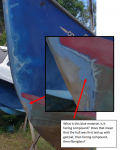
  1. Glass Matting. Assumed used with Polyester Resin.
  2. Then there is what looks light blue fairing material, shown by the red arrow in the photo.
  3. Then what looks like gelcoat.
  4. Then what looks like copper coat
Does anyone know what the blue material shown by the red arrow is? I need to understand, so that I can make sure I use the correct material to make the repair.

CO26 Hull.PNG
 
No idea, but the lay-up starts from the outside normally, so there's gelcoat, then mat. The blue stuff in your photo could be the result of a previous repair - in around 50 years a repair might be likely. There's certainly no reason to use a fairing compound after gelcoat has been put in the mould.
 
No idea, but the lay-up starts from the outside normally, so there's gelcoat, then mat. The blue stuff in your photo could be the result of a previous repair - in around 50 years a repair might be likely. There's certainly no reason to use a fairing compound after gelcoat has been put in the mould.
I'm starting to think that in 1974 the fiberglass hull may have been moulded without gel coat. Then the bare fiberglass hull faired and then gel coated after the bare fiberglass hull has been pulled from the mold. I don't think the material in question is part of a repair, as it on every section of the hull I have worked on so far.
 
Could be that it’s been painted at some time and the material indicated by the red arrow is the original (faded) gel coat
Could be, but there is gel coat and paint above it. But it's possible. The material in question doesn't feel like gel coat. It's not soft, but a little less solid that gel coat.
 
I'm starting to think that in 1974 the fiberglass hull may have been moulded without gel coat. Then the bare fiberglass hull faired and then gel coated after the bare fiberglass hull has been pulled from the mold. I don't think the material in question is part of a repair, as it on every section of the hull I have worked on so far.

This would definitely not be the way the hull was made, Gel coat would have been applied to the mould before lay-up, gel-coat will not set in air, it remains tacky, and it's shiny surface is achieved from the polish of the mould.
If you want to learn the system of grp production, have a look at the book 'Fibre Glass Boats' by Hugo Du Plessis, it's a gold mine of information on grp.
 
Last edited:
I'm starting to think that in 1974 the fiberglass hull may have been moulded without gel coat. Then the bare fiberglass hull faired and then gel coated after the bare fiberglass hull has been pulled from the mold. I don't think the material in question is part of a repair, as it on every section of the hull I have worked on so far.
That is not correct at any time in the 70s an probably not for a while earlier.
 
Hello

I'm trying to understand the materials used in the construction of my Contessa 26 (1974). I'm in the middle of a repair to the bow. See photo below.

From what I can see, the order of the layup is as outlined below:-

  1. Glass Matting. Assumed used with Polyester Resin.
  2. Then there is what looks light blue fairing material, shown by the red arrow in the photo.
  3. Then what looks like gelcoat.
  4. Then what looks like copper coat
Does anyone know what the blue material shown by the red arrow is? I need to understand, so that I can make sure I use the correct material to make the repair.

View attachment 119607

Are you sure that the light blue is not the original deeper blue gelcoat where you've sanded it making it appear lighter colour. So maybe you've got lay-up, Blue gelcoat, Grey primer paint then a top coat maybe two pack paint.
If you're sure the top layer is gelcoat and not paint then its a mystery but I don't think it matters at this stage. Whatever it is, it's had gelcoat on top of it before so go ahead and apply your colour matched gelcoat and finish it off.
What other options have you got.
 
Just call here jeremyrogers.co.uk Jeremy who built your boat is still building boats and will tell you exactly how your boat was built. However, I am with those who say the light blue is probably the original gel coat.
 
There seems to be some desire to use the same materials as originally used for repairs. This is not a good idea. Polyester is a wonderful resin when the boat is built because subsequent layers of resin will chemically bond if done in the right time frame. ie when the first layer is soft not cured. Years later polyester resin is quite inert. More polyester resin will only stick by mechanical adhesion. ie into the imperfections in the surface. The fact is epoxy resin is far better at this mechanical adhesion.
So far better to repair with epoxy. You should grind off the colored layers to get the best adhesion to glass itself. Finish the repair with filler then paint to stop UV damage.
ol'will
 
Are you sure that the light blue is not the original deeper blue gelcoat where you've sanded it making it appear lighter colour. So maybe you've got lay-up, Blue gelcoat, Grey primer paint then a top coat maybe two pack paint.
If you're sure the top layer is gelcoat and not paint then its a mystery but I don't think it matters at this stage. Whatever it is, it's had gelcoat on top of it before so go ahead and apply your colour matched gelcoat and finish it off.
What other options have you got.
Ive had a good look this afternoon. I think the top layer is paint. So you are probably correct.
 
There seems to be some desire to use the same materials as originally used for repairs. This is not a good idea. Polyester is a wonderful resin when the boat is built because subsequent layers of resin will chemically bond if done in the right time frame. ie when the first layer is soft not cured. Years later polyester resin is quite inert. More polyester resin will only stick by mechanical adhesion. ie into the imperfections in the surface. The fact is epoxy resin is far better at this mechanical adhesion.
So far better to repair with epoxy.
You are quite right that epoxy sticks to cured polyester a lot better than polyester sticks to cured polyester. However, polyester sticks quite nicely to epoxy, so a good cost effective solution can be made by using one layer of epoxy and then polyester. Mind you, the material costs aren't all that different, so it may just be easier to use epoxy all the way through.

Ive had a good look this afternoon. I think the top layer is paint. So you are probably correct.

Although many GRP structures are gelcoat coloured, it doesn't have to be like that. All Reliant cars, for example, were made with grey gelcoat and then painted.

The only GRP structure I have met (there will be others!) without gelcoat were prototype glider fuselages, made on a positive mould and then very, very carefully faired, filled, polished and painted. A very slow process, and only worthwhile for one-offs.
 
Ive had a good look this afternoon. I think the top layer is paint. So you are probably correct.
There is nothing unusual about your hull, except the paint which is probably a long time after moulding and applied either because the then owner fancied a change in colour or the original had faded. There is equally nothing unusual about carrying out repairs and plenty of guidance on line on how to do it. More common now to use epoxy rather than polyester for both laminating and filling for the reasons mentioned by a number of posters. The biggest challenge in repairs above the waterline is matching the colour of the final finish, whether it be gel coat or paint. Dark blue is one of the more difficult colours. Copperccoat is relatively easy to apply in small areas using a small volume repair kit from AMC. Sensible to overlap the surrounding sound coating, although you might find even when immersed the colour does ot match because of variation in the amount of copper in the mix. Doe not affect function.
 
I'm starting to think that in 1974 the fiberglass hull may have been moulded without gel coat. Then the bare fiberglass hull faired and then gel coated after the bare fiberglass hull has been pulled from the mold. I don't think the material in question is part of a repair, as it on every section of the hull I have worked on so far.
A lot of 2020s boats are faired and sprayed after removal from the mould so can’t see any reason it wouldn’t have happened in the 1970s to get a better finish. At the boat show it’s pretty obvious which are straight from the mould as they’re quite wavey whereas the faired ones are like a flat mirror.
 
Top