1974 Hull Materials

The metal moulds I saw were machined out of aluminium billets, 7.5m long, 1m wide and about 30cm deep. One side got the wing shape (top/bottom, left/right) and the other was largely cut away to leave a webbed supporting structure in order to save weight. Since the wing skins are very thin, my guess is that there wouldn't be much heating. Whether that's a good thing or a bad thing I don't know. I believe the aim was to reduce the finishing time required.
So in theory a summer wing might be slightly bigger than a winter built one and a springtime build might fly in circles ?
 
Spray booths have to be licensed for environmental reasons due to the volatile wast products.

Searching for their license I came across this:

"DTC Completes Extra Large Spray Booth Installation For Luxury Yacht Builder Based In Plymouth Manufacturing Facility."

Princess Yachts have a large spray booth at their works, 20M x 10M X 3.8M, that's 65ft long.

"The end result is that now the luxury yacht manufacturer are now able to have 6 operatives working on two fly bridges simultaneously."

Spray Booth.jpeg

DTC Completes Extra Large Spray Booth Installation For Luxury Yacht Builder Based In Plymouth Manufacturing Facility
 
Spray booths have to be licensed for environmental reasons due to the volatile wast products.

Searching for their license I came across this:

"DTC Completes Extra Large Spray Booth Installation For Luxury Yacht Builder Based In Plymouth Manufacturing Facility."

Princess Yachts have a large spray booth at their works, 20M x 10M X 3.8M, that's 65ft long.

"The end result is that now the luxury yacht manufacturer are now able to have 6 operatives working on two fly bridges simultaneously."

View attachment 119713

DTC Completes Extra Large Spray Booth Installation For Luxury Yacht Builder Based In Plymouth Manufacturing Facility


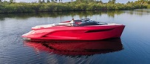
Exactly. Not nearly big enough, with one possible exception, the R Class Launch:

1627635747324.png

I have seen some pretty striking custom paint schemes on them.

.
 
In 1982 I bought a 1973 Nauticat and Osmosis was showing through. It turned out that when it was 6 years old (1979) the osmosis had been treated and the hull had been completely painted, but of course in 1979 boatyards were not using 2 Pack Paint like today and the hull would have been painted with whatever oil based paint boatyards used at that time. When I did the osmosis repair I had a body shop and had been using 2 pack paint for a few years and I believe that when International Paints introduced 2 pack paint for boats it was the same as the ICI 2 pack paint for cars.
So if you are doing anything with a hull which was made before 2 Pack paint came out you can assume that that it may have been painted with Woolworths best Gloss paint. Or Similar.
 
Spray booths have to be licensed for environmental reasons due to the volatile wast products.
I once had a body shop in a railway arch under Piccadilly Station Manchester, it had a large spray booth with two large extractor fans. What I did not know was where the ducting went to. After I took it over the owner of the body shop next door told me only to use it at night.
It turned out that the vents for the extractor fans exited at the edge of the pavement and would blow the paint fumes across the pavement towards people walking to catch their train.
Don't imagine that this set up would get a Licence these days.
 
Exactly, of course you wouldn't. The idea of accepting moulds that build in defects to be rectified later is the opposite of what they do. You spend time on perfecting the tooling so that each production hull needs as little work as possible.

Princess Yachts would be bankrupt if they had to give away an Awlgrip respray with every boat. They have no facilities for large scale respray work.
Each boat leaves the yard in gelcoat from the mould.


.
Exactly, there was no paint on my 1999 Princess V50 straight from the builder. I visited frequently and watched the build from lay up to completion.

But, my 2002 Beneteau 473 finished in blue was originally in white, then sprayed blue with something before it came out of the factory. Never did find out whether it was paint or a thin gelcoat layer. I was told by a dealer that all the boats came out of the mould white and then the colour was applied. Fortunately I never had to do a repair on it. Other dark blue 473 owners found they had to be careful cutting back the blue finish to remove the dirt and UV damage because the white started to show through after several years "polishing".
 
Last edited:
Exactly, there was no paint on my 1999 Princess V50 straight from the builder. I visited frequently and watched the build from lay up to completion.

But, my 2002 Beneteau 473 finished in blue was originally in white, then sprayed blue with something before it came out of the factory. Never did find out whether it was paint or a thin gelcoat layer. I was told by a dealer that all the boats came out of the mould white and then the colour was applied. Fortunately I never had to do a repair on it. Other dark blue 473 owners found they had to be careful cutting back the blue finish to remove the dirt and UV damage because the white started to show through after several years "polishing".
Almost certainly would have been awlgrip which has a manufacturer specified thickness of application which would have been checked by the sprayer. Very unlikely that normal polishing would take that off and show white through. I’ve no idea what they did in 1999 but I’d imagine it wasn’t as common to refinish and yours would have had the wavey out of the mould look which you may well have never noticed. If you have a photo from a sunny day looking along the topsides it would be visible though
 
Top