12V supply for cabin lights

lustyd

Well-Known Member
Joined
27 Jul 2010
Messages
14,997
Visit site
Just bought an 8-40V to 12V regulator for our lighting circuit in order to try and dim them a bit and prevent the LEDs from blowing. The 12V LED replacements we bought end up too bright and blow quite often on the boat's "12V" domestic bank. I believe Paul Rainbow suggested this a while ago and I've finally got around to trying it.

Anyway...

The lighting circuit obviously has a switch on the positive at the panel (plus downstream switches for the lights). I planned to take the output of this as the input to the regulator, and the output of that to the lighting circuit. So far so easy. The negatives are not as easy to find. Would I be right in thinking that it's acceptable to just bond both of the negatives to the boat negative? This should be similar to having both battery banks have a common negative and would be much simpler for me to wire. I can't see a problem for the regulator but thought I should check with the wise folk here first.
 
Just bought an 8-40V to 12V regulator for our lighting circuit in order to try and dim them a bit and prevent the LEDs from blowing. The 12V LED replacements we bought end up too bright and blow quite often on the boat's "12V" domestic bank. I believe Paul Rainbow suggested this a while ago and I've finally got around to trying it.

Indeed i did (y)

Anyway...

The lighting circuit obviously has a switch on the positive at the panel (plus downstream switches for the lights). I planned to take the output of this as the input to the regulator, and the output of that to the lighting circuit. So far so easy. The negatives are not as easy to find. Would I be right in thinking that it's acceptable to just bond both of the negatives to the boat negative? This should be similar to having both battery banks have a common negative and would be much simpler for me to wire. I can't see a problem for the regulator but thought I should check with the wise folk here first.
Obviously can't say for sure with your converter, but all of mine share common negatives. I have some Victron DC-DC converters and connect the inputs to positive and negative, no negative from the output, whatever it's supplying connects to the positive output and the negative busbar.

On the subject of dimming, i fitted very bright LEDs in the saloon (12V on a 24V boat, via a DC-DC converter, Victron so not adjustable), but also fitted remote control dimming. Check out Mi-Light / Mi-Boxer on Ebay or Ali-Express, cheap as chips and work really well.
 
This one is just an Amazon one 10A and looks like a heat sink. If I’m honest it’s the constant replacements that annoy me more than the brightness but nice to fix both.
I’ll give it a go and report back, thanks for the input
 
Most boat LEDs have built-in drivers that maintain a fixed level of brightness regardless of voltage i.e. varying the supply voltage won't dim the light. They can often be dimmed with pwm dimmers, but that doesn’t always work, as some of them don’t like pwm supplies.

It’s just possible that your LEDs aren't fitted with drivers, but that would be unusual for boat LEDs; however, voltage dimming would work with these .
 
They aren’t boat LEDs they’re replacement bulbs in halogen fittings which is far more common. Just trying to make them work as intended here we don’t need dimming.

Having seen the absolute fiasco of LED nav lights I would never give a marine company money for an LED fitting!
 
They aren’t boat LEDs they’re replacement bulbs in halogen fittings which is far more common. Just trying to make them work as intended here we don’t need dimming.

Having seen the absolute fiasco of LED nav lights I would never give a marine company money for an LED fitting!
We use G4 type light fittings with G4 LED lamps that have a bunch of electronics built in. They are sold as 9-30v voltage range. They have been incredibly reliable on our 24v boat. Most were installed 12 years ago and it's only recently I have had to replace a couple. They were all purchased off Ebay from China. For about £1 each at the time. They can't be dimmed because of the electronic circuitry
 
Ours are G4 but the flat type. I’ve not found any at a sensible price that self regulate in the UK. These ones do the job but are bright and blow now and then.
Jenyolon G4 LED Light Bulb DC/AC 12V, 3W, 400 Lumens, Warm White 3000K Equivalent to 30W Halogen Bulb, G4 bi-pin LED Bulb for Kit, Indoor, Camper Trailer Motorhome, Marine Boat (12 Pack) : Amazon.co.uk: Lighting

The 12V regulator seems to work as Paul suggested. Unfortunately I didn’t have any thin cable I’d want in a permanent install so have ordered some.
 
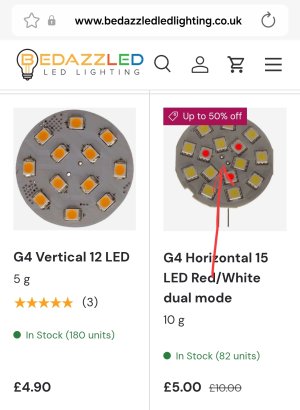
And I know this question wasn't about suppliers.. but I bought all of mine from Bedazzled over 12 years ago and have not had one go wrong..

The reason I chose them was they seemed to be the only place saying that their LED bulbs were protected/fused...

and of course the fact they work from 10v-30v..

and the best thing was their red/white G4 ones... Switch on once and they come on red. Switch off and then on again and they end up white. All my bulbs are now this red/white (which saves any dazzled eyes at night).

G4

and the final feature discovered in the G4 discs was that if you have a round light fitting that they only just fit into, you can de-solder the two prongs and solder wires (flying leads) into the two central holes from behind instead..

Screenshot_20251109_211313_Samsung Internet.jpg
 
Ok the 12V regulator is in and working as expected. Simple install, i pulled the connector from the switch panel and inserted the regulator between switch (supply) and lights (regulator out) with a single negative on the supply side to boat negative.
Lights are now less bright and I imagine will burn out less. Given the cost of LED lamps with regulators built in, this solution is overall much less expensive and I suspect has less scope for interference since theres one regulator rather than 20.
 
We use G4 type light fittings with G4 LED lamps that have a bunch of electronics built in. They are sold as 9-30v voltage range. They have been incredibly reliable on our 24v boat. Most were installed 12 years ago and it's only recently I have had to replace a couple. They were all purchased off Ebay from China. For about £1 each at the time. They can't be dimmed because of the electronic circuitry
My boat was built (in 2001, just before the big switch to LEDs) with very expensive Italian Cantalupi light fixtures, dozens of them, using G4 halogen bulbs. Immediately upon buying the boat in 2009 I started converting them with the flat disk-shaped G4 LED units which fit (kind of) into the original light fixtures.

This was not really satisfactory because (1) the optics are no good -- just direct radiation from one side of the LEDs, as the reflector was obscured by the disks; and (2) poor heat management inside the closed fixture.

I eventually pulled out and threw away the dozens of Italian light fixtures and replaced with inexpensive MR16 downlight fixtures which fit perfectly in the old holes, These take MR16 LED units with frosted lenses which are optically far superior to the old ones. An inexpensive and very satisfactory conversion, in case the tip is of any use to anyone. Dimmable MR16 LED bulbs are available for those that want that.
 
https://www.lighting-direct.co.uk/w...WLVQb1OuYbNmr8UU5clucr7346y0UNCnQ6zxTF0JGAzBk

I’ve used quite a few of these lights over the last 10 years, and haven’t had one fail yet. They produce plenty of light, have a good colour temperature, excellent colour rendition (CRI), and use highly efficient COB LEDs; they look good, are very compact and easy to fit, and best of all, they only cost £2.44. They also have integrated LEDs, which is supposed to make them more reliable than fittings with replaceable bulbs.

They don't have electronic drivers (which is also good for reliability) and makes them easy to dim, but it does mean that they have to be powered from a stabilised supply. However, as lustyd points out, a single well-engineered DC-DC converter will most likely emit far less RFI than the many distributed converters built into all those LED bulbs (especially the ones bought from eBay).
 
3W Warm White LED Downlight 12V DC with Quick Connector - Aluminium

I’ve used quite a few of these lights over the last 10 years, and haven’t had one fail yet. They produce plenty of light, have a good colour temperature, excellent colour rendition (CRI), and use highly efficient COB LEDs; they look good, are very compact and easy to fit, and best of all, they only cost £2.44. They also have integrated LEDs, which is supposed to make them more reliable than fittings with replaceable bulbs.

They don't have electronic drivers (which is also good for reliability) and makes them easy to dim, but it does mean that they have to be powered from a stabilised supply. However, as lustyd points out, a single well-engineered DC-DC converter will most likely emit far less RFI than the many distributed converters built into all those LED bulbs (especially the ones bought from eBay).
I have those exact same ones in my saloon ceiling. I had the bezels anodised before i installed them.
I use G4 types in my pelmet lighting in the saloon and back cabin, heads and front cabin.
 
I replaced all the halogen lights on my boat with LED 'bulbs' (actually flat PCBs with pins) and haven't had a singe failure in the 10 odd years since I did it. In contrast, at home I frequently have to replace the mains to 12V 'transformers' because they just pack up: MTTF is perhaps 2 years.

So I'm very dubious that putting in an extra box of electronics will improve reliability, as I said above my experience says the exact opposite. It's possible that a 12V -> 12V SMPSU is more reliable than the 240V -> 12V ones used in domestic lighting, but it's still a single point of failure: if it fails all the lights go out which is, I feel, worse than the occasional bulb going.

I bought my LED 'bulbs' from Bedazzled, for what it's worth.
 
Point taken, but decent DC-DC converters have a MTBF of around a million hours (which is 114 years). If you’re still concerned, pop one in the spares box; they’re not that expensive.
 
if it fails all the lights go out which is, I feel, worse than the occasional bulb going
If it fails I can convert back in about three seconds.
When charging the domestic supply is well above 12V. We probably see more ‘bulb’ failures than most as we use our boat all day every day while most are out of the water in dark months or used occasionally at weekends. I didn’t see a failure in the four years before moving aboard, just the lights were a bit bright. When I said Paul suggested this, it was a few years back and I ignored until it was more of a problem.
 
Three seconds! ok, some hyperbole is reasonable but nonetheless I do think (pax, Paul!) there may be something else amiss here. 'Llive aboard' vs weekend sailors isn't enough to explain it: we likewise lived aboard for a couple of years, and before that took quite long (like 2 or 3 month) breaks, but no lamp failures. I suppose not all bulbs are created equal: ours don't adjust brightness one jot between 8 and 30V so can't be the same as yours...
 
Three seconds! ok, some hyperbole is reasonable but nonetheless I do think (pax, Paul!) there may be something else amiss here. 'Llive aboard' vs weekend sailors isn't enough to explain it: we likewise lived aboard for a couple of years, and before that took quite long (like 2 or 3 month) breaks, but no lamp failures. I suppose not all bulbs are created equal: ours don't adjust brightness one jot between 8 and 30V so can't be the same as yours...
Nail on the head. "Basic" LEDs get very hot if subject to over voltage and don't last long, i've been out to boats where they're so hot they smell like burning electronics. Brightness will vary with voltage, same as it does with incandescent lamps, fitting a DC-DC converter gives a stable supply and stops all of these issues. If yours are rated 8V to 30V it won't happen, you're not exceeding the rated voltage. Try running them at 40V and see what happens ;)
 
Three seconds
They’re just blade crimps. Pull two apart, put one back.
'Llive aboard' vs weekend sailors isn't enough to explain it:
These things take time to fail, using the lights 4-5 hours a day leads to failures more than an hour once a fortnight.
ours don't adjust brightness one jot between 8 and 30V
Yes, you’re talking about different lamps.
 
Top