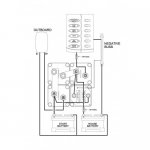
12V Battery Fuse / Switch install.

VicS Why would you need a bidirectional VSR? If all charge sources are connected to Start bat.,wouldn't the VSR bridge the House Bat. as soon as Start Bat. reached 13.6V ,thereby sharing/shunting the charge to House Bat? Am I missing something?
Cheers/Len

I did not say you necessarily needed a bi-directional VSR ( one that senses both batteries and closes when the target voltage is reached on either) but a possibility when one is fitted is to connect solar/ wind chargers to the house battery. The alternator then charges the engine battery as its first priority while the wind and solar chargers maintain the house battery as their first priority.

Its all down to personal preferences I think. There is no right way to do it, maybe no wrong way either.
 
Actually having another look, I think I'd do it like this. Take the alternator to the switch, not to the battery, but on the battery side of the switch. Then the scenario for a failed battery, as opposed to a flat one, is to disconnect engine battery lead, then close all three switches. Everything's then connected to the house battery.
Best to keep it simple, no combination is going to cover all scenarios. I like the idea of the ALT going directly to the battery makes it idiot proof as far as blowing the diodes. My personal choice would be the domestic bank then if 1of the batteries went down you could physically disconnect it without to much trouble leaving 1 in circuit as the initial ALT load

Michael
 
Now you are getting into defective components. ;) I know s..t happens,& it's a good exercise to analyze these possibilities.
It's a serious consideration, because one thing the old style 1-2-both switch did was allow you to disconnect a suspect or failed battery as an alternative to connecting it in parallel with the good one. And from my point of view not just theoretical, as our engine start battery failed last year .. around 25 minutes on charge motoring out, then two or three hours sailing, then stone dead when I wanted to restart the engine. In those conditions I certainly wouldn't want to connect that battery in parallel with the remaining good battery.

Out of interest I notice that BEPs diagrams for their cluster is similar - the emergency parallel switch requires both battery switches to be On.
 
That's an awful lot battery capacity to start a small yacht engine and provide a "small amount of power"

No technical reason why not I guess but smaller batteries would be less weight, lighter/ easier to handle when necessary and a whole lot lighter on the wallet when they need replacing
I agree, but I have the space, the 230AH battery is less than double the price of a 85AH so it was a no brainer. I have oodles and oodles of AH to play with.
 
I did not say you necessarily needed a bi-directional VSR ( one that senses both batteries and closes when the target voltage is reached on either) but a possibility when one is fitted is to connect solar/ wind chargers to the house battery. The alternator then charges the engine battery as its first priority while the wind and solar chargers maintain the house battery as their first priority.

Its all down to personal preferences I think. There is no right way to do it, maybe no wrong way either.

Got it! Tks/ Len
 
a winch should be taken off the dist. panel IMHO.

That's logical from an electrical point of view, but practical considerations might preclude it. My windlass cables were already installed along the port side of the boat, into the battery locker. The main panel is on the starboard side of the boat, with just enough room in a conduit through the bilge to carry the service supply, the battery monitor leads, and (in a separate conduit) the 240v supply to the battery charger. I don't want to have to make arrangements to take the windlass supply across the boat as well, nor uprate the feed to the panel to cope with an extra 100 amps of load, nor (possibly, I haven't done the sums) enlarge the windlass cable size to span the additional distance without excessive volt drop.

Instead the windlass feed comes off the downstream side of the service battery isolator (located in the wall of the locker), through its circuit breaker mounted next to the switch, then off to the bow using the existing cable.

What I do have is a separate supply for the low-current side of the windlass system, the part that runs through the buttons (and in my case also a remote control receiver, which it also powers) and the coils of the relays. This does come from the main panel (where it's fused at 2amps or something like that) and then goes through a switch in the cockpit before running to the relay box etc in the bow. Thus although the heavy supply to the windlass is always on when the boat is occupied, unless the relays in their box somehow short out then the windlass can't be engaged by fiddling with buttons or some kind of radio interference. Back when we still had foot switches on the deck, I once lay on them while trying to un-jam the furler. Having the windlass start turning underneath me (fortunately not dragging in any clothing or body parts) was scary, so I want to make sure it's well and truly off until it's wanted.

Pete
 
That's logical from an electrical point of view, but practical considerations might preclude it. My windlass cables were already installed along the port side of the boat, into the battery locker. The main panel is on the starboard side of the boat, with just enough room in a conduit through the bilge to carry the service supply, the battery monitor leads, and (in a separate conduit) the 240v supply to the battery charger. I don't want to have to make arrangements to take the windlass supply across the boat as well, nor uprate the feed to the panel to cope with an extra 100 amps of load, nor (possibly, I haven't done the sums) enlarge the windlass cable size to span the additional distance without excessive volt drop.

Instead the windlass feed comes off the downstream side of the service battery isolator (located in the wall of the locker), through its circuit breaker mounted next to the switch, then off to the bow using the existing cable.

What I do have is a separate supply for the low-current side of the windlass system, the part that runs through the buttons (and in my case also a remote control receiver, which it also powers) and the coils of the relays. This does come from the main panel (where it's fused at 2amps or something like that) and then goes through a switch in the cockpit before running to the relay box etc in the bow. Thus although the heavy supply to the windlass is always on when the boat is occupied, unless the relays in their box somehow short out then the windlass can't be engaged by fiddling with buttons or some kind of radio interference. Back when we still had foot switches on the deck, I once lay on them while trying to un-jam the furler. Having the windlass start turning underneath me (fortunately not dragging in any clothing or body parts) was scary, so I want to make sure it's well and truly off until it's wanted.

Pete

I think windlass installations would be a lot safer with an isolator with a removable handle that was installed in a readably accessible position. I wouldn't want to completely rely on any control circuits or relay contacts opening (short circuits can welled them cloesed) if I had my fingers any where near chain and windlass.

Michael
 
I'm googling around and found quite a few VSR solutions.

This looks quite good: http://www.ebay.co.uk/itm/2mtr-Spli...a7c73&pid=100338&rk=19&rkt=30&sd=251722319527

However I noted that a few forumites advised against the Durite product, its noted that campervan VSR's are cheaper (not by much though) so is the BEP one pretty much the standard that most boaters use?
Never having done big terminals before, I can't see why their construction can be that difficult to make up the lengths of lead that I want exactly.

I note also that the BEP cluster doesnt actually give the safety margin as per a post a while back in another thread, so I am angling towards a full DIY solution. The only think I cant track down in chandlers local to Portsmouth are the Blue Ocean battery fused terminals which I believe need to be inserted in the system to make it safe.
 
I think windlass installations would be a lot safer with an isolator with a removable handle that was installed in a readably accessible position. I wouldn't want to completely rely on any control circuits or relay contacts opening (short circuits can welled them cloesed) if I had my fingers any where near chain and windlass.

The breaker also serves as an isolator; it's accessible in the cabin and can be turned off if I'm doing something like dismantling and greasing the windlass. For normal use, I'm quite happy that the contactors aren't going to suddenly leap closed against their spring pressure when there's no power available to the coil side of the system. A short in your isolator is no less likely :)

Pete
 
The breaker also serves as an isolator; it's accessible in the cabin and can be turned off if I'm doing something like dismantling and greasing the windlass. For normal use, I'm quite happy that the contactors aren't going to suddenly leap closed against their spring pressure when there's no power available to the coil side of the system. A short in your isolator is no less likely :)

Pete

Agreed, I'm sure your aware of the problems I mentioned and work safely, just making a general comment.

Michael
 
Ref #43
I recall that BEP describe/recommend that the 3 switch cluster had the bridging switch joining the batteries directly. Having had a battery running hot off charge I believe that this is wrong and that the diagram in the thread showing it after the battery switches is correct. The hot battery was consigned to the deep on the basis that the sea could cope with an exploding battery better than the inside if my boat!
Is my memory wrong or have they changed their info?
 
I googled a bit and from what I can see the posts previously would be right, the middle switch joins the batteries and you can't isolate them.

img1394_1_130604155344-500x500.jpg
 
Top