10 year old boat

Take your point but it isn’t a Brokers job to mislead people. I know some who are very balanced and present a rounded picture with the pros and cons - these are the type I feel more comfortable doing business with.

To be fair, I don’t blame Brokers per se and would describe it as ‘the market’ favouring low use/low hours. As Portofino says, an older boat with lots of hours is going it be difficult to shift. This despite that fact that the engines may be good for thousands of hours if looked after properly.

Agree with outer points made that each boat should be treated on its own merits and with eyes wide open. Rarely will there be absolutely nothing wrong :)

He's not misleading anybody. Does 'the market' prefer low hours boats? Yes. Whatever the merits of that logic is open to discussion as this very thread proves - personally I'd prefer a boat with 'sensible' hours rather than very low hours, but the fact remains that many buyers get turned on by low hours.

So the broker highlights that as it is something people generally favour. If he didn't, he wouldn't be doing his job on behalf of the owner of the boat.

If a broker was selling your boat and it had (say) the smaller engine option of two possibilities, which would you prefer, that he was 'selling' the benefits of lower fuel consumption, or 'presenting a more rounded picture' and telling people that actually, it was a bit rubbish with the smaller engines and they would be better off buying one with the bigger option (assuming that were true)?

They're not there to provide a public service, they're there to work for their client, the seller, the one that pays their wages.

Should they lie or mislead? Of course not but very clearly they should be pitching the sale in the direction of anything buyers see as A Good Thing. That is unequivocally their job.
 
My boat was very low 200 hours at 11 years old and had issues found at the pre purchase survey that were time related and some were lack of use related.

One fault developed afterwards, a turbocharger issue, and was probably also associated with former lack of use.

Four years after my purchase it is now just over 600 hours at 15 years, so still low mileage. The interior is still smart with little signs of its age.

I would buy a low hours and little used boat again but I would not expect it to be fault free.

I think most things mechanical or electrical can be put right or replaced. The challenge, which is almost impossible, is the discovery of the items needing repair at the time of purchase. You cannot expect to buy a little used 10 year sold boat and discover no faults nor can you expect fault free boating in the longer term.

However I do think running a boat regularly helps prevent some issues from developing.

A little used boat may reward you with an unworn interior.

Having started with an only slightly used and only slightly dirty engine bay it is not difficult to keep the engines looking almost as good as new.
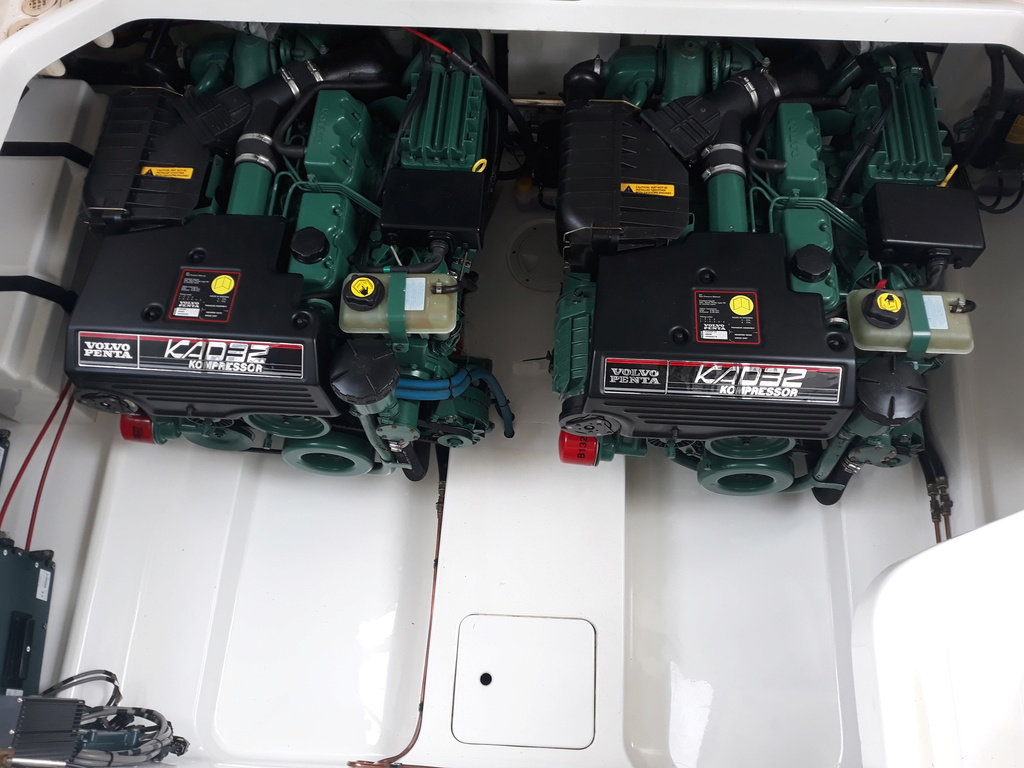
So how do you keep it that clean, what products do you use. OR did use to get it like that first off
 
This is an interesting thread for me as i have a question in the opposite side of the op's initial post. What are the thoughts on a 2016 boat that has done 1000 hours ? (MAN 1900 V12, I'm guessing the new spec engines)??
 
This is an interesting thread for me as i have a question in the opposite side of the op's initial post. What are the thoughts on a 2016 boat that has done 1000 hours ? (MAN 1900 V12, I'm guessing the new spec engines)??

What is it with that many hours? A fishing trawler.;) Entirely FWIW, I was talking to the technician who services my MAN V12 engines on Sunday. I was questioning how MAN could get 1900hp out of a block that started off at 1200hp or less. He explained that the original MAN V12 was based on an elderly Mercedes block but the latest V12 is based on a modern Cummins block and that, in his experience, those Cummins block engines were proving very reliable so far

Agree with jrudge. Providing youre going to do modest hours yourself and by the time you sell the boat, the average annual hours is around 100-150hrs per year, it could be a good buy assuming of course that the price reflects these high hours
 
He explained that the original MAN V12 was based on an elderly Mercedes block but the latest V12 is based on a modern Cummins block and that, in his experience, those Cummins block engines were proving very reliable so far
M, I was tempted to suggest you to change your technician after reading this. Then again, it only smells of BS to me, but I can't be positive about that.

Firstly, the current V8 and V12 MAN range (they abandoned V10s several years ago) are very obviously still based on the modular principle, since they share the same bore and stroke.
In other words, you might as well have asked how they could squeeze 1900hp from an engine whose shorter version (V8) was designed for a 680hp output, back in the mechanical days, when the V12 produced 1000hp.

Secondly, the original bore/stroke of the MB400 series block was 128/142mm respectively. When they introduced electronic control first (like in Portofino's boat) and common rail later (like in yours), they went up to 1360hp with that block, which was essentially a spiced up - electronically, I suppose - version of your 1224.
Afterwards, they obviously realized that they needed a stronger base and more displacement to go further up with power, and compete with Cat and MTU.
According to your technician, that's when they changed the block for a Cummins one.
But as it happens, both the V8 and the V12 still have exactly the same old 128mm bore, and only went up with stroke from 142 to 157 - which for the V12 means 24 rather than 22 liters, still well below the 32 liters of the equivalent power Cat engine, for instance.
Now, I don't need to explain to you that saying "only" is quite an understatement, because increasing the stroke implies a great deal of redesign, in an engine block.
Otoh, common sense suggest that they identified the crankshaft and the engine bottom as the bottleneck for increasing power further, and that's how eventually they decided to tackle the problem.
It would be an amazing coincidence to say the least, if they went to Cummins and found a suitable block with exactly the same bore.

Lastly, I quickly googled for Cummins blocks, and the only V12 I could find is a square (159mm for both bore and stroke) 38 liters.
And just to put the displacement/power ratio in perspective, it's capable of anywhere between 750 to 1500hp, depending on rating.

Bottom line: it's a pity that LS1 abandoned the asylum lately, because obviously nobody better than himself could have confirmed or contradicted the MAN/Cummins theory.
But time being, if I should win a lottery tomorrow and decide to buy a 2000hp or so powerboat, MAN would be very much down the list of my personal engine preferences.
 
Having started with an only slightly used and only slightly dirty engine bay it is not difficult to keep the engines looking almost as good as new.
I agree, it's not difficult. It's impossible!
Admit it, that pic was taken in some VP boat show stand where they were displaying an engine installation.
It CAN'T be taken on a boat which is actually being used! :rolleyes:
 
MAN and MTU ( merc ) shared the same independent foundry somewhere in deepest industrial Ruhr .
Hence with our range the commonality of the block sizes .
How ever a few years ago one of them went off and sourced blocks somewhere else , the other stayed put .Ithink they bought the heavy iron foundry - so the position of the none owner customer became untenable.

I,can’t remember for certain which way round - sorry .I Think MAN got it and MTU went else where .
Obviously it’s under a branch in the group ,so it’s possible they do blocks for Cummings as well as anybody who comes knocking with a enough € , if there’s slack capacity.
Or if MTU got it , then MAN and Cummings are now - sharing another independent foundry .

Suspect after looking at the MAN Co structure, they are very conservative and like to keep it all basically in Germany.
Not tempted to jump into bed with a Korean or Japanese supplier.

The 1000 hrs 1900 Hp will be a leisure planing boat ,

On the subject of going higher , it seems MTU v16 m92/93/94 seem to rule the roost from 1800/ 2000hp upwards , well at least with Ferretti stuff
Itama 75 has MTU v12 1815 Hp .

How ever looking back over the past 20 yrs and knowing the Germans re engineering I think the 1900 v12 will be fine ,
We had some MAN people at the Ferretti ( free for all test drive ) event in Monaco and they encourage us to give them some beans - 2100 / 2200 , there’s no rpm minus 10 % malarkey like VP , they are rated for exactly what it says in the tin .
I had one at 2400 + , I did ask btw and got. “ Ok fine “ was in a big Pershing saw 42 knots eek .
It had 40 hrs on .Super turbine smooth btw .
 
This is an interesting thread for me as i have a question in the opposite side of the op's initial post. What are the thoughts on a 2016 boat that has done 1000 hours ? (MAN 1900 V12, I'm guessing the new spec engines)??

I might not have concerns about the engines, but I would about reselling it again with that number of hours, so make sure you pay a figure that reflects the very large numbers.

Of course if you're going to keep it for 10 years and use it as a floating holiday home those numbers will balance out to some degree eventually (but I'd still want it cheap now, simply because it is worth less with very high hours, whether it should be or not).
 
What is it with that many hours? A fishing trawler.;) Entirely FWIW, I was talking to the technician who services my MAN V12 engines on Sunday. I was questioning how MAN could get 1900hp out of a block that started off at 1200hp or less. He explained that the original MAN V12 was based on an elderly Mercedes block but the latest V12 is based on a modern Cummins block and that, in his experience, those Cummins block engines were proving very reliable so far

Agree with jrudge. Providing youre going to do modest hours yourself and by the time you sell the boat, the average annual hours is around 100-150hrs per year, it could be a good buy assuming of course that the price reflects these high hours

I was shocked by the hours but she is a one owner, privately used SS 86. She stood out to me because she's the first one i have seen using Man's, they usually have MTU's.
 
I,can’t remember for certain which way round - sorry .I Think MAN got it and MTU went else where.
Yup, it's MTU who discontinued the MB block, around the mid 90s.
The latest of their 183 series engines (as they called it, based on the 1.83 liters capacity of each cylinder) was the semi-electronic TE93, of which afaik only markc here in the asylum has a couple in his Fer165 (V8 version).
MAN continued to develop that block for several years afterwards, up to the 1360hp V12, as I said (and 900hp for the V8).
They only introduced the longer stroke blocks around the late naughties (can't remember when exactly), progressively pushing the V12 and the V8 to 1900hp and 1200hp respectively.

Otoh, this doesn't help us one bit in understanding whether the current MANs are yet another evolution of the memorable 128mm bore engine as I suspect (albeit possibly the most radical), or if it's an entirely new Cummins block, as that Deleted User technician suggested.
I'm really missing LS1 contributions on topics like this...!

Anyway, what we know for sure is that for 1900hp light duty engines the market nowadays offers 24 liters blocks from MAN, 27L from MTU and 32L from Cat.
Of course, I can't say it's impossible that MAN managed to design an engine with just 75% of the C32 displacement, capable to produce the same output, and at the same time comparably reliable. If they did, good for them.

But time being, I'll rather spec a couple of C32 for my lottery boat, thank you.
Or if I should really be in the mood to go bonkers with power density, I'd rather have an Otam 80 built with four Seatek 950hp biturbo and Trimax drives.
Same power and (hard to believe, I know!) less overall weight vs. 2x1900hp MAN, with all the advantages of multiple surface props. :cool:
 
Thanks MrB, but that still doesn't help sorting the doubt, because the 1800hp, on which basis the 1900hp was developed, was already a longer stroke block.
The last and more powerful of their 142mm stroke V12 has been the 1360hp (now discontinued, as well as any other 142mm stroke engines), and the first 157mm stroke V12 was the 1550hp, IIRC.
 
But time being, I'll rather spec a couple of C32 for my lottery boat, thank you.
Or if I should really be in the mood to go bonkers with power density, I'd rather have an Otam 80 built with four Seatek 950hp biturbo and Trimax drives.
Same power and (hard to believe, I know!) less overall weight vs. 2x1900hp MAN, with all the advantages of multiple surface props. :cool:

My lottery boat , I would steer clear of C32.s .They have had issues with the SWHE quality and the suggestion from CAT is they are throw away part lifed for 7 years .
I can,t be bothered or should be btw ,have to fresh water rinse eveytime I think I don,t want to use the boat

Are those seatek still raw water cooled ? - explaining the Uber low kg,s ? —- if so no thanks from me I have a mate with a pair irrc 600 or 700 ,s in trimax driven Super hawk 50 — he says the only one made and has seen 70 knots but the manifold s rot out like any raw water cooled engine and it’s eating anodes faster than people running away when guardia Finanza turn up at an Italian political rally :)

Prefer a pair of MTU in Riva 88 shafts or Itama 75 Arnesons , or Arno Lepard 90/ 105 something on jets - thinking plug n play
It would have to be below the 24 M - self drive rule as that’s all I,am ticketed to drive and would not want to rely on a skipper —- every time :)
 
Apropos of fresh water rinsing, I just completed the installation of flushing connections/valves for:
- engines (MAN as you know, but better to have salt water in your heat exchangers, exhaust, etc. than in mine :rolleyes:);
- genset;
- shaft seals;
- a/c raw water pump.
If and when I will want to, leaving the boat with ZERO sea water anywhere inside her will be a matter of a few minutes.
But I understand your wish to not bother with all that, of course - In fact, you are in an overwhelming majority of boaters, in this respect.
So, each to their own!

Ref. Seatek cooling, your friend must be also the only one where S/skr installed some engines made in PRC, with a "Seatek" label on top of them... :p
In fact, their engines always used closed cooling circuit with titanium heat exchangers, as far as I can remember.
I would even dare saying (though I'm not 100% sure) that they pioneered that technology, before MTU (and nowadays also others, including Cat and FPT but not MAN, btw) followed.

Oh, and ref. Riva/Itama/Leopard, all very respectable choices of course, but I don't remember to have read that any of them established records like the round Italy, Round Britain and Monaco-London - as the hull on which the Otam 80 is built did.
But when talking of lottery boats, your dreams are as good as mine, of course! :encouragement:
 
M, I was tempted to suggest you to change your technician after reading this. Then again, it only smells of BS to me, but I can't be positive about that.
Dont shoot the messenger. The technician was recommended to me by MYAG of this forum whose judgement I tend to trust and he (and his Dad) have spent a lifetime servicing MAN engines. Of course I may have misunderstood him or he may have made a mistake. However it is perfectly normal these days for engine manufacturers to share the development costs of engines because the ever changing emissions regulations make it far too costly for manufacturers to develop new engines on a regular basis to meet emissions regulations which change every few years

As for the old MAN V12 engines, mine continue to perform excellently and have just been given a completely clean bill of health by the above mentioned technician. Maybe they're not so rubbish after all. As for Cats, I can tell you that in my industry, Cats are rapidly losing their reputation for reliability and service. One of the manufacturers my company represents has ditched Cats completely in favour of Cummins because of the worldwide problems they have experienced with Cats and their lousy service
 
Our last boat, an Absolute 41 now for sale with BCU who took it in px, had very low hours, mainly due to being too busy in early ownership & my health later on. She has however been fully serviced every year without fail, all improvements such as raw water strainers carried out, inc new batteries, some hoses etc before we let her go.
If low hours, or high, so long as she has been properly maintained by a main dealer / established outfit then all should be well-ish.IMHO
 
Top
