Yet another DS practical question

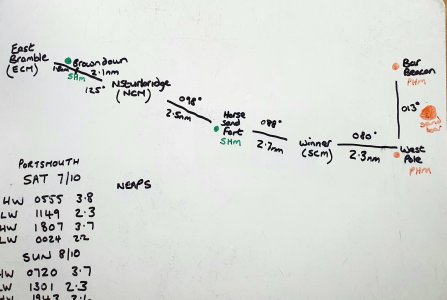
So taking this example, the port to take HW from is Portsmouth, it just mentions that Portsmouth is +20 minutes from Dover

Yes, that's correct. Going back years, Dover used to be common port to have tide tables for, and so if you only have Dover tides, you can still use the tidal stream atlas, albeit with a little less precision. Today, when you can look up tide information on line in no time, it's best ignored.
 
Yes, that's correct. Going back years, Dover used to be common port to have tide tables for, and so if you only have Dover tides, you can still use the tidal stream atlas, albeit with a little less precision. Today, when you can look up tide information on line in no time, it's best ignored.
Yep it was Dover tables we used in Wick with a small offset, was close enough for us in a small boat and diving around the coast.
 
Not at all my experience, and an a bit surprised it was anyone's experience. DS isn't about planning to sail at night (that's why it's called Day Skipper) - it's about how to manage the situation if you find yourself arriving at night. We didn't do night time pilotage, just about how to generally sail at night.
This matches my recent experience. A short night sail with the instructor taking the lead, just as a familiarisation exercise
 
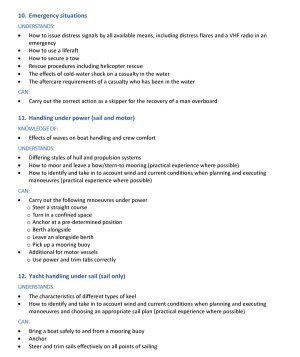
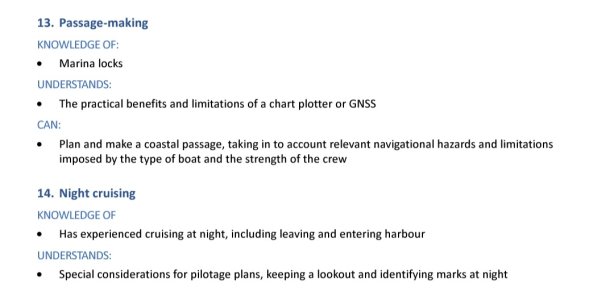
Reading the section about night work does explain why some instructors might combine the ‘experience’ requirement in bullet 1 with the ‘pilotage considerations' in bullet 2 by working up a pilotage plan for execution during the night passage.
 
Last edited:
Day Skipper "Night Cruising" could require development of a night passage plan by the day skipper, or that they use a night passage plan developed as a group with the instructor. It depends on how the course is being structured around the students.

It does require competency at the "understands" level for "special considerations for pilotage plans". Quoted text is from the syllabus, section 14.

"Understands" means that the instructor will deliver the topic in greater detail e.g. the importance of light sequences on passage plan, transits day shapes not visible at night, or transit lights, back ground shore lights masking bouyage lights. The student will be asked to demonstrate a basic understanding, but that demonstration is not defined. It could be by discussion, or by DS students working a developed night passage plan, or even developing their own night passage plan.

"Understands" also means that the student is expected to develop skills later in their own sailing time.

So, as usual, the RYA is flexible in how instructors deliver Day Skipper "Night Cruising" and how they assess the candidate.

Coastal Skipper, section 3, pilotage, the competency is defined as "can" to pilot a vessel at day and night. On this course, the student has to be able to proficiently develop and use a night passage plan.
 
Drift and leeway wasn't taught in the theory course as they said it wasn't part of the DS, it certainly wasn't taken into consideration in the exam. i guess that will be taught on the practical?
 
Here you are -

You absolutely need the RYA Yachtmaster Scheme Syllabus and Logbook G158 to record your course unless you're 100% sure you'll pass everything in the week.

RYA Yachtmaster Scheme Syllabus and Logbook

The school should have sent one to you ahead of the course.

You beat me to it.

The RTC does not have to send the syllabus and log book to the student and they don't have to buy it either. It is recommended though. The instructor does have to make sure that they can demonstrate all items were covered.
 
Drift and leeway wasn't taught in the theory course as they said it wasn't part of the DS, it certainly wasn't taken into consideration in the exam. i guess that will be taught on the practical?

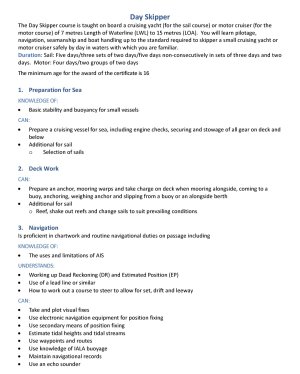
Day Skipper Shore Based Syllabus does include leeway, EP and CTS, all of which require "drift" which I assume you mean tidal set.
Leeway is competency C Outline Knowledge and CTS is competency B working knowledge.

Edit: Sorry didn't address the question. Yes it is taught on the practical course as well: DR, EP, CTS is at Understanding evelof competency.
 
Last edited:
Night hours on a Day Skipper course.

The recommendation is that you should have some night sailing hours prior to the course preferably 4. But that's not always possible, so only suggested.

On the course itself it will depend on the mix onboard of different levels of students (great in my opinion) and how much discomfort you want to give your students. It's a judgement call. Most instructors are good at this. Plus of course in Northern summers, the further up you go, the less 'night' there is during the summer. But easy in, say, the Solent in December.....

If you do keep students out until 0100 or later, they will be tired next day and not so good at learning. I often found that anchoring off gives an opportunity to get an early night followed by getting an hour or two in before dawn. Very popular.

Getting a couple of night hours during a course is often a bit of a highlight. Lots to learn, lots that's new. I found that most people enjoyed it if not too breezy.

So every course is different! The time to really energise potential skippers are on the coastal practical and also exam prep courses. That's the time to push things much harder.
 
Quite looking forward to the DS course on the Clyde, just hope there are no big black beasties coming doon the water from Faslane during the night ex.
The steaming lights are in unusual positions but the vessel will also have a yellow flashing light on the fin. And polis on boats to usher you out of the way. :)
 
Quite looking forward to the DS course on the Clyde, just hope there are no big black beasties coming doon the water from Faslane during the night ex.
Many years back I was skippering one of the Sunsail boats from Largs on a corporate sailing club weekend.
People tended to gather at Largs after work and the general rule was to make a short night sail over to Millport, very dark in October.

Whilst waiting for the last arrivals, some of the crew wanted some training on lights so we got the chart out and prepared - looking up the light characteristics of the Hunterston 3 red buoy, and the ship lights expecting to see the Cumbrae ferry. This don’t work well.
Heading out we soon saw the Cumbrae ferry coming out of Largs to cross us. Sadly, we couldn’t see the expected red light (amongst the many deck lights) - instead we saw a white light coming, and then before it crossed a pretty green light on the port side. The skipper had forgotten to flip the lights on the bidirectional ro-ro ferry:-)

So then looked for the flashing red buoy. Found the buoy in the dark - in fact nearly “found” it too well. But the light was out of order.
So the lights training didn’t work well.
(Though to be honest almost never dark in Scotland in summer, so largely pointless)
 
Top