Yanmar GM10 prop shaft

JMF21

New Member
Joined
27 Jul 2023
Messages
5
Visit site
Can someon advise me on the correct diameter for a prop shaft to suit this engine. My prop shaft has just sheared at the coupling junction, the dia. of the existing one is 3/4”.

 
It will not have sheared because it is underside. Rather because it has been flexing causing fatigue.
Its a tiny engine, 3/4" should be enough. When you say at the coupling junction, can you explain further or better a few photos?
 
Can someon advise me on the correct diameter for a prop shaft to suit this engine. My prop shaft has just sheared at the coupling junction, the dia. of the existing one is 3/4”.
Post some good quality photos of the broken faces.
Vyv Cox', or one of the other metallurgists will be able to tell you the mode of failure.
.
 
I also have a 1GM 10 and 3/4" shaft. It has been fine so far.(30 years).

Here is a calculator I have found :

Shaft Diameter = 100K x (3rd root of)[(P/R)*(560/(rho + 160))]

Where:
K = 1.22 for a keyless propellor, or 1.26 for a keyed propellor.
P = Engine Power (this power is in kW, use conversion 1hp = 0.746kW).
R = RPM of engine, or shaft after reduction gear if there is one.
rho = Material strength, Assuming the shaft is made of mild steel, use a value of 550 N/mm2, if stainless use around 750.

The answer overall comes out to be in mm, and since your wondering about if you need a bigger shaft, I would see how much difference there is in the size of shaft needed and the size already there. These shafts are picked with a safety factor of about 500% (5x),


I have done the calculation for my 2.21 reduction gear and 3000rpm and it comes out at 18mm.

I still have an old style greaser stern gland and I rely on an R&D flexible coupling and 80cm of exposed shaft to accommodate engine movement on the flexible mounts. If I changed to a larger shaft I would need a bellows type stern gland as the shaft would be more rigid.

I would suspect a misalignment problem which is causing fatigue where the shaft exits the coupling. R&D Marine have instructions on shaft alignment using feeler gauges to measure a gap as you rotate the coupling.
R&D see page 4
 
Single cylinder 1GM10s shake and roll a lot at very low revs. Have the engine mounts gone sloppy and excessive vibration weakened the shaft? It could be correctly aligned at rest but wobbling all over at tickover .
I try to keep the revs up on my 1GM10 to reduce the vibration and fatigue on the mounts, shaft and just about everything else, not least the fillings in my teeth
 
Last edited:
A previous boat I had did have a 1GM10 and although as you say the engine does appear to vibrate a lot at low revs, I always understood that when mounts etc were all correct, it actually rotated back and forth 'around' the centreline of the shaft.

It's a back and forth rotating motion of the engine, not anything random, so that should impart no extra bending stress on the shaft.

If you watch the engine at tickover from the front, you should be able to see the point at which it rotates about.
 
Under 1" was common for the 1GM, although 1" or 25mm is more commonly used now on the few boats that are built now to use the engine, mainly because of the better choice of stern gear available for those sizes.

Failure is unlikely to do with it not being strong enough and no reason not to replace with the same size as going up means new stern gear. The stern tube in particular is not easy to replace.
 
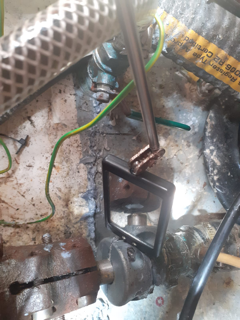
1690538400160.png The coupling on the left and a anode on the right, you can zoom in and see the break in the mirror.
Many thanks for all the replies, much appreciated.
 
From your photo it does not appear to be a typical setup but it may be the photo

if the item in the middle is an anode not sure that it’s actually doing any thing
 
View attachment 160869 The coupling on the left and a anode on the right, you can zoom in and see the break in the mirror.
Many thanks for all the replies, much appreciated.
Is the break where it leaves the coupling? You need to take it apart so that the faces can be seen.

Pointless attaching an anode there. An anode has to be in seawater connected to the prop or shaft to do any good.


A photo of the whole installation and details of the boat it is in would be useful. The incorrect placement of anodes raises questions about the installation.
 
That looks like an original Yanmar coupling with cap head bolts. They are pilot bored to 20mm which is just over 3/4". The 'marine engineer' that sold me the engine assured me that it would be fine but in practice it slipped and the shaft moved in the coupling.It is now replaced with an R&D 3/4" coupling which has never slipped.
Do you have a flexible coupling between the gearbox and shaft coupling? If not, you could add one and maybe move the shaft and propeller forwards enough to reconnect the shaft coupling. It is not ideal but could get the boat usable until you can replace the shaft.
 
No point in the anode, its not in the water!

Its just extra weight and stress on the shaft, dump it.
I might guess that it's doing a valuable job of keeping the shaft in the boat?
The extra weight of it is negligible.
Maybe it's a clever place to carry your spare anode?

It seems quite bizarre that this shaft has broken.
 
Unfortunately the photo tells me nothing. Its location suggests very strongly that it is a fatigue fracture. If the fracture faces are pretty much flat and at right angles to the shaft axis this pretty much confirms it. The most likely cause is misalignment, leading to bending at the coupling. Your cutless bearing may well be badly worn also.
 
Top