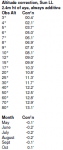
...Dip & sun corrections are a scan from an out of date "Complete onboard celestial navigator"
Edit: These look like more accurate altitude corrections:
http://astro.ukho.gov.uk/data/na2003/bookmark03.pdf
dip = -1.76 * sqrt(ht_of_eye);
parallax = 0.14 / distance * cos(alt);
refraction = 1 / tan(alt + 7.31 / (alt + 4.4)); %NB: alt is in degrees
refraction = refraction * air_press / 1010 * 283 / (273 + air_temp);
half_width = 16.01 * (1 + 0.0167 * cos(2 * PI * (day_of_year - 5) / 365.24));

The only wrinkle is that the sun must be fairly close to the horizon for an accurate compass bearing.
....if you are on passage and the rising/setting sun doesn't occur very close to your course, you will probably need a pelorus.
The Sun is on the celestial horizon when its lower limb is approximately two thirds of a diameter above the visible horizon.
I don't agree with this. On a steel yacht, I have had quite large changes of deviation induced by electrical storms and it is important to keep a check of these. For this reason I like to check deviation on the required course and it is of limited help to make a major heading change to track a well off-course object before doing so. I suspect you may find OYM examiners take a similar view.And as for 'doesn't occur very close to your course' I am reminded that there's nothing to stop you adjusting the vessel's heading temporarily, or even heaving-to, if such would help provide a more accurate sighting, or set of sights.
The practical use of a 'compass check' at sea in a small vessel is not to provide a precision comparison sufficiently accurate for a 'correction card' to be drawn up, but rather to indicate whether whether a navigationally-significant compass error had crept in, perhaps by the moving of deviating influences - such as re-stowing a cwt. or so of food tins from one side to another. One wants flat-calm and zero yaw/pitch/roll for accurate compass calibration work.
One more question - is there and RYA expected method for the compass check or would calculating the sun's azimuth using the almanac & sight reduction tables be acceptable?
I don't agree with this. On a steel yacht, I have had quite large changes of deviation induced by electrical storms and it is important to keep a check of these. For this reason I like to check deviation on the required course and it is of limited help to make a major heading change to track a well off-course object before doing so. I suspect you may find OYM examiners take a similar view.
Do not think you can measure compass error ONLY at sunset or sunrise (when your advice about sun's height is correct, but not very important*). It can, and often is (or was), measured from a conventional sight reduction to determine the sun's azimuth from well above the horizon. That is what GHA is suggesting. But there is a maximum height for the sun at which the pelorus can work, or at which, if you do it that way, the helmsman can accurately steer directly for the sun: maybe about 15 degrees above the horizon.
* Because the sun's azimuth between first appearance and lifting above the horizon barely alters.
I don't agree with this. On a steel yacht, I have had quite large changes of deviation induced by electrical storms and it is important to keep a check of these. For this reason I like to check deviation on the required course and it is of limited help to make a major heading change to track a well off-course object before doing so. I suspect you may find OYM examiners take a similar view.
Do not think you can measure compass error ONLY at sunset or sunrise (when your advice about sun's height is correct, but not very important*). It can, and often is (or was), measured from a conventional sight reduction to determine the sun's azimuth from well above the horizon. That is what GHA is suggesting. But there is a maximum height for the sun at which the pelorus can work, or at which, if you do it that way, the helmsman can accurately steer directly for the sun: maybe about 15 degrees above the horizon.
* Because the sun's azimuth between first appearance and lifting above the horizon barely alters.
I'm puzzled you don't follow this. Obviously you ask the helmsman to steer for the sun, while you watch the compass. There's no need to take a sextant sight WHILE you read the compass bearing on the sun. The sun's azimuth changes by just 1 degree per four minutes (approximately) so one task can be done after the other to a perfectly acceptable level of accuracy. If you insist on fine accuracy, measure the time between the bearing reading and the sextant sight and adjust the sun's azimuth accordingly.I may, however, have hugely failed to appreciate your skills. Do please demonstrate your ability to take an accurate sun sight ( or any other celestial body ) at sea, while simultaneously reading your yacht's steering compass AND while observing the sun's Relative Bearing with sufficient accuracy to permit a valid check to be made of residual deviation.... and I'll eat my hat. Or Bart Simpson's shorts.