Yachtmaster ocean requirements

  • Thread starter Thread starter GHA
  • Start date Start date
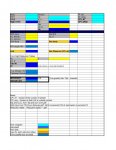
v1.0 of sight reduction sheet for a single sun sight.

Any comments , suggestions, errors?
First stab so must be room for improvement.

Ta
sight reduction sheet v1.jpg

edit. Oops - Spotted error already, Dec N/S & inc.d should be yellow- from data, not light blue- from navigator .
edit 2 Should be fixed now
 
Last edited:
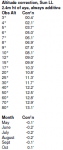
...Dip & sun corrections are a scan from an out of date "Complete onboard celestial navigator"

Edit: These look like more accurate altitude corrections:
http://astro.ukho.gov.uk/data/na2003/bookmark03.pdf

The corrections are pretty simple to do oneself, the formulae below give corrections to within 0.1':

Code:
dip = -1.76 * sqrt(ht_of_eye);
parallax = 0.14 / distance * cos(alt);
where distance is the distance in AU from Earth to the heavenly body,

The formula attributed to Garfinkel for atmospheric refraction:

Code:
refraction = 1 / tan(alt + 7.31 / (alt + 4.4)); %NB: alt is in degrees
refraction = refraction * air_press / 1010 * 283 / (273 + air_temp);

The sun's half angle is calculated from the orbit of the earth around the sun; due to the eccentricity of the orbit the distance between the earth and sun changes through the year, and thus the apparent diameter of sun's disc changes. It is largest at perihelion which occurs around the 5th of January and is at its smallest 6 months later:

Code:
half_width = 16.01 * (1 + 0.0167 * cos(2 * PI * (day_of_year - 5) / 365.24));

However, for the sun at least, the total correction is always ~12' additive, so complicated calcs are not really needed, see
Capture_corrn.PNG


As for a form: I think you may have missed clock error, ie clock reading + clock error = UTC.

But actually I don't find a printed form useful after a little experience. I prefer to write all the sights down in one note book, so unless you have access to book printing and binding this implies no printed form: you just have to adopt a format and stick with it. I like to use a lab book with graph paper (to make the plotting sheets) on the RHS and lined paper on the LHS on which one works out the sights.
 
Last edited:
Ta for that, those and a few more are actually at the start of the navsoft nautical almanac. Think i might stick to the UKHO tables for now :)

V1.1 now, the clock error should be taken care of in Deck Watch Error (DWE after DWT, deck watch time).
But that greenwich date wasn't on there!


sight reduction sheet v1.1.jpg
 
Pro Formas

Check out www.allaboutsailing.com

There are some excellent forms for sun, moon and star sights as well as a plotting sheet. I did my Ocean Theory with Alan who owns the site and he really is a top notch instructor with a wealth of knowledge on the subject.

G12
 
The only wrinkle is that the sun must be fairly close to the horizon for an accurate compass bearing. The error associated with large refraction close to the horizon isn't an issue for this measurement, since generally deviation is only required to the nearest degree or so.

When I did the OYM theory, they focussed on bearings taken on the rising or setting sun, as these don't need timings and the calculation is very simpl. This is certainly a convenient method: however, if you are on passage and the rising/setting sun doesn't occur very close to your course, you will probably need a pelorus. For the practical, any astronomical method that gives an accurate result will do, including using moon or stars.
 
Last edited:
The only wrinkle is that the sun must be fairly close to the horizon for an accurate compass bearing.

....if you are on passage and the rising/setting sun doesn't occur very close to your course, you will probably need a pelorus.


A tuppence worth....

'The sun must be fairly close'....

The Sun is on the celestial horizon when its lower limb is approximately two thirds of a diameter above the visible horizon.

It's all in here: http://msi.nga.mil/MSISiteContent/StaticFiles/NAV_PUBS/APN/Chapt-17.pdf para 1703 - Amplitudes

And as for 'doesn't occur very close to your course' I am reminded that there's nothing to stop you adjusting the vessel's heading temporarily, or even heaving-to, if such would help provide a more accurate sighting, or set of sights.

The practical use of a 'compass check' at sea in a small vessel is not to provide a precision comparison sufficiently accurate for a 'correction card' to be drawn up, but rather to indicate whether whether a navigationally-significant compass error had crept in, perhaps by the moving of deviating influences - such as re-stowing a cwt. or so of food tins from one side to another. One wants flat-calm and zero yaw/pitch/roll for accurate compass calibration work.
 
And as for 'doesn't occur very close to your course' I am reminded that there's nothing to stop you adjusting the vessel's heading temporarily, or even heaving-to, if such would help provide a more accurate sighting, or set of sights.

The practical use of a 'compass check' at sea in a small vessel is not to provide a precision comparison sufficiently accurate for a 'correction card' to be drawn up, but rather to indicate whether whether a navigationally-significant compass error had crept in, perhaps by the moving of deviating influences - such as re-stowing a cwt. or so of food tins from one side to another. One wants flat-calm and zero yaw/pitch/roll for accurate compass calibration work.
I don't agree with this. On a steel yacht, I have had quite large changes of deviation induced by electrical storms and it is important to keep a check of these. For this reason I like to check deviation on the required course and it is of limited help to make a major heading change to track a well off-course object before doing so. I suspect you may find OYM examiners take a similar view.

Do not think you can measure compass error ONLY at sunset or sunrise (when your advice about sun's height is correct, but not very important*). It can, and often is (or was), measured from a conventional sight reduction to determine the sun's azimuth from well above the horizon. That is what GHA is suggesting. But there is a maximum height for the sun at which the pelorus can work, or at which, if you do it that way, the helmsman can accurately steer directly for the sun: maybe about 15 degrees above the horizon.

* Because the sun's azimuth between first appearance and lifting above the horizon barely alters.
 
Last edited:
One more question - is there and RYA expected method for the compass check or would calculating the sun's azimuth using the almanac & sight reduction tables be acceptable?

Yes.
Simply compare with your compass bearing of the sun, when rising/going down, usually by pointing your bow/stern at it & noting bearing. You also use variation & simple sums, as with the examples on RYA Theory course.
 
I don't agree with this. On a steel yacht, I have had quite large changes of deviation induced by electrical storms and it is important to keep a check of these. For this reason I like to check deviation on the required course and it is of limited help to make a major heading change to track a well off-course object before doing so. I suspect you may find OYM examiners take a similar view.

Do not think you can measure compass error ONLY at sunset or sunrise (when your advice about sun's height is correct, but not very important*). It can, and often is (or was), measured from a conventional sight reduction to determine the sun's azimuth from well above the horizon. That is what GHA is suggesting. But there is a maximum height for the sun at which the pelorus can work, or at which, if you do it that way, the helmsman can accurately steer directly for the sun: maybe about 15 degrees above the horizon.

* Because the sun's azimuth between first appearance and lifting above the horizon barely alters.


Well, 'andrewb', you're right.....in the circumstances you specify. You clearly have a rather deeper understanding of 'Compasses and Magnetism' than is covered by the RYA syllabus, and I reckon that very few candidates for YMO doing 'qualifying passages' will be doing so, these days, on a steel yacht - which requires the deeper understanding you and I both have. Your expressed preference is valid for your requirement.

As one who was trained, qualified and paid by HM Queen to do compass calibration swings on HM aircraft to a very high degree of precision, and to do an astro 'compass check' by comparison of observed body's azimuth just about every time I took an airborne sight - which on the old Vulcan at high level was on occasion over a dozen times an hour - I understand quite well that other bodies and other times can be made to serve, when they can be seen.... e.g. Polaris.

I would find it difficult myself simultaneously to shoot a sun sight and at the very same time register exactly what the steering compass was reading, on a sailing boat at sea - especially when said steering compass was fitted into a cabin bulkhead and lacked a shadow pin. Perhaps I'm missing something.....

There are dozens of 'personal preferences' that skilled and competent astro navigators can employ, and several web sites which cater for the intensely-competent 'geeks' who discuss and compare them endlessly. Here's one of them.... www.fer3.com/NavList

For far too long, navigators obscured and made unjustifiably complex the skills and techniques required for competent navigation. the Blessed Nathaniel Bowditch worked hard to help dispel the mystiques. We would do well to heed his quest, and make such tasks simple wherever we could, that more could share in the satisfactions and fewer be dismayed and discouraged.

Let us start with a simple approach to compass checks on blue water. Let us encourage 'tyros' to buy into the need and the practice. Thereafter, the slightly more complex and structured techniques may be pursued from a confidence built on what went before.

*As for the final comment re sun's azimuth barely altering, that depends rather much on both latitude and declination. Think again if heading between Shetland, say, and the Lofotens..... or even further north. Or crossing the Southern Indian Ocean by a Great Circle Route in the austral winter.
 
Last edited:
Oldbilbo, while I sympathise with the need to use simple approaches for teaching, it doesn't help if they lead to misleading conclusions. I am quoting my own Ocean YM instructor in saying that the compass check should be done as nearly as practical on the required course, and he wasn't restricting this to steel yachts.

Even a tyro will understand this if the problem is cast in terrestrial terms. Let us say, before GPS, you wished to sail from Solent to Cherbourg but as you started suspected your compass might be out. What to do, short of re-swinging it? Well, you would already have worked out the course you need from the Needles to Cherbourg, allowing for tides. So, find a pair of buoys in the Solent such that if you get them in line and steer towards them, you will be on almost the same course. As you do so check your compass reading. That will give you the compass course you will need to steer across the Channel. Even a tyro will understand it won't help to check using a pair of buoys that stand east-west of one another when essentially you will be going south to Cherbourg. It might not even reveal that the compass is out!

However, I believe it is adequate for the Ocean YM to work the relatively simple sunrise (or sunset) check, regardless of the course. I did this myself; it so happened that sunset occurred pretty much on our course. But it wouldn't surprise me if an examiner confirmed the student's understanding of this.

PS on your PS: You'd be pressed to find a situation outside high latitudes in the depth of winter, when the sun's azimuth alters as much as 1 degree as it rises by one diameter close to the horizon, which is the normal accuracy of a compass check on a yacht. Even at latitude 60°N on 21st December, it's only about 1°55’.
 
Last edited:
My dear Bebbington, let me suggest you do it your way, I'll do it mine....

How can I put this - the more miles I get under my belt, the more I am persuaded that there are damned few absolutes, and that I can afford to nod tolerantly and avoid entanglements with those who 'know' absolutely that their one narrow viewpoint is the only valid one.

May I courteously suggest that we consider re-commencing this pointless 'pissing up the wall' contest when you hold an appropriate RYA Instructor qualification - or any other comparable and accepted sustificate - to teach this stuff, have logged a few thousand ocean miles navigating on astro, with a few hundred sights reduced, plotted AND scrutinised by top pro specialists......?

I'm quite happy you have confidence in what you've been taught. However, the inference that your grasp of this complex subject will have your opinions quoted in the Journal of the Royal Institute of Navigation alongside those of Nathaniel Bowditch, Sir Francis Chichester and Michael Ritchie is to be gently resisted.

I may, however, have hugely failed to appreciate your skills. Do please demonstrate your ability to take an accurate sun sight ( or any other celestial body ) at sea, while simultaneously reading your yacht's steering compass AND while observing the sun's Relative Bearing with sufficient accuracy to permit a valid check to be made of residual deviation.... and I'll eat my hat. Or Bart Simpson's shorts.
 
I don't agree with this. On a steel yacht, I have had quite large changes of deviation induced by electrical storms and it is important to keep a check of these. For this reason I like to check deviation on the required course and it is of limited help to make a major heading change to track a well off-course object before doing so. I suspect you may find OYM examiners take a similar view.

Do not think you can measure compass error ONLY at sunset or sunrise (when your advice about sun's height is correct, but not very important*). It can, and often is (or was), measured from a conventional sight reduction to determine the sun's azimuth from well above the horizon. That is what GHA is suggesting. But there is a maximum height for the sun at which the pelorus can work, or at which, if you do it that way, the helmsman can accurately steer directly for the sun: maybe about 15 degrees above the horizon.

* Because the sun's azimuth between first appearance and lifting above the horizon barely alters.

I generally tend to agree with billbo. In this instance you are correct. It is a bigger issue. On a steel vessel. Particularly a small on and if you venture far from your home region.
You may find in the other hemisphere your adjustments are well out.
I do take azimuth of stars, sun moon.even planets with a hbc. Though I agree with bilbo accuracy comparing to steering compas on a small boat can be a challenge
 
I may, however, have hugely failed to appreciate your skills. Do please demonstrate your ability to take an accurate sun sight ( or any other celestial body ) at sea, while simultaneously reading your yacht's steering compass AND while observing the sun's Relative Bearing with sufficient accuracy to permit a valid check to be made of residual deviation.... and I'll eat my hat. Or Bart Simpson's shorts.
I'm puzzled you don't follow this. Obviously you ask the helmsman to steer for the sun, while you watch the compass. There's no need to take a sextant sight WHILE you read the compass bearing on the sun. The sun's azimuth changes by just 1 degree per four minutes (approximately) so one task can be done after the other to a perfectly acceptable level of accuracy. If you insist on fine accuracy, measure the time between the bearing reading and the sextant sight and adjust the sun's azimuth accordingly.

Your mentioning Mike Richie has jogged my memory: I met him a couple of times. Then in July 1997 I came across Jester in mid Atlantic and sailed in company with him for a while, both encountering hurricane 'Bill' before I turned off for the Azores. (He gave an account of that crossing in the November issue of YM that year, describing his method of heaving-to during the worst of the storm. I just kept going: being further away from the centre it didn't seem all that bad). Crusty, but a very sharp guy and as you say, a brilliant navigator.
 
Last edited:
Top