Yachtlegs

I have a set of home made legs that work on our Hanse 301. I made a special clamp that is fitted to the toe rail and the leg is mounted via a simple through bolt. I used stainless Square box section and find the weight and overall length very difficult to accommodate on board. I am now working on a new design using a Machined Nylon clamp block that will both fit the existing toe rail clamp and take a stock standard carbon fibre tube with other stock standard a sliding fit inside. The objective is to have a very strong, lightweight telescopic leg. It's closed length will hopefully be about 1.5 M or less. It can then be stored in under berth with a lid opening of about 1.25M in length and occupying the unused space on our boat.

Would really appreciate it if you would share your design drawings/pictures, please. ��

Www.solocoastalsailing.co.uk
 
As someone who had a boat in a drying harbour on yachtlegs for over 20 years I eould not recomend a fixing that did not involve a substantial bolting through the hull for the top fixing. There are considerable strains placed on this fixing point when the boat is either coming to rest as the water recedes or as it lifts off as the water comes back in, the strains are not constant but intermittent bounces. The strain was sufficient at one point for the yachtleg hull block to fracture, I will post a photo of this later.
The leg block itself was held by two 16mm stainless steel threads passing through a plywood block bonded inside the hull and a stainless steel plate bonded to the block. See image in post #12 for an undamaged mounting block.
 
If it is any help here is the block of Iroko that I used to back the fitting. I then set it on epoxy to ensure it was level against the hull and then glassed it in place with several layers of mat which probably didn't add much strength but a little perhaps.

44081508_10156672525573162_2479529352065187840_n.jpg


My legs are the wind down ones so I can wait for the keel to settle before winding them down and therefore the pressure on the fittings is minimal in terms of shock loading. If I leave the boat on legs i make sure they are a few inches above the bottom of the keel. This results in the boat being on one side or the other but avoids any issues when rising and falling.
 
Last edited:
Hi Northcave, legs on mine wrre always a few inches above the keel as recomended by Yachtleg Co, but swell and current often still result in the base of the leg hitting ground before the keel, but my main point was that the fitting needs to be attached solidly in much the. same way as yours. I doint think a toe-rail fixing would be adequate in the long term or if conditions were adverse.
 
Would really appreciate it if you would share your design drawings/pictures, please. ��

Www.solocoastalsailing.co.uk


View attachment 73652IMAG1692.jpgIMAG1691.jpgIMAG1693.jpgIMAG1695.jpg 301 Leg.jpg

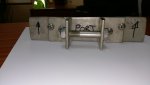
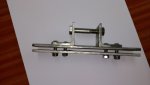
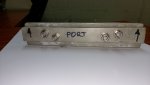
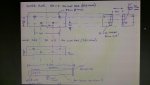
The above picture show a Leg a toe rail clamp and my back of fag packet drawing....

The main leg is 50*50*3mm stainless box section only 2.2M long and is sectioned into two parts that are bolted together.

The Toe rail attachment has two plates that sandwich the toe rail.
The inner plate fits inside the toe rail extrusion the outer plate carries two angle brackets that are through bolted through the standard oblong punched holes in the toe rail. Approximate overall length is 240mm.
The plates take up the slight curve of the toe rail when bolted up. This spreads the load well along the toe rail avoiding point loading. The plates are mounted at approximately the maximum beam of the boat.

The legs are set so that they are slightly splayed apart and held that way with the roller against the side of the hull.

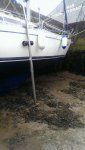
I use twin add on larger plastic spreader base on softer ground (It is called a bucket!) for drying out on soft ground. The first picture was taken at our local yards cleaning grid.

I would not advocate using legs in any adverse weather conditions or swell. Nor do I have intentions to use them on a half tide mooring on a permanent basis. My plan is to have them available for use in some of the drying locations of the Irish Sea. This could include Aberaeron but only on a fine summers day!

You will note that in the picture the starboard side leg is not actually touching the cleaning grid concrete base.
There are plenty of other boats that use toe rail mounts!IMAG0710.jpg and I have to say mine was not the first 301 to be so equipped Inspiration 2.jpg .

My inspiration came from seeing so many similarly equipped french boats at Sauzon and another Hanse owner.

We do start with an advantage that the 301 will virtually stand on its wing keel unaided. It just needs a little extra support once the tide goes down more than few inches.

I don't bother fitting legs to do a summer clean of the hull. I just dry out an hour and a half before low tide. I can easily walk around in .75 M of water and scrub off the bottom and keel before the tide even starts to come back in.

My idea for reducing the weight and length of the legs is to make a nylon block that will fit the toe rail mount without modifying them. The Nylon Block will have slightly off vertical bores which will take a standard carbon fibre tube.
The slight angle off will replace the need for a roller against the side of the hull and replicate the minimal splay required.

The Nylon block could incorporate a clamping mechanism for adjusting the leg length. However I have found that in actual use this really is not necessary unless you are grounding on very hard and uneven ground which is a crazy idea in the first place. Yachtlegs used to offer two versions and the adjustable ones looked very complicated.

http://www.easycomposites.co.uk/#!/...bon-fibre-tube/roll-wrapped-carbon-fibre-tube.

These carbon tubes for the same thickness as aluminium are much lighter and stronger. It is quite feasible to make a significant reduction in size and weight whilst maintaining the same strength as aluminium. It is also possible to select certain sizes that will be sliding fit to make a telescopic leg. I aim to come up with a simple and reliable twist and lock arrangement that will lock the sectional leg without weakening the tube end. That is the winter project. I am very familiar with the potential problem of shock, impact and/or crush damage to a Carbon Fibre tube. I have worked as a Production Engineer for most of my life and I do not anticipate this to be a problem for occasional use of yacht legs in appropriate conditions.
 
Last edited:
Hi TSB240, just avoid Aberaeron if the wind is in the WNW - N vector, that’s when and where the leg attachment failed to get the picture I posted earlier.
 
Hi TSB240, just avoid Aberaeron if the wind is in the WNW - N vector, that’s when and where the leg attachment failed to get the picture I posted earlier.
Bit of Fred Drift ... I know Aber and New Quay very well! I spent many infant hours digging holes in the sand at New Quay by the LB Station waiting for my Dad to come ashore after racing in his GP14 (Sail No.15!). Elderly family friend had an RNSA 14 that was on a mooring in Aber harbour. He used to be take me out fishing in it. Open Boat, Seagull O/B, Cork and Kapok Lifejackets, Those were the days.... Long time ago now!
 
Top