Yacht Mast 'derrick' from Compass

You mention three bridges on your route. The odds of both the outer two having owners who'd be happy with you using them aren't great, but if you could it would make it a breeze to raise and drop.

First bridge is a girder lattice based railway bridge that is prohibited access. Second is a fixed span road bridge. Third is a lifting road bridge that only lifts for small ships access on Pilots request. Yachts are kept in Fishing harbour in the Port. I'm basically the only daft ***** who has a sailing yacht up river of the bridges.

I could easily rig a derrick affair in my private mooring area - using the BBQ pontoon. But then the problem is to then raise the mast when away from there ...
 
With great respect and thanks to everyone ... near all ideas have been in my mind at various times in the past ... spinny pole fulcrum ... A frame ... etc. etc.

LittleSister has reminded me of a Westerly Pageant I looked at buying many years ago. Very nice as well ... guy had passed on and his widow put it up for sale. The Sunrider 25 was offered at same time and that extra 2ft made a big difference to me and I bought the SR25 instead.

Anyway - He set the boat up for single handed and modified the chainplates. He had access to aircraft alloy and stainless - so he extended the mainstay chainplates to be perfectly level with the mast pivot bolt. He could then lower the mast knowing those stays would look after the side motion. He also had a quick release on the forestay - but thats not the point.
It worked brilliantly and he enjoyed hops across channel and into French canals etc.

Sadly I heard later that a known 'Yacht Surveyor' had condemned these fittings ... advised to rip out the perfectly good Volvo engine to be replaced by an engine HE would supply etc. The Widow was advised by a good friend of mine who ran a repair facility in a yard to ignore the recc'd's as the engine was as perfect as you could get and the chainplates were better than originals ... he suggested that if she did carry out engine change - NOT to let Surveyor have the old ... also to check out Marine Power for better priced replacement.
Of course she had paid stupid money to the Surveyor for what was a **** report. She allowed him to take away the old engine for about 50 quid ... paid crazy for the new one ... and also to replace the chainplates.

Back to the chainplates .... I have a pal who is a metal fabricator ... I could have him create two V metal plates to bolt to the chainplates either side of the mains ... bringing the pivot point up level to mast pivot. Even the spinny pole could have guy lines back to same apex of the V plates ...

I think I have a simple and stowable solution...... just need to measure up ...
 
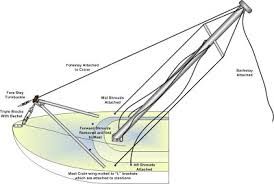
Compass some years ago advertised a mast lift system consisting of telescopic alloy poles and block / rope tackle. Idea being to lift mast vertically and then be able to lay flat.

I tried buying this some years ago - but they refused to ship to me in Latvia.

Has anyone used this system ?

Why do I ask ?

My yacht has a heavy mast and furling system forestay. Instead of my preferred tabernacle for mounting - it has the 'blade' system where mast foot has a slot and then a bolt to pivot. Its able to pivot and lay down mast - but extreme care has to be taken to not allow mast to fall t one side or other.
Because my yacht sits in private channel at rear of my house and also there are 3 bridges to get under - I have to raise / lower by hand. It takes at least 3 stout guys to do it.

I've tried posts fixed to pulpit - bent pulpit rails one year !

Of course best is crane or yard based derrick ... but not available ...

Anyone else with similar problem and how do you get round it ?

I have used the Compass derrick to lift and lower the mast on a Pioneer 9. Probably on the limits of it's capability but certainly reasonably easy with a bit of patience to set it up right for the boat.

Yoda
 
Hello Nigel The answer is to persevere with mast lowering aft on the pivotting base. The idea of shear legs lifting the mast was advocated by Lakesailor. However you need 2 shear legs which are longer than half of the mast length so that when you lift you are lifting from a point above centre of gravity of the mast.
I think even telescoping they would be to long to carry.
I have settled after many years on a system of 2 spinnaker poles. They fit into 2 purpose fitted rings on the side decks. So no tendency to fall sideways. The rings are mounted at a suitable distance from the forestay so they meet at the forestay. NB they do not have to be aligned abeam the mast base. Just aprox mine are at least 30cm aft of abeam.
Now you say you have a furler on the forestay. So it is really easier to use a spinnaker halyard to actually take the lifting load. I use the forestay and it is obviously stronger but you will need your forestay free to attach to the bow when it is back up. You may not have room under the forestay for the tackle to enable you to get the forestay attached. Just make sure the spin halyard is secure on the mast.
I have a high field lever in the forestay which makes tensioning the fractional rig very easy once the forestay is attached. But then I don't have reefing gear.
I have a dandy little hook arrangement attached to the forestay wire by a clamp just above the swage at the bottom of the forestay. I attach the tackle to this hook which leaves the eye on the forestay free to be attached or detached. My mast is light weight so I get away with a 3 purchase tackle finishing on a winch.

The concern is the sway of the mast sideways while in transit from up to sitting in the crutch. If you have a mast head rig with cap shrouds square abeam the mast, the trick is to shorten the stays and attach them to SS tubing or bar sitting on the chain plate and the top of the tube where the stay attaches is exactly in line with the mast pivot. The tube is stayed forward so it always remains vertical. As the mast swings down the cap shroud pivots on the top of the tube so stays tight right through the arc.

Not so easy with a fractional rig where cap shrouds are well aft of abeam the mast. One boat type MacGreggor 26 has additional intermediate stays to the point of the lower stays that pivot at a bracket (chain plate) on the cabin top exactly in line with mast pivot. These additional stays remain permanently fitted. If you have spare halyards you could run one each side to a similar point exactly in line with mast pivot. (so they stay the mast through the transit.) You may like to try attaching a clamp to each cap shroud about 1 metre from the bottom. You attach a line on each side that goes forward to a block then back to a winch so that you can tension the cap shroud as it goes slack.
Another method has 2 poles which pivot at a point on the gunwhales about half way from mast to transom. These poles attach to a car which runs up the mast track. Thus if you pull this car with a halyard (and a lanyard) If the car goes up the track the mast comes down. As you pull the car down the track the mast rises. The mast is always stabilised by the 2 poles. Poles are quite long and there is a limit to how low the mast can go. I would use a tackle on the forestay or spin halyard as well.
In practice I just use a person to stabilise the mast. But of recent years I have not traversed the bridges just use the system for taking mast down to tow home for winter.

Anyway I know an old guy on a mooring near me with a 45 ft or so boat he built to return to his native Croatia. He finished the boat but did not do the voyage. He does however regularly traverse under our bridges single handed. He uses the whole bow rail as a gin pole and stabilises the mast with the extended chain plates.
Another important trick is to have a crutch at the transom which is as high as possible commensurate with fitting under the bridges and for me low enough that I can reach and lift the mast down to a lower crutch for complete removal or work on the mast top.

Just keep at it as I said . Think about and improve you system and keep your helpers until you are happy to do it alone. It can be done. ol'will
Sorry Nigel did not see your last post I think you are on the right track ol'will
 
I have used the Compass derrick to lift and lower the mast on a Pioneer 9. Probably on the limits of it's capability but certainly reasonably easy with a bit of patience to set it up right for the boat.

That reassures me as the Pioneer 9 will have taller mast than mine. Probably heavier as well. The trick of course is to keep the weight dead under the apex and not let it move outside causing the legs to bend and fold.

I will be raiding the piggy bank soon I think for it ... I drive through Germany when I go back to UK ... so a small detour if necessary.

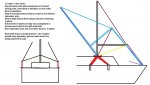
As to the raising chainplates to mast pivot height .. I have thought it through and come up with :>

Mast V plates.jpg

As in the text - the mast and spinnaker pole have guy lines to control side movement to the red metal V plates bolted to the baby stay chainplates (mine are actually U bolts through the toerail).
 
Its funny ... I modify a good suggestion of one ... then reading another (William H) - I get another 'brainwave' !!

The good ol' Centaur has chainplates in the cabin sides ... now this gives me an idea. I could have a temporary chainplate made up that bolt to each cabin side directly in line and matched to the mast pivot. In fact why not have them rigged permanently ?

I then use the spinnaker pole etc. etc.
 
That reassures me as the Pioneer 9 will have taller mast than mine. Probably heavier as well. The trick of course is to keep the weight dead under the apex and not let it move outside causing the legs to bend and fold.

I will be raiding the piggy bank soon I think for it ... I drive through Germany when I go back to UK ... so a small detour if necessary.

As to the raising chainplates to mast pivot height .. I have thought it through and come up with :>

View attachment 82735

As in the text - the mast and spinnaker pole have guy lines to control side movement to the red metal V plates bolted to the baby stay chainplates (mine are actually U bolts through the toerail).


This is a simpler way which will retain the stability of the mast.

Th e main difference is that the A frame pivots on a chain plat pair so there is no need to have the stabilising lines pivot at the same level as the mast pivot. This is due to the fact that the A frame stabilizes the mast s any movement sideways will be pulled back centre due to gravity.

da1133fbf224ca117e2c62c9032ab8ce.jpg


I did first consider your design but changed to what I consider is a simpler way.

The A frame can be any poles steel / aluminium / wood and can be easy connected together if the length is shorter for easy storahe on board.

Have a look at this guys setup

The DIY Restoration of a Small Yacht: Un-stepping the mast- Short-handed (#3) | Gael Force Marine
 
Last edited by a moderator:
Interesting and his photo is intriguing ... he shows only himself at the sheet winch - but in the text mentions father in law and wife ...

His mast fitting - that's one I really do not understand how a designer can come up with that !! I've seen ths on a few boats and always regarded it as worse than mine. My smaller day sailer has a mast that pops over two vertical tongues to keep foot in place ... awful !!

Using that guys idea ... local Builders merchants have metal fence poles of various lengths up to 3m ...... I tried them before as verticals from pulpit (two together) but they bent with mast weight. But used as sheerlegs - the weight is along the pole ...
 
Knowing it took two strong guys to lift my mast with furling forestay gear - I'm sure its a lot more than 30kg. My boat is not exactly a McGregor job ... its a 1975 Sunrider with an original Mk1 Centaur HD mast.

The furling gear would have been a problem if you had managed to obtain the Compass system. You could not have lifted the mast and furling spar together because the spar would have been trapped between the legs but it would have been impractical to lift it with the spar outside the legs.

I use an A frame similar to what neil-s describes
The forestay and furling spar attach to the apex of the A which is sized to just reach the stem head fitting when the mast is up.

My mast is lighter than Neil's, so do not need the assistance of a winch. I always pick a day with no wind and ask somebody to just help guide the mast up straight

My lower shrouds are in line with the mast ( caps and spreaders are swept aft ). I have often thought of relocating the attachment points for the lowers to the cabin sides ( It would also get them clear of the side decks) and raising them to be in line with the mast step pivot bolt. That would eliminate the possibility of the mast swinging sideways and not require any adjustment as the mast goes up or down.
 
Interesting and his photo is intriguing ... he shows only himself at the sheet winch - but in the text mentions father in law and wife ...

His mast fitting - that's one I really do not understand how a designer can come up with that !! I've seen ths on a few boats and always regarded it as worse than mine. My smaller day sailer has a mast that pops over two vertical tongues to keep foot in place ... awful !!

Using that guys idea ... local Builders merchants have metal fence poles of various lengths up to 3m ...... I tried them before as verticals from pulpit (two together) but they bent with mast weight. But used as sheerlegs - the weight is along the pole ...
The point about the mast pivot is to locate on the aft side of the mast so that as the mast pivots it will lift the mast base from the mounting.

My mast foot is a Tee mounter on deck locating in a wide slot on the foot of the mast.

I built a pivot pic posted above that clamps to the deck and the mast. Again the pivot is to the aft of the mast a the mast is lowered towards the aft.

If you keep the back stays connected their weight will tend to pull the mast aft. You may need to start the mast to lower so you may need someone else. I would like someone else just to check all is going ok.
 
I don't need to lift the mast of the T blade .... all I really need is to have the mast pivoted down to clear bridges ...

Image016.jpgDSC_6039.JPG

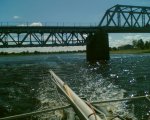
Here you see the metal fence posts bending ! But I think in sheerleg form - I can get longer - will be better.

One of the problems is that the boat is floating ... so any movement on board causes her to roll / tilt ... this makes mast 'sway'
 
The key is to have the A frame near horizontal with the mast vertical. The point of the A at the bow fitting and the wide part of the A connected to the aft lowers chain plate so the A can pivot upwards as the mast lowers.

The forstay/roller reeving is then disconnected from the bow fitting and connected to the point of the A and a line from the point of the A around the bow roller then back to a winch or windlass drum.

The forward lowers need to the disconnected to allow the mst to be lowered towards aft .

The mast does need a pivot of some kind to stop the mast base sliding forward out of control.

You may need someone to push the mast backward to start the lowering of you can use the halyard from the top of the mast pulling the mast towards aft.

The A frame is in compression and not in bending ar you have with your poles attached vertical to the pulpit.
 
Hi Roger ... known ... just posting ...

I tend to post thinking of others who may not understand or are having thoughts to try similar. The purpose of forums is to help others as well as ourselves ... Showing the picture with those posts bending - shows the force exerted ...
 
My intention is :

1. Be able to navigate the bridges as easy as possible.
2. Ne able to carry the solution on board to use anywhere.
3. That 2 people can do it.

To get back to this :

019-August52007_SA098.JPG

009-August52007_SA023.JPG

022-August62007_SA101.JPG

Enjoying the Baltic again
 
I have the approach of doing thing by my self or with wife's help and being a mechanical design engineer designing mechanical handling equipment for many years I tend to design setups to do things by myself.

As i am now retired I do like helping people to do what they need but sometimes I can go overboard with advice.

I have designed and supervised the lifting and building several boats weighing up to 24 tons including the my last one detailed in the wed site as linked to n my signature below.
 
I'm ex serving Merchant Navy Officer - so sheerlegs ... derricks ... etc. are all part of my previous career.

Trouble on ships now - they've gone ultra crazy on HSE and documentation before a job - that the job has become second place ,,, AND the old skills are lost.

Many a time recent years I've stood on deck waiting for crew to sort gear ... I see a ropes end all shaggy ... I splice it in time it takes them to sort. Every time I get amazing looks and questions about how I did that !!
 
Don't forget that the second hardest part of raising/lowering is the awkward fact that the CofG of the mast can be behind the boat when you're trying to make the initial connection at the heel pivot, which means that the 'weight' supported can be more than the mass of the mast. A decent temporary crutch/gallows at the back of the cockpit whines a lot less than the friend on whose shoulder it would otherwise be.
 
This is a simpler way which will retain the stability of the mast.

Th e main difference is that the A frame pivots on a chain plat pair so there is no need to have the stabilising lines pivot at the same level as the mast pivot. This is due to the fact that the A frame stabilizes the mast s any movement sideways will be pulled back centre due to gravity.

da1133fbf224ca117e2c62c9032ab8ce.jpg

I personally would be unwilling to rely on the A-frame keeping the mast central during the lift. I can't see that it does so effectively except during the very early stages of the lift, when the apex of the A-frame is above the mast head and gravity will tend to centralise the mast.

The drawing above shows the cap shrouds taught, but in fact they they will be loose until the mast is fully upright (unless the chainplates align vertically and horizontally with the mast). In the meantime, the mast is supported only by the mast step and the forward pull on the mast head. Any slight misalignment of the gear, lean to the mast, puff of wind, or (as in Refueler's case) movement of the boat and the masthead will come off the centreline and once that happens the line from the A frame will be pulling the mast further to that side as well as forward. The amount the mast falls to one side before being restrained by the opposite cap shroud might well exceed that at which damage is done to the mast foot or cabin top.

In order for the mast to be positively held centrally, lateral stays are necessary, in my view, and either their anchor point must align with the mast foot pivot point, or these stays must run through blocks and held under tension throughout the lift.
 
My main worry is that sideways motion of the mast ..... even with 3 stout people on the job - the lever effect that mast has is significant and hard to hold.

The A frame is the way to go .... and I am going to sort a way to have side guy-lines to control the side motion ... the eventual solution is hoped to be a single man operation ...

Another thought I had was to replace the pivot bolt with a short piece of threaded studbar. This would have a nut each side.

Two pieces of metal length to match from mast foot to side of boat. With vertical to the capstays fitting. At outer ends of bars - have attachment for side guy lines. Lock the vertical to capstays fittings. Undo each nut at mast foot, attach metal bar, replace nut. This then gives a supported in line set to control the sideways motion of mast.

Just throwing ideas out ...
 
Last edited:
Top