Yacht Mast 'derrick' from Compass

Refueler

Well-Known Member
Joined
13 Sep 2008
Messages
23,994
Location
Far away from hooray henrys
Visit site
Compass some years ago advertised a mast lift system consisting of telescopic alloy poles and block / rope tackle. Idea being to lift mast vertically and then be able to lay flat.

I tried buying this some years ago - but they refused to ship to me in Latvia.

Has anyone used this system ?

Why do I ask ?

My yacht has a heavy mast and furling system forestay. Instead of my preferred tabernacle for mounting - it has the 'blade' system where mast foot has a slot and then a bolt to pivot. Its able to pivot and lay down mast - but extreme care has to be taken to not allow mast to fall t one side or other.
Because my yacht sits in private channel at rear of my house and also there are 3 bridges to get under - I have to raise / lower by hand. It takes at least 3 stout guys to do it.

I've tried posts fixed to pulpit - bent pulpit rails one year !

Of course best is crane or yard based derrick ... but not available ...

Anyone else with similar problem and how do you get round it ?
 
How about using sheerlegs?

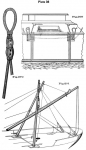
An inverted V-frame made of tubes and tube fittings [ Kee Lite - Fittings ]

With the bottom of the legs loosely attached to chain plates, and some temporary stays attached, angled slightly forward, with a block and tackle attached to the apex, you can lift the mast and then swing it down horizontally .

Obviously you would have to have guy ropes and a couple of helpers to control everything.

1577016747784.png
 
I tried with spinny pole giving better angle - but as mast angle increased - the pole went to side before could be stopped ... lucky I had my usual guys to stop the mast falling to one side.
To use spinny pole would add more rope-guys to handle.

This is the item I wanted that they refused to ship :

Telescopic Mast Derrick

I notice that compared to old advertisement - they have reduced the max load rating to 120kgs. That would likely put my mast into questionable range ... anyone know weight with Plastimo 509 a Centaur mast ?

At 385 euros ... not exactly cheap and considering I have to add blocks / rope etc. as it only comes as two legs.
 
Last edited:
I tried with spinny pole giving better angle - but as mast angle increased - the pole went to side before could be stopped ... lucky I had my usual guys to stop the mast falling to one side.
To use spinny pole would add more rope-guys to handle.

This is the item I wanted that they refused to ship :

Telescopic Mast Derrick

I notice that compared to old advertisement - they have reduced the max load rating to 120kgs. That would likely put my mast into questionable range ... anyone know weight with Plastimo 509 a Centaur mast ?
That is what I described in Post #3 (perhaps not very well). You don't need to pay all that money for something so simple to make yourself.
 
That is what I described in Post #3 (perhaps not very well). You don't need to pay all that money for something so simple to make yourself.

I agree .... but I need to carry it on the boat as well and its only a 25ft'r ... so the Compass system telescoping down to 2.5m would sit on coachroof OK.

From my house mooring to baltic is via 3 bridges, and usually there are only two of us on board. So with this - we could drop mast ... get to the outer port area ... raise it back up and off we go ...

I asked a metal fabricator in Riga who makes alloy flag poles if they could produce something for me ... wasted effort !
 
Get a mast step fabricated that you can bolt down replacing your existing one,with sides say 18 inches should give stability for mast operation without other parafanalia except maybe a jockey pole that gives you a better angle to start the lift or lowering
 
I agree .... but I need to carry it on the boat as well and its only a 25ft'r ... so the Compass system telescoping down to 2.5m would sit on coachroof OK.

From my house mooring to baltic is via 3 bridges, and usually there are only two of us on board. So with this - we could drop mast ... get to the outer port area ... raise it back up and off we go ...

I asked a metal fabricator in Riga who makes alloy flag poles if they could produce something for me ... wasted effort !
Join two lengths of 2.5m aluminium tube using these L14 - Straight Coupling

Or buy 2.5m lengths of tube that will telescope into each other, and drill through where they overlap for drop nose pins or just screws and wing nuts
 
Could you build some sheerlegs out of ally scaffolding poles? Adjustable guys fore and aft would fix it in place until you want it to move, so it should be doable single handed.

As for the weight, how many people does it take to pick it up? If two people can pick it up and put it on their shoulders to carry it, it's unlikely to be more than about 100kg. If I'm one of them, it's a fair bit less
 
There are 3 main ways

1) using an A frame as a crane to lift the mast and lower to the deck. The one you shown is this type.

2) Using a pivoted A frame and a pivoted mast. The pivoted A frame will provide sideways stability when lowering the mast.

3) A single raising pole pivoted on deck like the A frame and a pivoted mast. You need side lines to provide stability when lowering the mast.

The one in the video I posted is the pivoted A frame and pivoted mast which can be easy rigged and left rigger to lower . lift the mast when passing the mast.

Comoaired to my mast 15 meters high and weighting several 100 Kg.

My A frame has flanges on each end 1 meter long and that together and can to give a 6 meter high A frame. The forestay is disconnected from my bow fitting what the mast lowered using a block and tackle from the bow fitting to the A frame.

I would use my anchor windlass to lower and raise the mast when under way.
 
There are 3 main ways

1) using an A frame as a crane to lift the mast and lower to the deck. The one you shown is this type.

2) Using a pivoted A frame and a pivoted mast. The pivoted A frame will provide sideways stability when lowering the mast.

3) A single raising pole pivoted on deck like the A frame and a pivoted mast. You need side lines to provide stability when lowering the mast.

As having a pivoting mast would be difficult for me, I've often wondered whether an A frame (type 2) such as that used in pivoting set ups (i.e. fixed to the deck athwart the mast, and shaped to follow inside the gunwale to the bow when lowered) would be sufficiently rigid to use as a crane to lift a non-pivoting mast. They are typically stainless steel tubing, but I also wonder about laminated wood.

Perhaps I'll make my first million manufacturing ultra-lightweight carbon fibre masts filled with helium. :D
 
As having a pivoting mast would be difficult for me, I've often wondered whether an A frame (type 2) such as that used in pivoting set ups (i.e. fixed to the deck athwart the mast, and shaped to follow inside the gunwale to the bow when lowered) would be sufficiently rigid to use as a crane to lift a non-pivoting mast. They are typically stainless steel tubing, but I also wonder about laminated wood.

Perhaps I'll make my first million manufacturing ultra-lightweight carbon fibre masts filled with helium. :D

If you wish to use an A frame to lift the mast you will need a for and aft support of the A frame. You would also need to totally disconnect the standing rigging from the deck to allow the mast to be lifted.

My Mast does not have a built in hinge so I built one to clamp onto the mast and to the deck

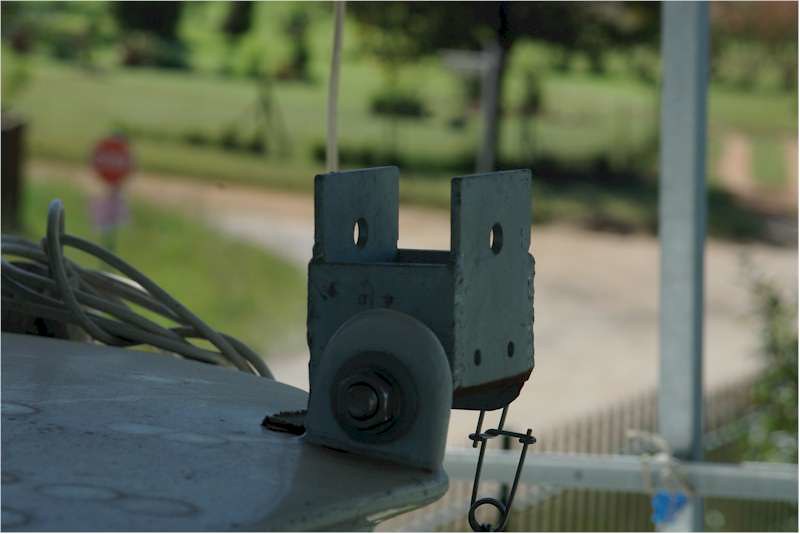
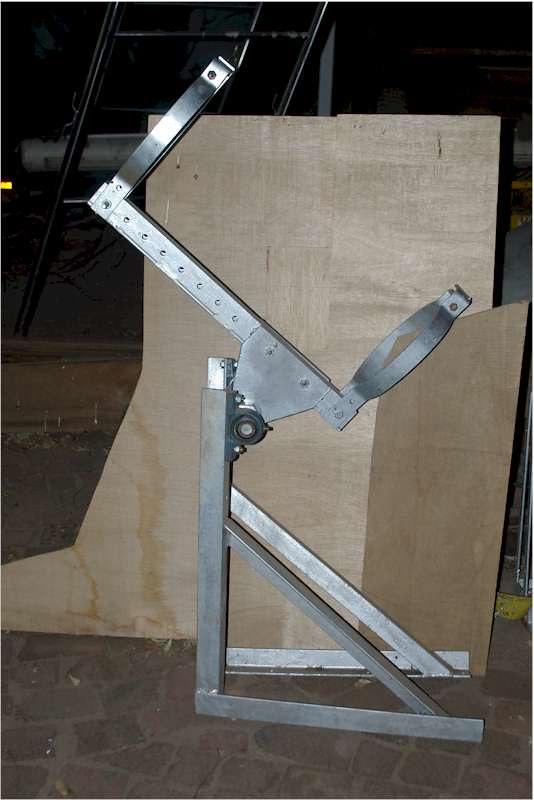
A frame deck/cabin top hinge

36086035985_e14622e7ca_c.jpg


35953141491_d0657902aa_c.jpg


The DIY Restoration of a Small Yacht: Un-stepping the mast- Short-handed (#3) | Gael Force Marine

2-sunfire-invicta-mast.jpg
 
Last edited by a moderator:
I have used two vertical aluminium scaffold poles with a shorter crosspiece secured with scaffold clamps and with the guys crossed to give some lateral support. I used the main halliard to raise the frame and a block on the crosspiece to lower and raise the mast. When the mast work was completed the frame could be lowered with the halliard so it was a one man job. Not so easy if you need to get the frame up and down without the mast in place. No problem on a 26ft boat with the mast probably weighing about 30Kg. The only thing I got wrong was to use a single block which puts twice the load on the crosspiece when you pull down. A multi-part tackle would have been much better.
 
Made one for a 21ft boat recently, so he could launch and recover solo on day trips.
Two ally poles with the bottoms hinged by the gunnel as close to the line running through the mast step as is possible. Apex of poles joined by an 'A' plate with one side single bolted to hinge, for storage. Two hooks on 'A' plate, one aft to allow a line to go round the mast then down to deck via a pulley. Other hook faced forward to attach the hoist line. In this case the foot sat on a spigot, but with a cross bolt behind that sat in two U shaped sockets.
To raise: The frame is assembled with the line round the mast slack enough for the frame to be up from the horizontal and the mast supported on a crutch off the pushpit. The hoist line is led back to a winch via a clutch. Mast is pulled up to the apex by the line at the apex and that line tied off. Remainder of hoist is by the winch. The frame holds the mast vertical until the shrouds become taut. Forestay (in this case, the forsail is hanked on) is then secured and tensioned.

I will try and put up a sketch later...
 
Compass some years ago advertised a mast lift system consisting of telescopic alloy poles and block / rope tackle. Idea being to lift mast vertically and then be able to lay flat.

I tried buying this some years ago - but they refused to ship to me in Latvia.

Has anyone used this system ?

Why do I ask ?

My yacht has a heavy mast and furling system forestay. Instead of my preferred tabernacle for mounting - it has the 'blade' system where mast foot has a slot and then a bolt to pivot. Its able to pivot and lay down mast - but extreme care has to be taken to not allow mast to fall t one side or other.
Because my yacht sits in private channel at rear of my house and also there are 3 bridges to get under - I have to raise / lower by hand. It takes at least 3 stout guys to do it.

I've tried posts fixed to pulpit - bent pulpit rails one year !

Of course best is crane or yard based derrick ... but not available ...

Anyone else with similar problem and how do you get round it ?
We have one at our club, works very well as long as pivot point below 5m as the legs are 6m max. You could easily make one with 2x 6m Ali scaffold tubes. I’ve just lowered my mast today which has to be lifted of foot plate before swinging out. We had to make a crane onto the end of our boat hoist and it worked very well. Lifted, moved sideways and then lowered directly onto floor stands.
8870BB6D-2F63-4792-9B79-052275E19C47.jpeg
 
28 foot boat with roller furling and a blade type mast step. I used a soft wood A frame resting against the forward chain plates. Pull was provided by the main sheet tackle with the fall directed to a sheet winch. The mast was kept over the centre line with a couple of light temporary shrouds to a slider in the mainsail slot. This was held up by the main haliard so it could be adjusted as the mast came down (or up). A gallows at the pushpit supported the mast when down. Note that the spreaders will be outboard of this so be careful if you have to undo the mast step bolt. I could do all this by myself when a bit younger! A mast down and a mast up would be seriously hard work in one day, but for you, the mast would only need to pivot down, tidy the shrouds to keep them on deck, motor to the port and then mast pivoted back up and secure. Good luck!
 
You mention three bridges on your route. The odds of both the outer two having owners who'd be happy with you using them aren't great, but if you could it would make it a breeze to raise and drop.
 
Some years ago I raised and lowered the fairly heavy mast on a 23 footer as follows, which might be of use/interest to someone tackling the task.

Mast could pivot on bolted foot, but no tabernacle. Mast supported at rear by crossed pieces of scrap wood making a temporary crutch, and bolted loosely to the mast foot. Backstay attached both ends.

Spinnaker pole in usual fitting on front of mast, to act as a jockey pole, rigged up at right angles to mast. Masthead halyard attached to other end of spi pole. Mainsheet attached between bow fitting and other end of spi pole. Spi pole held laterally by lines from chainplates (as the chainplates are not in line with the mast foot pivot point the spi pole will fall a little to one side or the other as the mast comes up, but not enough to be critical, and it does not flop about because of the amount of tension on mainsheet/halyard.

Keeping the mast central laterally is, however, critical to avoiding serious damage to the foot and cabin top. This is normally done by rigging up plates from forward and aft shroud chainplates to form a triangle with its apex in line with the mast pivot, and attaching a guy (or upper part of two piece shroud) from this to high up the mast. I kept the mast central by the cunning ruse (patent applied for ;) ) of attaching the fall of the masthead halyard (external to the mast, and the other end of which went to the spi pole and mainsheet) to 2 equal length lines running from the chainplates either side. As the mast comes up the tension on the halyard (from the mainsheet lifting the mast) takes up the slack in these lines which would otherwise arise.

Mainsheet (four part IIRC) was ample to lift after assistant had helped lift the mast from the cockpit for the first couple of feet (not sure this was necessary). Spi pole falls to one side a bit, as expected, but mast stayed firmly central. Once the mast was vertical it could be easily held in place by the backstay aft, the halyard/mainsheet combination forward, and laterally by the 'patent' guys mentioned above while the forestay and shrouds were attached and tensioned.

I had spent much time and the back of many envelopes devising this set-up, but at the time had no previous experience of raising and lowering masts. In practice, all went smoothly both raising and lowering the mast, but I was very nervous as I had only a single helper who was neither strong nor mechanically minded, and didn't know if I'd overlooked some critical consideration, or whether all the parts under strain were capable. Had anything gone wrong it would have been difficult to recover, and with other boats packed tightly around a lot of damage could have been caused.

As mentioned on another thread, having got the mast up I belatedly discovered the mail order replacement rigging had not been made up (by the chandlery well known for this service) to the lengths I'd specified, so the mast had to come straight down again, and when I eventually got the correct parts (but no apology) I bottled out and paid the yard to crane the mast up again. Having gained a bit more experience with such matters I'd be less nervous about tackling it now, but also try harder to find a more capable assistant.
 
Last edited:
Get a mast step fabricated that you can bolt down replacing your existing one,with sides say 18 inches should give stability for mast operation without other parafanalia except maybe a jockey pole that gives you a better angle to start the lift or lowering

I considered removing the 'blade' fitting and replacing with tabernacle or as you suggest - a mast step with sides. But all cleats and fittings are too low on the mast ....
 
No problem on a 26ft boat with the mast probably weighing about 30Kg.

Knowing it took two strong guys to lift my mast with furling forestay gear - I'm sure its a lot more than 30kg. My boat is not exactly a McGregor job ... its a 1975 Sunrider with an original Mk1 Centaur HD mast.
 
Top