Yacht leg modification - strength affected?

Tim Good

Well-Known Member
Joined
26 Feb 2010
Messages
2,889
Location
Bristol
Visit site
I have some Yacht Legs beaching legs whicj we’ve use to great effect. However when deployed on flat ground they’re on their maximum lower leg setting. I can then wind the leg up or down by about 15cm but it isn’t really much.

I want to drill one more hole in the lower leg as I’m currently on the last hole. In doing so this would afford my an additional 6cm adjustment longer if needed.

Question:
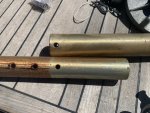
Clearly if I add one more hole then the overlap into the next section will be less and therefore weakened. But is there an engineer that can tell me if it is significant enough to worry about. Currently there is 19cm to hole. A new hole would reduce that by 6cm.

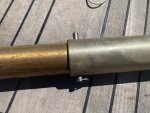
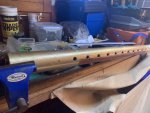
See the dot where I plan for a new hole. And another photo showing the two pieces side by side and the amount of overlap.

Now most of the force is downwards via a 12mm Stainless pin. But there does need to be some lateral strength. Perhaps not much.
 

Attachments

  • 8D1B21E9-06B4-4AE8-96ED-C061E33F8441.jpeg
    8D1B21E9-06B4-4AE8-96ED-C061E33F8441.jpeg
    98.3 KB · Views: 26
  • 52F1D93F-A8BD-4AD7-BAC1-80BDFD5619D6.jpeg
    52F1D93F-A8BD-4AD7-BAC1-80BDFD5619D6.jpeg
    132.3 KB · Views: 27
  • 7CF2C750-F5E1-4E3A-BB7C-93DE002AD27C.jpeg
    7CF2C750-F5E1-4E3A-BB7C-93DE002AD27C.jpeg
    117.1 KB · Views: 30
  • 73D4F285-2D94-43F9-8983-A36E1DF532AD.jpeg
    73D4F285-2D94-43F9-8983-A36E1DF532AD.jpeg
    77 KB · Views: 28
When sleeving tubing you should have at least a 2.5 times of the diametre overlap. The shear load on the 12mm bolt in your case is 2x the shear load and about half that if threaded. One option would be to find a length of tubing of the same diametre and make an auxiliary sleeve.

I have found the loading on the legs to be surprisingly low. Two people walking from side to side would make our 8.5t boat switch legs. Originally I made the legs 1.5" shorter than the keel; I have now cut off another 1.5" to accommodate the legs sinking in and to cut down on the jarring hippo dance when refloating.
 
When sleeving tubing you should have at least a 2.5 times of the diametre overlap. The shear load on the 12mm bolt in your case is 2x the shear load and about half that if threaded.

Many thanks. Good to know that fact. So presumably 2.5x maintains the integrity of the tube laterally. But as you say, the tubes in this instant aren’t taking lateral forces, not even remotely, even in the worse possible case scenario. Or at least the boat would need to topple over and fall on the leg, by which time there are other things to worry about.

If I make a new hole it would then equate to 2x the diameter. It’s currently 3x. But as you say, the better solution would be a short extension to give me more than the added 6cm id get from a new hole.

The reason for all this is that even the longest legs weren’t quite long enough for my boat. Or at least boarderline. I want more security to know that if we dried out on ground which wasn’t perfectly level or if there was a hole to one side, that id have more than the 15cm of added extension I have currently.
 
I don't think there would be a problem at the bottom there, either.. Though if you increase the working length you potentially load the top fittings more and that is probably where the point of failure would be. Not that I am suggesting a problem, in ordinary use I am sure it would be fine for most boats.

It might help to know that the original legs, with the standard hull fittings, were rated by the manufacturers up to 9 ton displacement with a maximum average working length of 9ft (hull spigot down to base of keel - with the adjustment at the red dot, mid position).

.
 
I have some Yacht Legs beaching legs whicj we’ve use to great effect. However when deployed on flat ground they’re on their maximum lower leg setting. I can then wind the leg up or down by about 15cm but it isn’t really much.

I want to drill one more hole in the lower leg as I’m currently on the last hole. In doing so this would afford my an additional 6cm adjustment longer if needed.

Question:
Clearly if I add one more hole then the overlap into the next section will be less and therefore weakened. But is there an engineer that can tell me if it is significant enough to worry about. Currently there is 19cm to hole. A new hole would reduce that by 6cm.

See the dot where I plan for a new hole. And another photo showing the two pieces side by side and the amount of overlap.

Now most of the force is downwards via a 12mm Stainless pin. But there does need to be some lateral strength. Perhaps not much.
If I were you I would add a 6cm block of hardwood to the foot.

www.solocoastalsailing.co.uk
 
Many thanks. Good to know that fact. So presumably 2.5x maintains the integrity of the tube laterally. But as you say, the tubes in this instant aren’t taking lateral forces, not even remotely, even in the worse possible case scenario. Or at least the boat would need to topple over and fall on the leg, by which time there are other things to worry about.

If I make a new hole it would then equate to 2x the diameter. It’s currently 3x. But as you say, the better solution would be a short extension to give me more than the added 6cm id get from a new hole.

The reason for all this is that even the longest legs weren’t quite long enough for my boat. Or at least boarderline. I want more security to know that if we dried out on ground which wasn’t perfectly level or if there was a hole to one side, that id have more than the 15cm of added extension I have currently.
Bending forces become an issue if, or rather when, the boat dries out with a list, or a foot finds a soft spot. At this point you are adding a bending component to the compression load and calculation of the compound load gets a bit tricky.

I'm pretty sure though that a foot either way in length or a ton of displacement more or less would still be well within the safety margins, especially since a great deal of the weight is in your keel and the CoG probably near or below DWL.

I went quite crazy calculating the possible loads on my legs before building them: storm force winds, tanks only filled on one side, the liquor cabinet shifted to port, a dozen guys from my son's rugby team standing to port only and with the contents of the a fore mentioned cabinet, the boat listing 20 degr ... you get the point. In the end I saw a picture of a 100t + Breton trawler propped up by a couple of 4x4s and decided to get a grip and just grab a couple of 2 3/4 x 3/8 tubes from the rack. Later I sleeved them so they could be split in half and stored in the bilge.
 
Top