

You are using an out of date browser. It may not display this or other websites correctly.
You should upgrade or use an alternative browser.
You should upgrade or use an alternative browser.
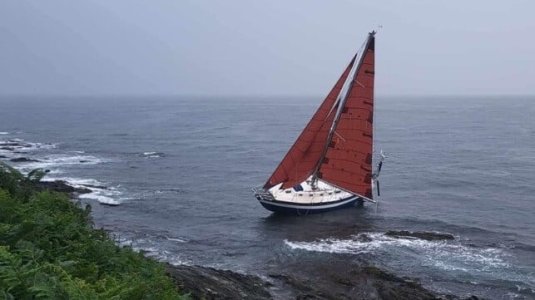
Yacht ashore on the Cornish coast.
- Thread starter garymalmgren
- Start date
KevinV
Well-Known Member
Oh dear, that's not going to be a happy tale 

Stemar
Well-Known Member
My thoughts exactly.Oh dear, that's not going to be a happy tale
It seems a search has been called off. Search for missing yacht skipper called off in Cornwall

MikeBz
Well-Known Member
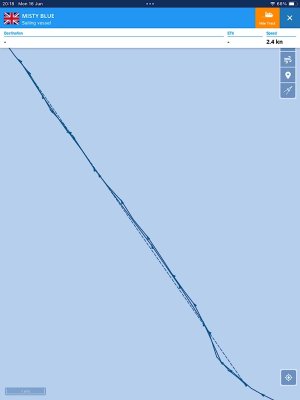
Very sad. AIS track is odd. Left Roscoff on the morning of the 12th heading slightly W of N, at 20:46 that evening is a bit over 1/3 of the way across the channel, then the next update approx 6 hours later is 10nm back in the direction of Roscoff. From that point the updates continue in the original direction.
C08
Well-Known Member
Boat sailing on auto-could have fallen off anywhere, sad.

LittleSister
Well-Known Member
Sad, and nice looking boat.
Boat has wind-vane self steering (and sails up, so presumably enough wind for it to operate). Could strange change and then resumption in course be the result of a (local?) change in wind direction then it going back to the original wind direction?
Boat has wind-vane self steering (and sails up, so presumably enough wind for it to operate). Could strange change and then resumption in course be the result of a (local?) change in wind direction then it going back to the original wind direction?
MikeBz
Well-Known Member
I did wonder, but it would have to have been 2 x near-exact 180 degree wind shifts 6 hours apart. Odd that there are no AIS pings during that 6 hours.Boat has wind-vane self steering (and sails up, so presumably enough wind for it to operate). Could strange change and then resumption in course be the result of a (local?) change in wind direction then it going back to the original wind direction?
oldmanofthehills
Well-Known Member
Sad. I am pretty sure we saw it in Roscoff with the skipper getting ready, before we motored back last Monday/Tuesday to catch the weather window
I expect it’s single handed sailor not clipped on and falling in, as people smugglers would take sails down to make themselves less noticeable on the beach
Probably will never find the corpse if it happened mid channel. A sombre thought. RIP voyager
I expect it’s single handed sailor not clipped on and falling in, as people smugglers would take sails down to make themselves less noticeable on the beach
Probably will never find the corpse if it happened mid channel. A sombre thought. RIP voyager
ylop
Well-Known Member
Is that not just that she was out of range of whichever shore stations are feeding marinetraffic? That's presumably a function of both the boat's antenna height and the height of the shore station, potentially with weather factors on top?Odd that there are no AIS pings during that 6 hours.
MikeBz
Well-Known Member
There are pings over that section as she is heading North, then a 6 hour gap at the end of which she has retraced 10nm, then pings again as she re-covers the same (more or less) track North again. You can view the track on VesselFinder.Is that not just that she was out of range of whichever shore stations are feeding marinetraffic? That's presumably a function of both the boat's antenna height and the height of the shore station, potentially with weather factors on top?

johnalison
Well-Known Member
I have always regarded the autopilot as the most dangerous piece of equipment on board.
oldmanofthehills
Well-Known Member
On that crossing we had no shorebased vhf messages for about the middle 50 miles. We could see AIS for boats about 15 miles from us. The ocean is big and sometimes you are on your ownIs that not just that she was out of range of whichever shore stations are feeding marinetraffic? That's presumably a function of both the boat's antenna height and the height of the shore station, potentially with weather factors on top?
john_morris_uk
Well-Known Member
That’s why I have a rule that lone watch keepers are ALWAYS clipped on and NEVER leave the cockpit without calling for someone below to help. (It’s just about impossible to fall overboard when clipped on in our centre cockpit. It’s too far…)I have always regarded the autopilot as the most dangerous piece of equipment on board.

wonkywinch
Well-Known Member
Seeing other nearby vessels on your system based AIS (eg AIS receiver onto chart plotter) mid ocean is not the same as seeing (or not) a vessel on an internet based service like Marine Traffic or Vesselfinder.On that crossing we had no shorebased vhf messages for about the middle 50 miles. We could see AIS for boats about 15 miles from us. The ocean is big and sometimes you are on your own
The latter mainly use shore based receivers feeding the service. Some vessels are equipped with Marine Traffic devices that then feed traffic within that boat's range to the internet server but only when they are online, eg Starlink.
MikeBz
Well-Known Member
I thought I’d posted a snapshot of the part of the AIS track in question, which shows that it’s not an out-of-range issue. The dotted line is the 6 hour gap at the SE end of which she has returned 10nm back in the direction of Roscoff. There is then a 2nd trail of pings heading back NW, approx 6 hours later than the first set.

MontyMariner
Well-Known Member
What a luxury to sail mob handed! Us lonesome soles do the best we can.That’s why I have a rule that lone watch keepers are ALWAYS clipped on and NEVER leave the cockpit without calling for someone below to help
KevinV
Well-Known Member
Odd indeed, if the data is correct.I thought I’d posted a snapshot of the part of the AIS track in question, which shows that it’s not an out-of-range issue. The dotted line is the 6 hour gap at the SE end of which she has returned 10nm back in the direction of Roscoff. There is then a 2nd trail of pings heading back NW, approx 6 hours later than the first set.
View attachment 194891
Looks like someone hit "reverse track" on the autopilot, as you might if you came above decks to find your companion on watch missing.
Or perhaps simpler, just biding time to arrive at a particular time?
Last edited:
oldmanofthehills
Well-Known Member
Well to reverse your course is itself strange. Either you have an equipment failure which you are hoping to sort out if necessary at your port of origin, or you have found the conditions so bad you have considered aborting your passage, or as Kevin suggested you are looking for something or someone lost overboard.I thought I’d posted a snapshot of the part of the AIS track in question, which shows that it’s not an out-of-range issue. The dotted line is the 6 hour gap at the SE end of which she has returned 10nm back in the direction of Roscoff. There is then a 2nd trail of pings heading back NW, approx 6 hours later than the first set.
View attachment 194891
Surely a person overboard would prompt a MayDay. No one adds 6 hours looking for a lost fender. And surely an MOB would forcibly remind the person remaining to make sure they were clipped on for further foredeck work
wonkywinch
Well-Known Member
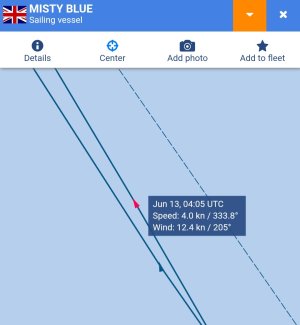
The tracker doesn't show any turn back/course reversal. Both tracks are a NW course but carried out 8 hours apart (1900ish then 0300ish). I can't see any pings with a SE course.I thought I’d posted a snapshot of the part of the AIS track in question, which shows that it’s not an out-of-range issue. The dotted line is the 6 hour gap at the SE end of which she has returned 10nm back in the direction of Roscoff. There is then a 2nd trail of pings heading back NW, approx 6 hours later than the first set.
View attachment 194891
The second pass is so close to the other the trip must have been in nav mode with the drift laid off. Or an electrical gremlin with the data transmissions.

garymalmgren
Well-Known Member
Two different AIS transponders switched on at the same time?
But that doesn't count for the time difference.
But that doesn't count for the time difference.
Last edited:
Other threads that may be of interest
- Replies
- 11
- Views
- 279

- Replies
- 9
- Views
- 225
