

You are using an out of date browser. It may not display this or other websites correctly.
You should upgrade or use an alternative browser.
You should upgrade or use an alternative browser.
Wrap around jib on a furled genoa
- Thread starter garymalmgren
- Start date
justanothersailboat
Well-Known Member
Interesting! Thanks for sharing it.
There's a lot to be said for having an option for a smaller headsail... I hope this one works out, it looks handy.
There's a lot to be said for having an option for a smaller headsail... I hope this one works out, it looks handy.
fredrussell
Well-Known Member
Nice project- give us an update when you’ve tried it out in heavy winds. Seems like a great idea.

Roberto
Well-Known Member
Nice one  The professionally made ones I saw have a sleeve which uses the same jib hanks. Yours seems to use a thin line through grommets (?), will the sleeve remain closed in case of stronger winds -if the sail is supposed to be used such ?
(Really envy your roasted onigiri )
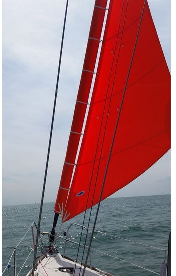
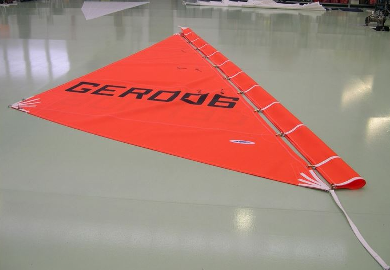
The professionally made ones I saw have a sleeve which uses the same jib hanks. Yours seems to use a thin line through grommets (?), will the sleeve remain closed in case of stronger winds -if the sail is supposed to be used such ?(Really envy your roasted onigiri
)
garymalmgren
Well-Known Member
RE; I saw have a sleeve which uses the same jib hanks.
This was a test run.
will the sleeve remain closed in case of stronger winds
The line through grommets system worked when up, but not sure how strong that will be.
However, it took way too long to thread through and set up. Have to modify that.
I looked at reusing the original hanks but they are too small. Longer hanks are maybe an option later.
RE; an option for a smaller headsail.
My genoa furls quite well, but it is only 2 years old and quite light and I don't want stretch and wear.
I often sail in 25 plus knots with it furled. So when this smaller staysail fell into my lap I thought , Why not?
This test sails sets well.
RE; when you’ve tried it out in heavy winds.
That will be test 2 after a few mods.
All in all it was quite good and free!!
Thanks for your interest.
gary
This was a test run.
will the sleeve remain closed in case of stronger winds
The line through grommets system worked when up, but not sure how strong that will be.
However, it took way too long to thread through and set up. Have to modify that.
I looked at reusing the original hanks but they are too small. Longer hanks are maybe an option later.
RE; an option for a smaller headsail.
My genoa furls quite well, but it is only 2 years old and quite light and I don't want stretch and wear.
I often sail in 25 plus knots with it furled. So when this smaller staysail fell into my lap I thought , Why not?
This test sails sets well.
RE; when you’ve tried it out in heavy winds.
That will be test 2 after a few mods.
All in all it was quite good and free!!
Thanks for your interest.
gary
Neeves
Well-Known Member
Perfect PBO project.
Keep us updated.
Jonathan
Keep us updated.
Jonathan

Porthandbuoy
Well-Known Member
Interesting. I wonder if using parrel beads, akin to a gaff mainsail, instead of a sleeve would make hoisting and dropping less of a faff.
Neeves
Well-Known Member
If you had a dyneema luff and dyneema halyard for the sail you would not need to use the furled headsail.
You could bodge up a halyard, from dyneema, using a block at an appropriate location on the mast (under the forestay) and a swivel just aft of the existing forestay termination at the bow. The new halyard is, obviously, not in the mast
Its not an original idea - and was a part of a recent thread (but I forget which)
You do need to grind the halyard hard (tight) on a winch to allow the new headsail to point - but it makes the new sail independent of the furled headsail.
Jonathan
You could bodge up a halyard, from dyneema, using a block at an appropriate location on the mast (under the forestay) and a swivel just aft of the existing forestay termination at the bow. The new halyard is, obviously, not in the mast
Its not an original idea - and was a part of a recent thread (but I forget which)
You do need to grind the halyard hard (tight) on a winch to allow the new headsail to point - but it makes the new sail independent of the furled headsail.
Jonathan

Supertramp
Well-Known Member
Would big dyneema soft shackles work over the furled sail ? They might not slide up or down easily.
I completely agree about trying not to spoil a good sail in too much wind. One of the keys is that it's simple to deploy when you need it, with second sheets already in place - usually in strong wind already etc. I have a detachable Solent stay but it means tacking is impossible without furling and there is a sail to keep on deck.
Great to see some one experimenting. You are inspiring me to have a go with an improvised mizzen staysail this year.
I completely agree about trying not to spoil a good sail in too much wind. One of the keys is that it's simple to deploy when you need it, with second sheets already in place - usually in strong wind already etc. I have a detachable Solent stay but it means tacking is impossible without furling and there is a sail to keep on deck.
Great to see some one experimenting. You are inspiring me to have a go with an improvised mizzen staysail this year.
garymalmgren
Well-Known Member
RE. using parrel beads, and Would big dyneema soft shackles
The idea of stress or rubbing points on the furled genoa bothered me. After all I was trying to preserve that sail.
Both exposed soft shackles and parrel beads rubbing on the genoa would defeat the purpose.
My first idea was to use soft shackles in (yellow 50mm tape) sleeves which I sewed onto my skirt in line with the grommets.
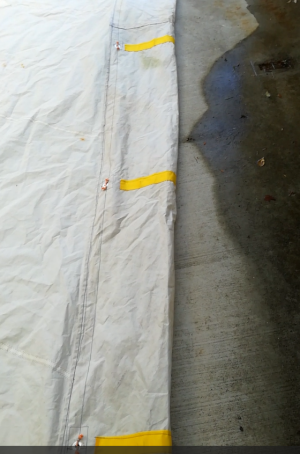
I thought that the stress would be spread by the skirt. Then I thought that those stress points would still be concentrated as wear lines on the genoa.
So I went for the threaded line.
When I tried it last weekend everything was floppy and difficult to thread through. This would be useless in heavy weather.
My next move will be to epoxy the end of the line so that it is rigid and will be easier to thread through the loops.
After that I am thinking of every second grommet with a soft shackle in combination with the threaded line and finally just soft shackles or lanyard and toggles through the sleeves.
Winter is long so I have lots of time to experiment.
RE: If you had a dyneema luff and dyneema halyard for the sail you would not need to use the furled headsail.
Almost all head sails excluding spinnakers, gennakers and code zero are hanked onto a stay. I don't think I would get enough tension even with dyneema on a free flying jib in heavy weather that is why I am taking this path (for now).
Thank you all for your input.
gary
The idea of stress or rubbing points on the furled genoa bothered me. After all I was trying to preserve that sail.
Both exposed soft shackles and parrel beads rubbing on the genoa would defeat the purpose.
My first idea was to use soft shackles in (yellow 50mm tape) sleeves which I sewed onto my skirt in line with the grommets.
I thought that the stress would be spread by the skirt. Then I thought that those stress points would still be concentrated as wear lines on the genoa.
So I went for the threaded line.
When I tried it last weekend everything was floppy and difficult to thread through. This would be useless in heavy weather.
My next move will be to epoxy the end of the line so that it is rigid and will be easier to thread through the loops.
After that I am thinking of every second grommet with a soft shackle in combination with the threaded line and finally just soft shackles or lanyard and toggles through the sleeves.
Winter is long so I have lots of time to experiment.
RE: If you had a dyneema luff and dyneema halyard for the sail you would not need to use the furled headsail.
Almost all head sails excluding spinnakers, gennakers and code zero are hanked onto a stay. I don't think I would get enough tension even with dyneema on a free flying jib in heavy weather that is why I am taking this path (for now).
Thank you all for your input.
gary
Roberto
Well-Known Member
If the sail is to be used with strong winds, they would have to pass over the rolled Genoa sheets (+maybe their bowlines), which might prove difficult for -essentially- loops of rope kept taut against the rolled sail; the sheets could be untied and the rolled sail blocked by some rope, my rolled Genoa sheets are at 2-3m above deck level I have to stand on the pulpit to reach them, no way I'd make such acrobatic figures with bad weather.Interesting. I wonder if using parrel beads, akin to a gaff mainsail, instead of a sleeve would make hoisting and dropping less of a faff.

greeny
Well-Known Member
ATN Tacker - Sanders Sails if you can source some Teflon or similar sheet and come up with a way of making a number of small versions of these.
Neeves
Well-Known Member
RE: If you had a dyneema luff and dyneema halyard for the sail you would not need to use the furled headsail.
Almost all head sails excluding spinnakers, gennakers and code zero are hanked onto a stay. I don't think I would get enough tension even with dyneema on a free flying jib in heavy weather that is why I am taking this path (for now).
Thank you all for your input.
gary
Dyneema luffs and halyards are used on storm jibs. They are also used, as you say, on large sails, asymmetric, screechers on multihulls. You can get the tension to sail quite close to the wind -but not as close were you to use an inner forestay. I would hope that when you are using the new sail you do not intend to sail close to the wind - as that also means you are pointing into developing seas. Its the developing seas that will discourage you from pointing as with such a small sail you will not make much progress hard on the wind.
Jonathan
Other threads that may be of interest

- Replies
- 84
- Views
- 3K

- Replies
- 19
- Views
- 421