Would you buy a boat with Boat Pox /minor osmosis?

I never knew that.

Presumably they found gelcoat is less resistant to osmosis than plain polyester resin?
That was John Tyler's opinion. Perhaps your comment vindicates his opinion.

The one production method that some places used that I never thought was sensible was to mould the hull in 2 parts and then laminate them together. IIRC Southern Shipyards used this method for boats about 40ft and longer in the late 1960's.
 
The one production method that some places used that I never thought was sensible was to mould the hull in 2 parts and then laminate them together. IIRC Southern Shipyards used this method for boats about 40ft and longer in the late 1960's.
That was mainly for 2 reasons. First because it was really difficult to laminate into the narrow deep trough of long keel boats (think Nic 32) and second because many boats of the time had tumblehome in the hull so they could not be removed from a one piece mould. It was also easier to layup the half hull if it was inclined as you did not need to get inside the mould. That is how we did it at the builder I worked for. This was a deep V planing hull with chines and rubbing strakes moulded in which would be really difficult to do properly with the hull in an upright position. The transom was a separate moulding and once laid up the three moulds were bolted together and laminated along the centreline then a grid laminated in the bottom plus a series of bulkheads, 2 of them full height laminated in before the moulds were unbolted and removed. Lot of making good on the external joins, particularly as one side of the hull was slightly longer than the other if we took the transom to the end for maximum hull length.!

Happy days.
 
That was John Tyler's opinion. Perhaps your comment vindicates his opinion.
[/QUOTE]

In the late 70's ... can't remember exact year .. but a number of builders changed the chemical base of resin they used - from a low resistance to high resistance to osmosis ... I would need to dig out my old files to give the data. But one factor was the change caused a difficulty to colour the surface resin .. the boats were laid up in natural resin and then painted to buyers option.

The one production method that some places used that I never thought was sensible was to mould the hull in 2 parts and then laminate them together. IIRC Southern Shipyards used this method for boats about 40ft and longer in the late 1960's.


I watched various boats laid up ... in UK and abroad ... Tranona talks about difficulty to 'crack' the mould if done in one piece ... but that was solved by having the moulds in sections ... moulds bolted together ... release agent applied ... hull laid up .... moulds unbolted and hull removed.

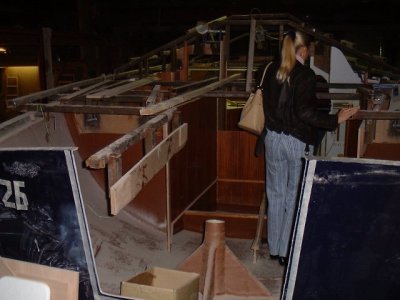
Example : Ridas 35 ...

DSCF0394.JPG

The moulds were bolted together in a rotating frame .... which allowed to be rotated from 90 deg one side through 0 to 90 deg other way ... giving the operator easy access to lay up the hull ...
Not easy to see here - but the hull is just above and right of centre ... already laid up and moved into fitting out shop ;; STILL in mould as hull is 'green - ie not fully stable / cured' .... turned 90 deg to its port side.

DSCF0390.JPG

Then its rotated back to level and internal structures fitted to a) support and maintain hull shape, b) to allow all work to be completed before adding deck ...

DSCF0391.JPG

Sorry about photo quality ... I was on a quick visit to see another order being filled ... I had agency agreement with Ridas.
 
Thanks for all the replies, appreciated!

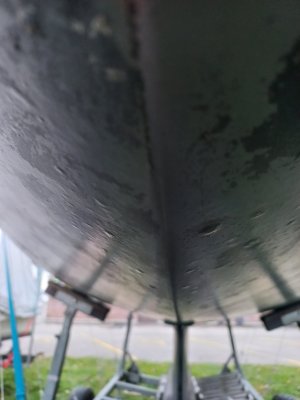
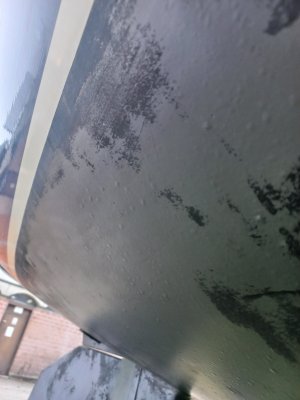
If you pressure bubbles with your finger they do not burst, with a knife they scrap off. The boat has been on land for 6 months.

Nots sure how well the photos show it. But it is all over the under water section of Hull.

The issue we have is that we would intend to sell it again in 2 to 3 years....
 

Attachments

  • 20260209_085645.jpg
    20260209_085645.jpg
    1.4 MB · Views: 28
  • 20260209_085906.jpg
    20260209_085906.jpg
    1.5 MB · Views: 27
We have found a great little sailing boat, 25ft 1987, same owner for over 30+, looks like the most well looked after boat I have seen.

BUT! The hull has lots (not just in one area) of small blisters (5 - 10mm) - sometimes referred to as boat pox.
He did mention it has "only" had osmosis in two small spots at the very forward part of the hull, which he had repaired.
The small blisters do not count as osmosis to him, he is over 80 and has obviously obsessively cared for the yacht for decades.

The boat has only been in fresh water and always winters on land.

Is this something that just has to be accepted with boats of this age?
Would you still buy it?
Or is this a case of signing up to a big issue which will just develop expensively in the near future?

Advice appreciated.
I'd be cautious. While I agree with the comments that it won't likely cause you any problems in day-day ownership it may make the boat difficult for you to sell on. And however it seems now, one day you'll end up either selling or disposing of this boat, that is pretty much inevitable. That's where the expense could come in, either extra storage because it takes longer to sell, having to cut the price or - very worst case - having to scrap the boat if noone wants it. Disposal is very expensive. Its an eye opener looking at some of the boats that are being given away for free on facebook and how good they are. Of course that's maybe another option for a boat you can't sell that is fully usable.

There are undoubtedly 1987 and older boats out there without blisters. Whether they are so well looked after in other ways, probably not so you might prefer this one anyway. But that's what you've got to weigh up. It wouldn't be a definite no to me, but a red flag just because of possible resale hassles. Its better to have a boat you can get rid of quickly if life changes.
 
I would get a price for disposal and put that in the figures.

I got a quote for a 25ft boat and thought it was quite reasonable considering - especially if you can sail it to one of their pick up points.

Any boat from 1987 is nearly 40 years old so will have a limited life before something expensive fails and makes it uneconomic to continue - but you might be lucky and it lasts as long as you want it to.
 
Last edited:
Thanks for all the replies, appreciated!

If you pressure bubbles with your finger they do not burst, with a knife they scrap off. The boat has been on land for 6 months.

Nots sure how well the photos show it. But it is all over the under water section of Hull.

The issue we have is that we would intend to sell it again in 2 to 3 years....
I wouldn't be too worried about that. Just make sure you get it at the right price.

If however, you only want to keep it for a couple of years, don't buy it, as you'll have the same issue when you try to sell it.
 
.......
The issue we have is that we would intend to sell it again in 2 to 3 years....
Sadly otherwise nice small yachts can be difficult to sell, even without that issue. With it then may be impossible - see recent thread where a beautiful Sadler was scrapped.
You would need to have a clear plan B for disposal in 3 years time.

A lot depends on type / model of boat as to resale ability (though that Sadler was arguably one of the most sellable).
A common / average old boat may effectively have zero value in this condition - even though could probably sail on for another 40 years by ignoring the bumps.
 
The issue we have is that we would intend to sell it again in 2 to 3 years....
I can't back it up with facts, but my feeling is that running costs are a bigger issue for cheapish boat buyers than the purchase price - whether it's £1k or £5k to buy doesn't really make a difference, hence the vast number of small scruffy boats essentially being given away.
I totally agree with others that they are a non-issue technically, BUT you're hiccuping about these blisters, so expect the next buyer to do the same. If the price is right that might be okay, but it'll cost you in time moving it on again - unless you go to the expense of doing the remedial work now so you can enjoy the benefits and make it easier to move on when you want to.
In short - if the rest of the boat is as good as you say and you can budget the time /money to fix it now I'd go for it. If you can't I'd walk away.
 
No boat has ever sunk with osmosis.
OF osmosis - plenty have with it (from other causes).

If you aren't buying this boat as a long term investment, walk away. If you are worried by the bumps, when you decide to sell up you can expect any future buyers to feel the same way.

The osmosis is not a problem. The perception of it from a buyers perspective is, as someone will be left holding the bag here. No point being that guy.
 
Thanks for all the replies, appreciated!

If you pressure bubbles with your finger they do not burst, with a knife they scrap off. The boat has been on land for 6 months.

Nots sure how well the photos show it. But it is all over the under water section of Hull.

The issue we have is that we would intend to sell it again in 2 to 3 years....
That does look like a fairly serious case of blisters.
If you need to sell again in 2 or 3 years get another boat. There are loads around being virtually given away.
If you like the boat and it is jncredibly good value buy her and sail her. Only go for 3rd party insurance and don't bother with a survey.
If the blisters bother you, grind them out individually, wash, dry and patch with epoxy laminate patches in the spring. More will probably appear.
 
Lets put this detail out there :

Some years ago - money was being made by Surveyors / Boat Yards / Paint companys - providing Osmosis treatment. You literally could not have a day go by without the subject coming up ... everywhere was with boats being stripped / treated etc.

Now go round yards and see the difference ... its not only that construction has moved on with more resistant forms of Gel-coat ... but also that no longer is it the 'be all and end all' of matters.
In those days - literally first part of survey - was the metering of hulls ... it was so common that I had to laugh a few times when observed a few surveyors metering hulls and exclaiming about the readings - to be told .. OI mate - its a Ferro hull !! No kidding.
Insurance Co's only mentioned it because of survey reports ... later once the craze had lessened .. it lost its high stakes position.

Osmosis can lead on to more serious matter of delamination - but that takes seriously long term to start ....

5 - 10mm blisters are not small and also indicate long term ... best practice here is to break open the biggest ... carefully grind back - wash and dry - then fill with epoxy. Each lift out - do another batch ...

Is it a reason to walk away from the boat ? If price is in line with age / condition - then fine .. go for it. But if seller is asking top notch for it based on market shown prices 'better examples' - then if he does not drop his price to reasonable - then walk away.
 
Last edited:
If you like the boat and the price is keen, plus you have some time, then grinding back the blisters and filling is the way to go.

Many of the boats that had the gel coat stripped and replaced 10 to 15 years ago are showing signs of osmosis again. This is never a guarantee it is a permanent solution. Many older boats have damp bilges and can cause osmosis on the inside of the hull.

On my 1980 Fulmar I have micro blisters (2 to 3 mm diameter) in the hull due to poor brushing out of the gel coat in the mould, but is not osmosis. I did find osmosis under the TreadMaster on the cockpit seats and under the solar panel, both caused by the meniscus of water causing the water to be held between two close surfaces. Neither of these places are where you expect to find osmosis.

Many surveyors rely on damp meters to prove the hull is damp, well virtually every GRP boat built in the 1960's to 1980's will have raised moisture levels. There is no way of having a dry hull in boats of this period. My opinion is the damp meters are used to help justify the surveyors fees rather than offering any real advice in how to reduce the levels - which is almost impossible in the UK climate. It is something we all have to live with. My greater fear is excess moisture in the hull can expand when frozen causing the start of delamination. The best way to prevent this is for the boat to remain in water over the winter. Usually I prefer to work on my boat in the summer months as the days are longer, warmer and drier, which means the work gets done quicker.
 
Interesting the view from Concerto to leave the boat in the water over winter to reduce chance of delamination from frost - I have always felt it is safer to leave afloat in winter in its element, less stress when it is windy - but take out every couple of years or so for a 'dry out' to hopefully prevent osmosis but maybe I have been wrong - presumably if the boat has been epoxyed in the past it won't dry out much over winter anyway - does anyone else have any thoughts on this?
 
Last edited:
Interesting the view from Concerto to leave the boat in the water over winter to reduce chance of delamination from frost - I have always felt it is safer to leave afloat in winter in its element, less stress when it is windy - but take out every couple of years or so for a 'dry out' to hopefully prevent osmosis but maybe I have been wrong - presumably if the boat has been epoxyed in the past it won't dry out much over winter anyway - does anyone else have any thoughts on this?
Hulls don't dry out by just leaving them out of the water for a few months. Old wives tale.
 
I also leave my boat in the water over the winter and work on it in the summer. Not because I’m worried about delamination, but because (as Concerto also said), the days are longer and warmer for doing yard work, and the yard is much quieter.
 
Interesting the view from Concerto to leave the boat in the water over winter to reduce chance of delamination from frost - I have always felt it is safer to leave afloat in winter in its element, less stress when it is windy - but take out every couple of years or so for a 'dry out' to hopefully prevent osmosis but maybe I have been wrong - presumably if the boat has been epoxyed in the past it won't dry out much over winter anyway - does anyone else have any thoughts on this?
The natural environment for a boat is in the water as the hull is in the correct shape. When the water is removed the hull is supported by slings if lifted and then by the keel and chocks. No matter how strong a boat is, the hull shape will be different and therefore under more strain out of the water.

I remember a conversation with the crane driver from Hythe Marina whilst at the boat show several years ago. Modern yachts must have the slings on the bullheads as the loading in an unsupported hull area can cause compression. He also mentioned a few boats had glued in furniture units moved after the boat was lifted due to this. This does not surprise me as the modern construction method of bonding in a matrix to the hull to stiffen it and accept the CNC bulkheads and furniture units, both of which are glued into the matrix. Also numerous owners have commented that doors like the loo door either do not lock or will not shut when the boat is out of the water.

With regard to drying the hull out, this was necessary for many wooden boats to stop rot. The change from wooden boats to glassfibre did not change people's attitudes that boats must come out of the water during the winter months. But as I mentioned before, working in the winter is much harder than in the summer - but the work gets done quicker.

Some people assume having a boat out of the water in winter is safer but consider the extra risks. If the mast remains up, then the wind is slightly stronger than afloat as the land acts as a compressing force pushing the wind upward close to the surface. The boat is held in a cradle or by chocks, neither have any give, whereas in the water the boat will heal and absorbing any strong gust. With boats stacked closely together on a boatyard, it only takes one boat to move and fall to knock others over as well. This usually happens either when a chock vibrates loose or a furled headsail unrolls in strong winds. The only downside to staying in the water is chafe to the lines and possible topside rubbing from fenders or if one pops out. For the winter I always double up the berthing lines so if one chafes through, the boat remains securely moored.

Epoxy coatings like Gel Shield are waterproof coats that will not allow the hull to dry out, just dry off. With the micro blisters to my hull I was advised by my surveyor not to apply the recommended 5 coats of Gel Shiel, but use only 3. This was due to filling all the existing small holes would never stop other small bubbles from breaking open.
 
The natural environment for a boat is in the water as the hull is in the correct shape. When the water is removed the hull is supported by slings if lifted and then by the keel and chocks. No matter how strong a boat is, the hull shape will be different and therefore under more strain out of the water.

I remember a conversation with the crane driver from Hythe Marina whilst at the boat show several years ago. Modern yachts must have the slings on the bullheads as the loading in an unsupported hull area can cause compression. He also mentioned a few boats had glued in furniture units moved after the boat was lifted due to this. This does not surprise me as the modern construction method of bonding in a matrix to the hull to stiffen it and accept the CNC bulkheads and furniture units, both of which are glued into the matrix. Also numerous owners have commented that doors like the loo door either do not lock or will not shut when the boat is out of the water.

With regard to drying the hull out, this was necessary for many wooden boats to stop rot. The change from wooden boats to glassfibre did not change people's attitudes that boats must come out of the water during the winter months. But as I mentioned before, working in the winter is much harder than in the summer - but the work gets done quicker.

Some people assume having a boat out of the water in winter is safer but consider the extra risks. If the mast remains up, then the wind is slightly stronger than afloat as the land acts as a compressing force pushing the wind upward close to the surface. The boat is held in a cradle or by chocks, neither have any give, whereas in the water the boat will heal and absorbing any strong gust. With boats stacked closely together on a boatyard, it only takes one boat to move and fall to knock others over as well. This usually happens either when a chock vibrates loose or a furled headsail unrolls in strong winds. The only downside to staying in the water is chafe to the lines and possible topside rubbing from fenders or if one pops out. For the winter I always double up the berthing lines so if one chafes through, the boat remains securely moored.

Epoxy coatings like Gel Shield are waterproof coats that will not allow the hull to dry out, just dry off. With the micro blisters to my hull I was advised by my surveyor not to apply the recommended 5 coats of Gel Shiel, but use only 3. This was due to filling all the existing small holes would never stop other small bubbles from breaking open.
I agree. Modern boats are better left in the water, where they belong.
 
I found that after my boat had been ashore from November to March that she floated a bit higher having dried out.
I was with the surveyor for the survey on my latest boat, and he was only really "concerned" when the meter went off the scale expecially by some deck fittings. The boat is over 40 years old so some dampness is to be expected, but overall the hull and deck was good and blister free.
 
I found that after my boat had been ashore from November to March that she floated a bit higher having dried out.
I was with the surveyor for the survey on my latest boat, and he was only really "concerned" when the meter went off the scale expecially by some deck fittings. The boat is over 40 years old so some dampness is to be expected, but overall the hull and deck was good and blister free.

mmmmm I would suggest that change of Seawater density would have more effect that any drying out ashore ...

The figure of 1.025 as SW desnity is not a static / stable figure ... its a figure much like 0 C for freezing water ... its not fixed. SW especially around the UK varies significantly .... depending on rainfall and also dry periods ... it is not unusual for density to reach 1.030 or more ... which would have a visual effect on boat ...
 
Top