Wood plinth for mounting windlass

davidmh

Well-Known Member
Joined
30 Jan 2015
Messages
477
Visit site
I am refitting an anchor windlass on a friends yacht. I was orginally mounted on a teak plinth and through bolted through the plinth and the deck. When we took the windlass off the plinth had split in places and it needs renewing. The plinth size is approx 300 mm long and 200mm wide anf 15/16 mm thick.
Teak is expensive could I use Iroko for the plinth? Since most of the plinth will be hidden would a rough sawn peice of timber be ok to use?
I am based in Portsmouth, where would be good places to buy timber in short lenghts like that?

David MH
 
There are sellers on ebay for bits of wood for 'projects'. There are a couple of old fashioned wood yards between Portsmouth and Southampton. There is a recycled wood project somewhere in the area.
In the absence of a hand or power plane I'm sure you could sand a rough sawn piece of that size
 
Why is the plinth actually there?
Does it need to be that thick?
Would some other arrangement be easier/better/more cost effective?
 
I agree - iroko will be fine, or could the original teak be glued and screwed? with stainless screws or even ss studding with washers and nuts each end - counterbored & plugged?
 
Iroko would be a suitable replacement for teak, I have used it in many places aboard Tolerance, I have some lengths available, 200mm wide, 20mm thick, up to 2500 long. The timber is dry, straight and comes up great either varnished or probably better oiled given your requirements, happy to post.

PM me if interested 👍
 
One problem with iroko is that it can produce an allergic reaction to its fine dust particularly the eyes. Easily solved by safety specs.

There's also a possible issue with Gadget's suggestion of plastic cutting board (HDPE). Under compression, some versions (and I can't remember whether linear-linked, or cross-linked HDPE is more susceptible) can "creep" over time, and this means the securing bolts may need to be tightened. This may cause difficulties with some sealing compounds which harden, or where resin/epoxy is used to bed the board.

That said, I have HDPE backing plates to some beefy cleats, and they have been fine for the past 5 years, but I used big washers, and butyl as a sealant for the holes.
 
Why is the plinth actually there?
Does it need to be that thick?
Would some other arrangement be easier/better/more cost effective?
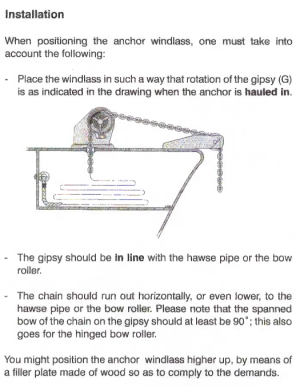
In my case the plinth was necessary to achieve an angle of 'wrap' exceeding 90 degrees, ie so that the chain travels uphill from the bow roller to the windlass gypsy.

Also, a plinth brings the top of the navel pipe higher off the deck, thereby lessening the chance of water running down it.

___________________________________________________________________________________________________________________________________

1716891891626.png
 
Last edited:
Thank you for the replies, I will investigate the HPDE boards, Iroko seems to be an option, I have used Iroko before and it benfits from very sharp tools. I need to check the curvature of the deck where the windlass sits, the original teak board may have been shaped underneath or it may have been bedded on a filler. We have let to take the plinth off the deck.
David MH
 
I have a few teak doors, that were popular in the 60s & 70s, found in skips and salvaged by me for free.

Good seasoned teak and. Mahogany.

Perfect for these kind of boaty jobs.

Try asking skip truck drivers, double glazing fitters etc. Or look online for old doors, often for cheap or free
 
Why the fixation on mahogany, teak and iroko?
Good old English oak or perthaps better elm would be just as long-lived and tough - and vastly cheaper.
 
Last edited:
Why the fixation on mahogany, teak and iroko?
Good old English oak or perthaps better elm would be just as long-lived and tough - and vastly cheaper.

I thought the big advantage of teak or iroko was that they are oily woods with natural resistance to decay. Mahogany is not in the same class.
I used to have an oak tiller and it was pretty bad for going black as soon as the water was white to get through the varnish.
 
I thought the big advantage of teak or iroko was that they are oily woods with natural resistance to decay. Mahogany is not in the same class.
I used to have an oak tiller and it was pretty bad for going black as soon as the water was white to get through the varnish.
The mistake there, I would suggest, is not in the choice of wood, but the choice of finish. An oil or similar sealant, or le Tonkinois if you want a high gloss, won't lift like varnish if it gets damaged.
 
Top