With a midship spring line - how do I control the boat with the engine so that it glues parallel to the pontoon?

It would if the tiller wasn't held over towards the pontoon.
The resulting prop wash counteracts the tendency of the spring to pull the bow in.
I understand that but if you move the midship cleat forward you get more force pulling the bows in so need more prop wash, and if you move it aft you need less. But you and Refueler seem to think the opposite, if I’ve read your posts properly.
 
It would if the tiller wasn't held over towards the pontoon.
The resulting prop wash counteracts the tendency of the spring to pull the bow in.
Yup but on little sisters 'long keeler' (the point in question where the comment was raised) the cut rudder removed the ability to use prop wash over the rudder to pivot the boat against the spring! so to stop / reduce the bow turning in the attachment point of the spring needed to be moved towards the stern. So again all things been equal ie no wind , no stream and no rudder then moving the attachment point aft brings the bow out and moving it forward brings the bow in except at the sweet point where dependent upon the external conditions the boat will lay parallel. How much you wish to correct mis positioning by using the tiller is a matter of choice me thinks. But more than happy for you to disagree as it all adds to the fun!
 
If the OP finds Stress Free Sailing on YouTube Duncan Wells has a clip with the way to do it. A pal has added a line on the end of the spring line so he can pull the transom in should he need to.
 
My midships cleat is at the widest part of the boat. A spring from there to a cleat on the outer end of pontoon prevents the boat moving forward and with power on the only way the boat can, and does, move is towards the pontoon until it comes into contact with it and stops.

If the tiller is held over towards the pontoon, the stern moves in towards the pontoon and, by suitable adjustment of the rudder angle and engine revs, she will lie parallel to the pontoon.

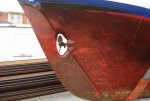
Here is a photo of her rudder and propeller aperture. As you can see the rudder is quite narrow behind the propeller but despite that the propwash is enough to keep her stern in towards the pontoon.

(Now, if she would only steer astern as easily ..... :(

1623084282370.jpeg
 
Just get a centre line round a cleat and back to the boat and pull it really hard? it is very effective and much easier than messing about with trigonometry on my chunky 33'. Once short enough it is not going anywhere
 
Has anyone tried this with:

a) A thin fin keeled yacht with a a saildrive well ahead of the rudder (little prop wash) ?
or
b) A twin rudder boat with almost no prop wash ?

Disaster I imagine. Just curious.

.
 
Has anyone tried this with:

a) A thin fin keeled yacht with a a saildrive well ahead of the rudder (little prop wash) ?
or
b) A twin rudder boat with almost no prop wash ?

Disaster I imagine. Just curious.

.
I suppose you would have to fall back on those indispensible aids: plenty of fenders and a sense of humour :ROFLMAO:
 
Has anyone tried this with:

a) A thin fin keeled yacht with a a saildrive well ahead of the rudder (little prop wash) ?
or
b) A twin rudder boat with almost no prop wash ?

Disaster I imagine. Just curious.

.
I have a saildrive and a gap to the rudder, but my keel is average rather than thin. In a static situation as described it will behave like any other boat. It is only when trying to execute a sharp turn when moving that the difference becomes obvious. Twin rudder boats all have bow-thrusters don’t they?
 
Has anyone tried this with:

a) A thin fin keeled yacht with a a saildrive well ahead of the rudder (little prop wash) ?
or
b) A twin rudder boat with almost no prop wash ?

Disaster I imagine. Just curious.

.
I tried it with the former, but not the latter. The shape of the keel matters little as the boat isn't moving through the water. The sail drive just means that there's a bit of a pause before the prop wash starts to act. It still works though.

I guess that whether it works with as twin rudder boat will depend on how much water you can get flowing past the offset rudder. On some boats it might work.

Isn't messing about with boats fun!
 
Just get a centre line round a cleat and back to the boat and pull it really hard? it is very effective and much easier than messing about with trigonometry on my chunky 33'. Once short enough it is not going anywhere
You can try and do that on our 12 tonnes of boat. I humbly suggest you'll be reaching for the power of the engine to help you once you've done it a few times. It'll work, but there are easier ways to achieve the aim.

When I used to drive Nicholson 55's at JSASTC with lots of muscular crew that needed jobs to do, a line round the midships cleat and back to a winch was sometimes used to drag the 26 tonnes of boat sideways. I guess that it made them think that they were important and doing a useful job sometimes... Short handed, we'd drop a midships spring on and drive the boat alongside, lash the wheel and set to getting the lines set. It's completely pain free and you're under control the whole time.
 
Has anyone tried this with:

a) A thin fin keeled yacht with a a saildrive well ahead of the rudder (little prop wash) ?
or
b) A twin rudder boat with almost no prop wash ?

Disaster I imagine. Just curious.

.
Yes and yes. Works just as well on motorboats with tiny rudders. Displacement boats and planers. Bigger yachts like Bavaria 46, 48, and Hanse 48 have very little prop wash. But it can be done.

Bit of throttle bit of wheel or tiller, bit of juggling to practice. Which is the key. Practice. ?
 
With 2 engines we don't worry about any of this anguish. Sailing is about relaxation not complications

:)

I believe its all so complex that Volvo has expensive systems, as does Dockmate, to allow people to park their yachts.

Jonathan.
 
That’s weird - I’m with the first idea. To exaggerate the thought - if the midline was as far forward as the forward cleat then the bow would be dragged in even with a long line.

Who said far forward ?? A cleat just forward of midships is ideal for this manoeuvre .... with engine on idle pushing forward and tiller toward dock.
 
I understand that but if you move the midship cleat forward you get more force pulling the bows in so need more prop wash, and if you move it aft you need less. But you and Refueler seem to think the opposite, if I’ve read your posts properly.

Wow ... what a kerfuffle about nothing.

If the cleat is just a touch more forward than true midships - then you have a 'restraining' force delivered by that line to assist the bow to stay in if stream or wind is trying to blow it off ...
Even without wind / stream - the balance of engine / rudder and line holds the boat nicely.

If you put the cleat on the pivot point of the boat - then tiller over can cause the bow to pay off from the dock ..... meaning in fact that you would use MORE engine than the guy with a slightly fwd cleat ...

Funny that even biggest ships in the world have been springing on and off docks for years ...
 
Wow ... what a kerfuffle about nothing.

If the cleat is just a touch more forward than true midships - then you have a 'restraining' force delivered by that line to assist the bow to stay in if stream or wind is trying to blow it off ...
Even without wind / stream - the balance of engine / rudder and line holds the boat nicely.

If you put the cleat on the pivot point of the boat - then tiller over can cause the bow to pay off from the dock ..... meaning in fact that you would use MORE engine than the guy with a slightly fwd cleat ...

Funny that even biggest ships in the world have been springing on and off docks for years ...
Ah, so you admit you were wrong in post 11 - it’s only “a little forward of the pivot” as of course anything forward of the pivot brings the bow in - the more forward the more the bow goes in. Good to have you back on board.
 
Has anyone tried this with:

a) A thin fin keeled yacht with a a saildrive well ahead of the rudder (little prop wash) ?
or
b) A twin rudder boat with almost no prop wash ?

Disaster I imagine. Just curious.

.
(A) yes. Piece of cake. Just takes a second or two for the rudder to respond to prop wash
 
Ah, so you admit you were wrong in post 11 - it’s only “a little forward of the pivot” as of course anything forward of the pivot brings the bow in - the more forward the more the bow goes in. Good to have you back on board.

???? So you never really read my initial posts which specifically said just fwd of midships .... Post #10 .... qualified by post #11 ....

AND lets be clear - even a bow cleat can be used - its a case of balance of forces. If you ever get chance - watch a ship going alongside. The springs are often used to aid vessel to remain alongside and they are NOT led from anywhere near midships. If thousands of tons can do it - a piddly bit of Tupperware in the water can certainly do it.

Owner will come to their own methods . conclusions based on what they have to use ... many boats do not have cleats near midships - but they seem to do OK ...

And to be clear - I advocate a just fwd of midships, but that is MY preference. It does not mean others have to follow ...

I have explained why I prefer that due to the balance of forces that OP is looking for.
 
???? So you never really read my initial posts which specifically said just fwd of midships .... Post #10 .... qualified by post #11 ....

RupertW was initially replying to your post #13. I suspect you may have been saying "That's two of us!" without realising what you were seconding, ie poignard's suggesting that moving a midship cleat *forward* rather than aft would counter the tendency on some boats for the bow to swing towards the pontoon with rudder steering away from the dock and ahead engaged. I agree with RupertW on that

As often happens on this forum, I suspect a number of people are generalising behaviour of their own and other boats they've personally sailed to *all* boats. That's not unreasonable but when someone presents a counter example, if you say "that's not my experience so it must be wrong" , that is perhaps not the most scientific approach. LittleSister described an experience with one boat where the midship cleat manoeuvre would swing the bow in (and presumably stern out) . I can assure you this happens with mine too, especially on my "preferred" berthing side (ie astern prop wash kicks the stern in, but ahead kicks it out). Per my post #19, the solution is to use a line through a block just aft of centre cleat. Having a relatively wide stern, there's only just so far the bow can swing out when pinned like that.

Other boats I've sailed the midship cleat thing works as advertised. But I'm asserting that not all configurations behave the same.
 
Top