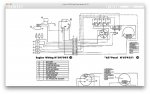
Wiring in a Sterling Alternator to Battery Charger


The easiest way to ensure this is correctly used is to have 3 identical on/off switches, the ones with the removable red handles. Then take the handle out of the emergency switch and dispose of it. Then, if the start battery is flat and you need to start from the house bank, take the red handle out of the start switch (thus ensuring it's turned off) and put it in the emergency switch.
 
The easiest way to ensure this is correctly used is to have 3 identical on/off switches, the ones with the removable red handles. Then take the handle out of the emergency switch and dispose of it. Then, if the start battery is flat and you need to start from the house bank, take the red handle out of the start switch (thus ensuring it's turned off) and put it in the emergency switch.

That's neat ... assuming you never want to combine the batteries.
 
In almost 50 years of playing about with boats, I can't remember ever not being able to start the engine from the start battery. Maybe I've been more careful than most to ensure the start battery is dedicated and isolated.
 
I need to briefly resurrect this thread.

I got the Sterling Alternator to Battery Charger installed. My first simple question to those who have such a unit is whether it should be powered up (showing some LEDs e.g. voltage) even though the engine is not running? The reason I ask is that I originally disconnected a lead between the starter motor and B+ on the alternator and nothing worked at all. When I reconnected it the unit powered up as above and with the engine running I measured 14.3 volts at the alternator terminal on the A2B so was happy with that. I haven't had time to test it more thoroughly.

I assumed it was OK until I read this article ... https://albindelta.de/?p=945 ... which sewed some doubts. It seems to suggest that the unit should usually be off and will only start up when the ignition is turned - requiring a wire between ignition and unit.

Does anyone know?
 
RTFM! "Extended Installation" - "Starter solenoid".

Thank you for your kind reminder to read the manual. I have read it thoroughly. The problem is that at no point does it say to disconnect any lead from the B+ terminal. Perhaps this is too obvious to mention. Only on doing so did I have no power (and hence considered connecting a lead from the ignition to the unit). However on re-connecting the B+ to the solenoid everything worked and I got a boost charge of 14.3 volts with the engine running so I left it there. I appreciate that I am on the edge of my knowledge and this may be completely obvious to you and others but this of course is why I need to ask.
 
Last edited:
Thank you for your kind reminder to read the manual. I have read it thoroughly. The problem is that at no point does it say to disconnect any lead from the B+ terminal. Perhaps this is too obvious to mention. Only on doing so did I have no power (and hence considered connecting a lead from the ignition to the unit). However on re-connecting the B+ to the solenoid everything worked and I got a boost charge of 14.3 volts with the engine running so I left it there. I appreciate that I am on the edge of my knowledge and this may be completely obvious to you and others but this of course is why I need to ask.

You must remove the original connection between the alternator output and the starter solenoid.
Instead connect the alternator output directly to the input terminal of the AB charger.

If the unit does not then operate the instructions tell you to connect a feed from the ignition switch ( which becomes live when the engine is started)

After installation if the unit does not work when the engine is running , then
with the Engine running check the voltage at the alt input stud on the product,
if its not above 13.3 ( x 2 for 24 v ) then the unit will not work, if its 0 volts then
you will need to apply a ignition feed to the product, see next paragraph

Ignition feed/ Starter solenoid: Some alternators will not fire up without a
voltage on their B+ terminal. Because the alternator-to-battery charger contains a
split charge diode there will be no voltage feed on the B+ terminal which means that
the engine will start but the alternator may not work. If this is the case, then simply
connect a ignition feed ( from the key switch ) which becomes live when the engine
is started. this will feed 12 v through the unit and fire up the alt
 
Last edited:
OK. Armed with the advice to deffo disconnect alternator positive to solenoid and connect the ignition switch direct to the A2B unit I got ... nothing.

After disconnecting the lead from solenoid to B+ there was no power to the ignition switch and a wire from the switch to the A2B made no difference.

As before I reconnected the solenoid to the alternator B+ and added the A2B connector to the same. As I said in the original post the unit seems then to work - producing just over 14.3 boost charge on the house bank and no more than 14 on the engine battery. I haven't got an ammeter (a DC clamp meter is in the post) so haven't measured the output but I had installed a Smartguage which, although probably not fully synchronised yet showed my 270ah domestic bank go from 85% charged to 96% charged in 90 minutes of boost charge (as per the LED on the unit) before switching to float mode.

So it appears to be working. I don't have a wiring diagram (and may not understand it if I did) but is anyone able to explain why it was not (apparently) necessary to disconnect alternator from solenoid?

I should add that conductivity between B+ and solenoid was established by multimeter rather than visually as the cable from the B+ soon disappears into the loom. It is also not that big - about 1/4 inch diameter including casing.
 
Last edited:
After disconnecting the lead from solenoid to B+ there was no power to the ignition switch and a wire from the switch to the A2B made no difference.

As before I reconnected the solenoid to the alternator B+ and added the A2B connector to the same. As I said in the original post the unit seems then to work - producing just over 14.3 boost charge on the house bank and no more than 14 on the engine battery. I haven't got an ammeter (a DC clamp meter is in the post) so haven't measured the output but I had installed a Smartguage which, although probably not fully synchronised yet showed my 270ah domestic bank go from 85% charged to 96% charged in 90 minutes of boost charge (as per the LED on the unit) before switching to float mode.

There should be power to your ignition switch when the engine battery is turned on, this shouldn't be dependent on a connection to the alternator B+ terminal.

If you've now got the starter solenoid connected to B+, you may have by-passed the A-to-B system. 14.3v doesn't sound like a very high boost charge. What does the float voltage drop to?

The earlier version of the A-to-B manual contained this advice: "Some alternators will not fire up without a voltage on their B+ terminal. Because the alternator-to-battery charger contains a split charge diode there will be no voltage feed on the B+ terminal which means that the engine will start but the alternator may not work. If this is the case, then you need to use the starter solenoid feed terminal on the alternator-to-battery charger. It connects to the starter motor terminal becomes live when the starter motor bendix is engaged, i.e. the first two seconds of having the ignition key fully turned. During these two seconds, a 12 volt feed is sent to the alternator B+ terminal which is enough to let the alternator fire up. Thereafter, the alternator looks after itself. Use a 0.5mm² wire for this connection."

Note that the connection has to be made to the separate terminal on the charger, not to the B+ terminal.
 
You may well find the online instructions rather better than the ones provided in the box.

If you set the boost to one of the higher voltages it should be more obvious as to whether it is working correctly.
 
Thanks for this PVB.

There should be power to your ignition switch when the engine battery is turned on, this shouldn't be dependent on a connection to the alternator B+ terminal. alternator fire up.

Yes, that is what is puzzling me. It is definitely the case that without that wire (that has connectivity with the solenoid) there is no power to the ignition switch.

If you've now got the starter solenoid connected to B+, you may have by-passed the A-to-B system. 14.3v doesn't sound like a very high boost charge. What does the float voltage drop to?

These are sealed lead acid so instructions say I should get 14.4v on boost - I got 14.32 max. I turned the motor off shortly after changing to float and didn't make a note of the charge. It was certainly below 14v.

The earlier version of the A-to-B manual contained this advice: "Some alternators will not fire up without a voltage on their B+ terminal. Because the alternator-to-battery charger contains a split charge diode there will be no voltage feed on the B+ terminal which means that the engine will start but the alternator may not work. If this is the case, then you need to use the starter solenoid feed terminal on the alternator-to-battery charger. It connects to the starter motor terminal becomes live when the starter motor bendix is engaged, i.e. the first two seconds of having the ignition key fully turned. During these two seconds, a 12 volt feed is sent to the alternator B+ terminal which is enough to let the alternator fire up. Thereafter, the alternator looks after itself. Use a 0.5mm² wire for this connection."

Note that the connection has to be made to the separate terminal on the charger, not to the B+ terminal.

That's useful. But it doesn't sound like it will overcome the problem of no power at the ignition switch with the B+ to solenoid cable disconnected.
 
You may well find the online instructions rather better than the ones provided in the box.

Thanks ... but, other than the older instructions that PVB found the written and online ones are identical.

If you set the boost to one of the higher voltages it should be more obvious as to whether it is working correctly.

Hmm ... I'm a bit reluctant to do that with brand new batteries. I'll see what the DC clamp meter says and I may have a go at speaking to Mr Sterling.
 
I have found a wiring diagram (although my switch panel is A3 rather than A2).

Would connecting together the two wires ending at B+ but isolating both from the B+ terminal do the trick?

Nanni 3.100HE Wiring diagram.jpg
 
I have found a wiring diagram (although my switch panel is A3 rather than A2).

Would connecting together the two wires ending at B+ but isolating both from the B+ terminal do the trick?

Yes, it should. That will feed battery voltage to the switch.
 
BINGO!

And thanks ...

Once those two wires were connected the ignition was powered and didn't need the extra input from unit to ignition to wake the alternator up.
 
Top