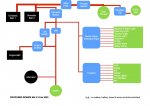
Thanks, Pete and Vic.
Vic, I'm not clear what you're saying about the VSR. As far as I can see if either the domestic or engine battery isolated, then the VSR can't connect them. I don't have any switching in the negative side of the circuit.
VSRs are normally connected directly to the battery +ve terminals so that they continue to control the charging from a battery charger, solar etc with the isolator switches both off. If you will be adding other charging sources this is how the VSR is best wired .... then a disabling switch becomes relevant.
Don't use fuses for Thruster or windlass, these should be thermal breakers.
Re the thruster and domestic - I wanted to be able to have the thruster (and windlass) switched off most of the time, and not on all the time the domestics are on.
You have to fit protection rated . . . to protect the thruster motor from overload. . . Resetting a breaker is much easier than changing a megafuse, especially if you're in a hurry![]()
You might want to add a fuse where the domestic loads connect to the fat cable around the VSR?
Also perhaps a fuse in series with the VSR?
If you label each line with a length and diameter, it might be easier to justify what you decide to fuse or not.
I think you should consider fitting at least a small amount of solar and designing it in from the word 'go' rather than the traditional approach of 'organic' wiring development. Likewise I would consider at least basic shore power charging, even if you are a swinging mooring user like me.
Likewise, I'd add a fuse and breaker for an 'always on' branch, for e.g. Navtex, alarms, bilge pumps if you must,....?
Does the VSR maker suggest a fuse in series?
I am still on the hunt for a circuit breaker equivalent to a medium blow 250A fuse and/or suitable for a (fairly small) bow thruster of 315A nominal current draw.