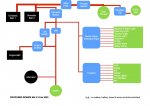
Wiring advice, please

  • Presumably the things on the “Fusebox” rather than the “Panel” are there because you’ll use the switches on the items themselves? Personally I find it convenient to leave all the nav stuff (plotter, vhf, AIS, etc) on locally, and just run my finger along the row of switches at the panel rather than finding each different-shaped button or knob. But it’s up to you. Similarly I find it useful to be able to turn off all of the interior lights at the panel, or turn them back on when we get back on board in the evening, but again that’s a personal choice.
  • It’s not normal to split the service bank isolator into “domestic” and “thruster” as peers of each other, but I don’t see a problem with it.
  • Your thruster and windlass are going to want a bigger fuse than 20 amps ;)
Seems reasonable to me.

Pete
 
Just a thought

You have the emergency link switch on the switched side of the isolators.......... That's good because you can then use either battery bank for all purposes while completely isolating a defective battery bank if necessary

However the VSR could still operate and combine the battery banks ......... unless you incorporate a switch in its negative connection to disable it. Maybe youve already thought of that and not shwn it because youve not shown any negative connections... if so ignore me.

All the rest looks OK
( except for the fuse labelled 250 W ;) )
 
Thanks, Pete and Vic.

The switches/fuses are a bit simplified here, as I was struggling with an unfamiliar drawing facility, and also want to do the work in two stages, as I don't have enough switches currently for everything to be separate but might add another switch panel later. In fact I have pondered one switch for several nav instruments, with the single switched wire going to several individual fuses for separate instruments.

Re the thruster and domestic - I wanted to be able to have the thruster (and windlass) switched off most of the time, and not on all the time the domestics are on. I'm also not sure my current domestic isolator would like the current for the thruster going through it. I intend both the light-ish domestic circuit and the heavy gauge thruster circuit will be taken directly from the battery (both positive and negative).

Uncanny that I drew the first version of that diagram in November, and have done a couple of variations since, and it was only 5 minutes after posting it, and when I was doing something completely different, that I somehow became conscious that I'd mislabelled the fuse! :rolleyes:

Vic, I'm not clear what you're saying about the VSR. As far as I can see if either the domestic or engine battery isolated, then the VSR can't connect them. I don't have any switching in the negative side of the circuit.
 
Thanks, Pete and Vic.

Vic, I'm not clear what you're saying about the VSR. As far as I can see if either the domestic or engine battery isolated, then the VSR can't connect them. I don't have any switching in the negative side of the circuit.

Yes sorry my bad. I was seeing what I expected to see not what you have drawn.

VSRs are normally connected directly to the battery +ve terminals so that they continue to control the charging from a battery charger, solar etc with the isolator switches both off. If you will be adding other charging sources this is how the VSR is best wired .... then a disabling switch becomes relevant. As you have drawn it it would be irrelevant.

Must learn to concentrate.. been keeping an eye on the cruise ships leaving Port Everglades because a friend is on the Caribbean Princess leaving this evening... should have already gone but they all seem to have been delayed. Pity it'll be dark by the time they go so I wont see her if she gives me a wave as they pass the web cam.
 
Last edited:
VSRs are normally connected directly to the battery +ve terminals so that they continue to control the charging from a battery charger, solar etc with the isolator switches both off. If you will be adding other charging sources this is how the VSR is best wired .... then a disabling switch becomes relevant.

Vic, good thought re solar power, as I'm intending to fit some. Back to the drawing board!

Don't use fuses for Thruster or windlass, these should be thermal breakers.

Paul, the manufacturer states 'We also advice to install a fuse. . . It should be of the slow type and sized to take the amperage draw for at least 5 minutes. A circuit breaker can be used instead of the fuse and main power switch as long as the functionality is the same.'

I looked for a suitable breaker for the thruster (the windlass already has one) a while back, but didn't find one of sufficient capacity that didn't cost a fortune. I am, though, a bit confused about the size it needs to be as the thruster is rated at '315A nominal current draw', but the recommended fuse is only ANL 250A, which is, I think, medium blow, but only giving a second protection.
 
Most circuit protection on a boat is for the wiring, not the device on the end of it. The protection for the windlass circuit nit only protects the wiring, but the windlass too. The wiring could easily be rated at several hundred amps, but you wouldn't want to fit a 500a fuse/breaker, because if you overload the windlass motor damage would be done before the fuse blows. You have to fit protection rated for the windlass, an appropriate thermal breaker is perfect here.

A bow/stern thruster is no different, you have to protect the thruster motor from overload. Thrusters almost always have limited run time, so less of an issue than a windlass, but it's not impossible to overload the motor and cause the fuse to blow. Resetting a breaker is much easier than changing a megafuse, especially if you're in a hurry :)
 
Re the thruster and domestic - I wanted to be able to have the thruster (and windlass) switched off most of the time, and not on all the time the domestics are on.

My thruster and windlass are switched on when the domestic power is on - that way the thruster and windlass are instantly available if you need them, without having to go down below and fiddle with switches.
 
Thanks, both.

You have to fit protection rated . . . to protect the thruster motor from overload. . . Resetting a breaker is much easier than changing a megafuse, especially if you're in a hurry :)

I am just about to have the thruster installed, and would much rather have a breaker but couldn't find any standard boat type breakers rated over 200A, when the thruster has '315A nominal current draw' and even the recommended 'medium blow' fuse rating is 250A. IIRC the only ones I found over 200A were gert great industrial plant type things costing an arm and a leg. As my thruster is one of the smaller ones available, I wonder what breakers others use.

The windlass and its breaker have been in use for several years. I am just changing it from direct cables all the way to the battery aft to 'piggy back' on the much heavier new cables going to the bow for the thruster. The existing windlass breaker will be moved to the bow between the thruster and the windlass, as per the diagram above.
 
You might want to add a fuse where the domestic loads connect to the fat cable around the VSR?
Also perhaps a fuse in series with the VSR?
If you label each line with a length and diameter, it might be easier to justify what you decide to fuse or not.

I think you should consider fitting at least a small amount of solar and designing it in from the word 'go' rather than the traditional approach of 'organic' wiring development. Likewise I would consider at least basic shore power charging, even if you are a swinging mooring user like me.
Likewise, I'd add a fuse and breaker for an 'always on' branch, for e.g. Navtex, alarms, bilge pumps if you must,....?
 
I'm still hoping for any suggestions of a suitable breaker for the bow thruster, but meanwhile -

Steve and Flying Goose -
Diagram done in Pages (Apple word processor). New to me (unlike Word). Neither especially suited to this, but OK. It would be handy to have something that had the electrical symbols built in.

LW935 -
It could be clearer in the diagram, but the domestic cable goes straight to the battery (to which the separate bow thruster cable also goes). The battery connections are fused (this is mentioned in the diagram notes but not shown on the diagram. I can't see a need for an additional fuse between there and the domestic switch and fuse panels, nor in line with the VSR.

I would have labelled all the cables had I had a more practicable (or familiar) drawing package. (As it happens, a long time ago in a land (not) far away, I worked as an electronics draughtsman, but in those days I had a drawing board, draughting machine, a set of Rotring pens, and could neatly draw all the regular symbols and write text as small as 1mm high. Nowadays I couldn't read text that small, let alone write it! )

I am intending to fit some solar and, following Vic's earlier reminder, will amend the design to accommodate that, but won't have time to fit it before other things have to be installed.

I already have shore power and charger (not shown on diagram for simplicity), and may add an 'always on' branch if the need arises.
 
The thruster on Katy Louise is fed by large cables from the domestic bank, three x 85 AH and has a fuse at the battery end with an isolation switch in the main cabin. I can check the fuse size on friday if that is of any help. No breaker though I am afraid. I guess you will only be using the trusted when mooring or departing so if the fuse goes pop it would be inconvenient but not the end of the world.
My Rotrings have been in a box for twenty years so and would need a good soak to get them going again.
 
Does the VSR maker suggest a fuse in series?
What is the rating of the battery fuses, and how does that compare with the current rating of the cable to the domestic panels?
Those battery fuses need to take starting current and thruster current, so are unlikely to do much to protect the wiring running to the main panels.
You may decide this is low risk if the insulation is sufficiently robust.
However if a fault should take out the battery fuses, you might be fixing it in the dark?
For the sake of a couple of 30A fuses costing beans, you can avoid having single faults knock out the whole installation.
On our boat, virtually the only thing which can stop the VHF working is the VHF itself for instance.

Some of the stuff you've left off the diagram can change the whole flavour of it.
For instance how the solar is connected when the boat is unoccupied matters.
 
You might want to add a fuse where the domestic loads connect to the fat cable around the VSR?
Also perhaps a fuse in series with the VSR?
If you label each line with a length and diameter, it might be easier to justify what you decide to fuse or not.

I think you should consider fitting at least a small amount of solar and designing it in from the word 'go' rather than the traditional approach of 'organic' wiring development. Likewise I would consider at least basic shore power charging, even if you are a swinging mooring user like me.
Likewise, I'd add a fuse and breaker for an 'always on' branch, for e.g. Navtex, alarms, bilge pumps if you must,....?
Does the VSR maker suggest a fuse in series?

There certainly should be a fuse in series with the VSR... equal to the max current rating of the VSR
(some makers recommend two, one close to each battery connection,in order to protect the wiring as well as the VSR)
 
Last edited:
I am still on the hunt for a circuit breaker equivalent to a medium blow 250A fuse and/or suitable for a (fairly small) bow thruster of 315A nominal current draw.

How about https://www.wish.com/product/5a1be3206cecb9653b5c3b06?hide_login_modal=true&from_ad=goog_shopping&_display_country_code=GB&_force_currency_code=GBP&pid=googleadwords_int&c={campaignId}&ad_cid=5a1be3206cecb9653b5c3b06&ad_cc=GB&ad_curr=GBP&ad_price=10.00&campaign_id=6493229882&gclid=EAIaIQobChMIvoLnnJCA6AIVVPhRCh2hnAfUEAQYAiABEgIUH_D_BwE&share=web

In a range of sizes including 250 A and 300A

Paul Rainbow is quite firm about fitting a cb, Ask him what he would fit
 
Top