Winterising diesel additive or not?

And I wrote a report for MBY in the Our Boats section of the March 2012 explaining the problems that we had with the bug.
Believe me - JUST TREAT YOUR FUEL
As I say above I use Marine 16 - it is dirt cheap - a no brainer - just do it.
 
WE brim in winter & add fuel set which was recommended by Volvo dealer when we had bug years ago, never had a problem since.

The bug lives in the interface between the fuel and any water.
It feeds on the fuel but uses the oxygen in the water
So bug usually found in the bottom of the tanks but also in the separators (Racor/Separ etc)

There are two ways to combat the bug.

Either
Remove the water in the fuel
Or
Kill the bug with a biocide (weed killer by any other name)

IIRC, Fuel Set is one of those treatments that emulsifies any water into the fuel so that it can be burned through the engines.
On the other hand Marine 16 (Grotimar is another brand) just kills any diesel bug present.

IMO, it doesn't make sense dissolving the water in the fuel unless you are going to burn it all out.
Loading it in for the winter period where it just stays in the fuel doesn't seem to resolve the problem.

My thoughts are - Kill it DEAD
 
The bug lives in the interface between the fuel and any water.
It feeds on the fuel but uses the oxygen in the water
So bug usually found in the bottom of the tanks but also in the separators (Racor/Separ etc)

There are two ways to combat the bug.

Either
Remove the water in the fuel
Or
Kill the bug with a biocide (weed killer by any other name)

IIRC, Fuel Set is one of those treatments that emulsifies any water into the fuel so that it can be burned through the engines.
On the other hand Marine 16 (Grotimar is another brand) just kills any diesel bug present.

IMO, it doesn't make sense dissolving the water in the fuel unless you are going to burn it all out.
Loading it in for the winter period where it just stays in the fuel doesn't seem to resolve the problem.

My thoughts are - Kill it DEAD

A sound argument.
However SDM claim they’ve not had to polish a premier boat for ages which seems to suggest that emulsified water doesn’t feed the bug either.
As I can’t drain my tanks I’m going the soltron route. Let’s see!
 
As I said earlier, the most important thing is to prevent water getting in the tank in the first place. So it's REALLY important to check filler cap O rings and smear some Vaseline around the threads.

The odd thing about Marine 15 is that the PBO test describes it as a Biocide but then goes on to say...

"Our results suggest that this was the fastest biocide to act, doing all its work in the first 24 hours with no change over the next nine days (within the 5% error of the test). The bottom of the flask showed some gummy deposits and debris, but water was well dispersed. Marine 16 say that further doses will break down the debris. They offer another product for ongoing treatment, Diesel Fuel Complete (see below)."

So if the water is dispersed does it get caught in the filters or does it make it through to the injectors to be burned off. Does this matter?

Also, I don't have any drain at the bottom of my tank so dispersal would seem to be better than separation?

Incidentally, when we talk about Marine 16, I believe we're all talking about using Bug Killer (not their Complete Treatment that seems to have further snake oil properties and is dearer).
 
I think what they mean by “ water is dispersed “ “ dissolved “ or what ever phase ?
Is it converted chemically into injector friendly stuff .Its not plain water which would break down to hydrogen , and burn the tip off .So forget any perceived risk of water and pseudo benefit of not tacking the water issue ......from condensation.
Obviously as PeteM infers a faulty filler orifice is another problem if water leaks in , Theses products just deal with humid air water and condensation not wholesale leaks .

You may recall this thread ?
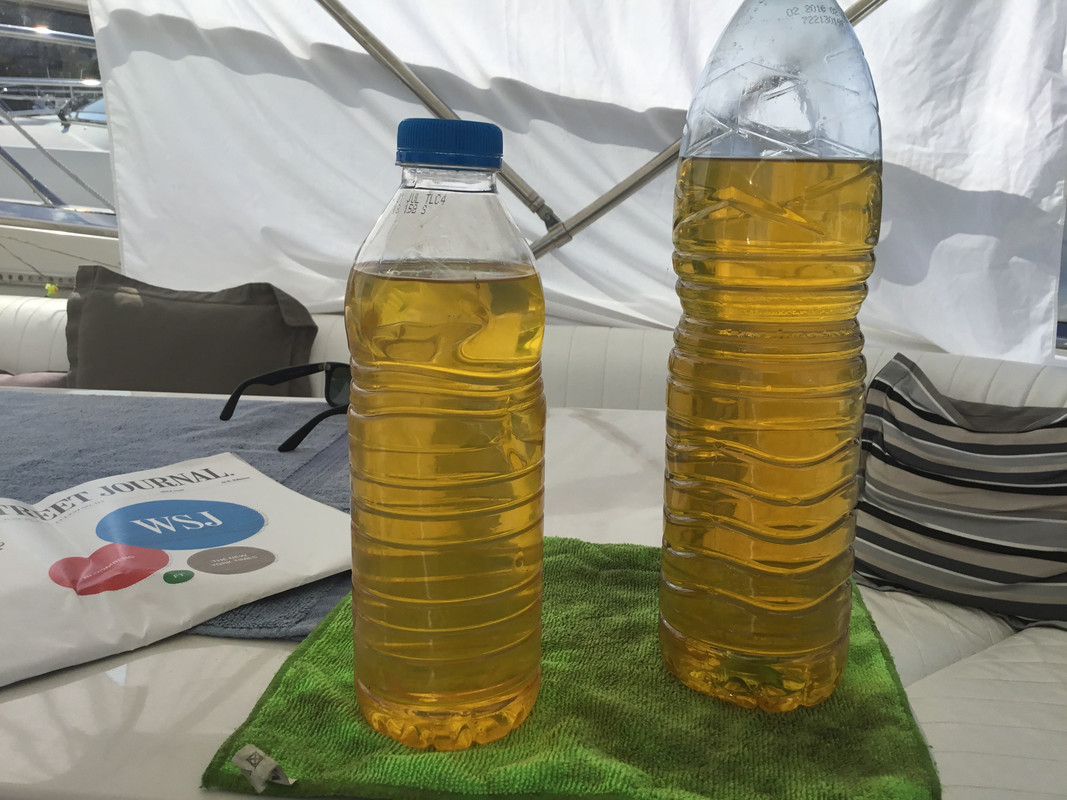
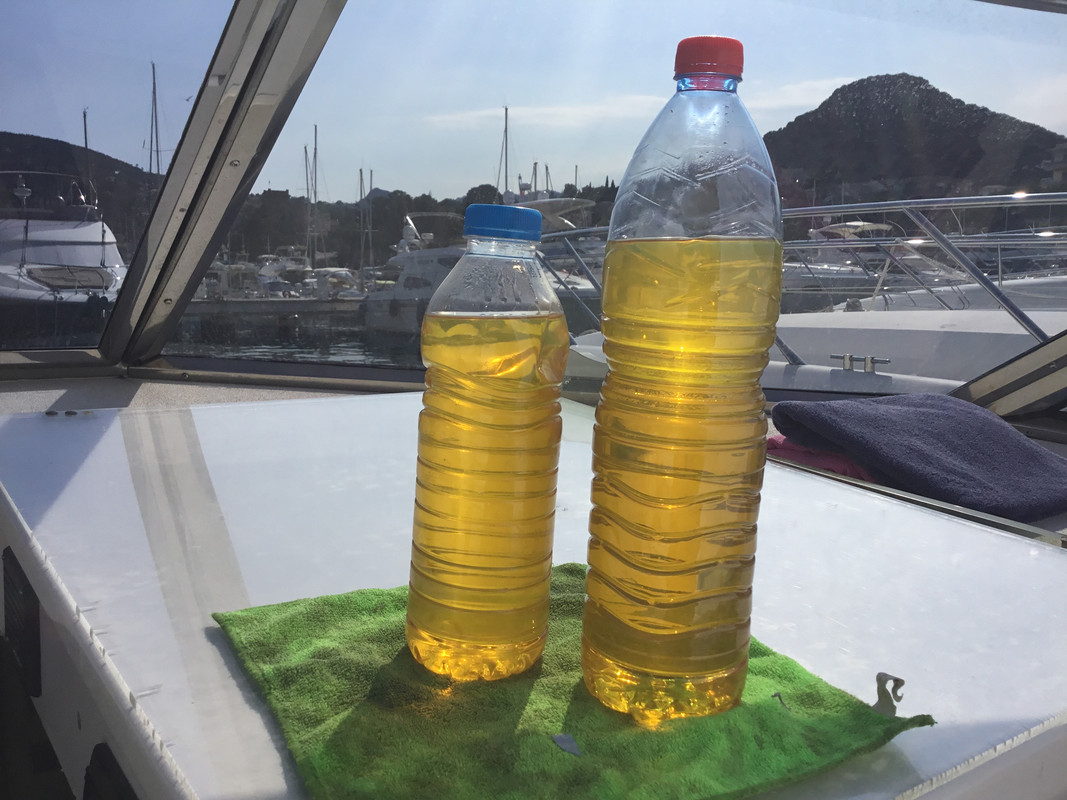
Basically I discovered my reserve tank was 1/2 full after a few years .....but is was Startron d .
I drained some off , the little bottle is the first out .
My 3 tanks have cocks .
http://www.ybw.com/forums/showthread.php?502534-Fuel-colour-diagnostic-value&highlight=


The pic are 24 hrs between them .So clear as time goes by .
But even the little bottle was just a bit cloudy on the 1 st pic say 1/2 L out of 400
3 years of Startron has worked as it sat .
 
Last edited:
So I briefed the Admiral before tacking the spare fuel that there could be “ Ellessar “ moments .
Me up to my neck in the ER messing with clogged pipe / filters etc etc , limping back on one engine etc etc .Days lost .
Fortunately I could isolate the aged fuel and in the end after the basic bottle test it run ran ( stb engine ) as normal .
I note Startron does well in PeteM,s linked test ^^^ .
 
So I briefed the Admiral before tacking the spare fuel that there could be “ Ellessar “ moments .
Me up to my neck in the ER messing with clogged pipe / filters etc etc , limping back on one engine etc etc .Days lost .
Fortunately I could isolate the aged fuel and in the end after the basic bottle test it run ran ( stb engine ) as normal .
I note Startron does well in PeteM,s linked test ^^^ .

To be honest, they all seem to do the job don't they? So it's really more a matter or availability, price, whatever has worked I in the past. Personally I use Marine 16 as it comes in 100ml bottles so handy for carry on bags.
 
So if the water is dispersed does it get caught in the filters or does it make it through to the injectors to be burned off. Does this matter?

Depends on what you mean by “ water “

You mention “ dispersed “ in the same sentence.
So in my book that’s not water per se .IT was buts been chemically changed as said by the product ( doing what it claims ) to be injector friendly .

We need to draw a distinction ( language issues ) between this dispersed water and neat water sat at the bottom un dispersed.
Neat water that gets through .....hence WIF and clear bowls will form hydrogen and knacker the injector tips = hosing , they can’t close properly and melt a piston .

No water no bug .
So there’s two things to protect.
Neat water - WIF + clear bowls and the lucky few tank drain cocks .

This is different to the bug .
Bug as said two approaches , biocides- debris sinks and is caught on the paper elements of the twin filtration 30 to 2 or 5 or 20 to 2 or 5 or what ever.

Or water dispersement....which I think ( there’s always doubt re snake oil but the cost is peanuts ) works , or seems to do for me .
This season we have moved around a lot and fuelled up all over the place......and can you trust the supplier ..? So for me I’ll continue to treat .
 
To be honest, they all seem to do the job don't they? So it's really more a matter or availability, price, whatever has worked I in the past. Personally I use Marine 16 as it comes in 100ml bottles so handy for carry on bags.
Agree .
There’s even a school of thought regarding microbial resistance.
It suggest don’t keep using one brand .....,swop about .
So this summer I could not get Startron at the local shop so came away something else.
Not worried in the slightest .
Or bothered checking the research on the resistance theory .:)

Any thing is better than nothing ,
 
Well speaking as someone who has actually had the bug - we had both tanks and all the filters contaminated.
I've documented the cleaning process on here and in my piece in MBY's "Our Boats Section"

But I also carried out an important test that made the decision for me.
We had to drain the fuel in the bottom of the tanks to get the worst of the bug out.
Our tanks have small sumps and drain cocks.
So, initially I drained off a full container of gungy diesel sludge from the bottom of one of the tanks.
I used one of those large plastic "bottled water" containers that you buy from supermarkets containing drinking water - 5 litres I think.
The container was full of black gungy stuff so I added about a thimble full of marine 16, shook it up and left it overnight.
In the morning 98% of the fuel was clear - only a little trace left in the bottom of the tanks.
This biocide really does work.

We finished the job over a couple of days - mainly just circulating a concentrated Marine 16 diesel mix throughout the fuel (tanks were about one third full).
Also cleaned the filters with a strong Marine 16 mix and replaced the cartridges etc.

I then filled the tanks (full) with a strong Marine 16 mix and set off on a short cruise.
At the end of the season, I decided to refill the tanks with the Diesel Complete that Pete refers to.
The diesel Complete is much more expensive because you have to use quite a concentrated mix but it is supposed to give you better fuel economy.
I just thought I owed my fuel pumps and injectors a bit of special treatment after the bug attack.
In fact, I don't think any of the bug actually reached the engines - the Separ filters seemed to have caught it all.
The engine electronics identified the problem as low fuel pressure and alarmed accordingly.
The scary bit was that the first alarm was 100 miles from land!! - I'm sure that DJEFABS will remember it well!!
 
Top