Windward ability

deep denial

Well-Known Member
Joined
10 Mar 2006
Messages
517
Location
Southampton
Visit site
Bermudian rigs are supposed to excel at pointing high - but what is the reason for this as compared to other rigs eg
Gaffer - is this due to the twist in the main?
Ketch - would have thought the stern sail would push her up rather than the reverse
Cutter - is this something to do with disturbed airflow?
bilge keel - presumably due to leeway?
What's the reason in each case?
 
I read somewhere that in order to go well to windward a boat should be tall and deep.That rules out most bilge keelers and gaff rigged boats.
 
Luff Length

Nothing takes you to windward like luff length.

Two very similar vessels, one with a tall mast and one with two shorter masts, same hulls, same sail area, the one with the greater continues luff length will go to windward better and closer than the other.

Bermudan Sloop - Long luff - good windward ability
Gaff Sloop - Short Luff - Poor windward ability.
Ketch - split sail plan - Poor windward ability

same is true for Yawl, Schooner.

There are lots of other factors to think about, but with to similar hulls the one with the longer luff will win.

Simes
 
Nothing takes you to windward like luff length.

Two very similar vessels, one with a tall mast and one with two shorter masts, same hulls, same sail area, the one with the greater continues luff length will go to windward better and closer than the other.

Bermudan Sloop - Long luff - good windward ability
Gaff Sloop - Short Luff - Poor windward ability.
Ketch - split sail plan - Poor windward ability

same is true for Yawl, Schooner.

There are lots of other factors to think about, but with to similar hulls the one with the longer luff will win.

Simes

Cor ! I have learnt something. I didn't know that. Thank you.:D
 
Of course pointing high isn't the same as making distance over the ground to windward, which is ultimately what really counts when comparing windward performance.

Perfectly true.

Reading a book on Nelson's Navy, I discovered to my horror that the warships of that time used to sail sideways, as they could not point at all.

What about mast rake then ?
 
Luff length - the real issue is aspect ratio. A taller, skinnier foil will be more efficient than a shorter fatter foil. Think glider wings.
 
It's all about aspect ratios and lift. Just like a gliders wing is long and thin, to provide maximum lift, so an efficient rig needs to be tall and narrow.

That is the simple description of it.

Beyond this the more sails you have the lower you point as once you start getting too close to the wind sails start back winding each other. So technically a catboat with a tall bermudan rig should point higher than a sloop. However, the extra power and speed you get through having a headsail more than makes up for the few degrees you lose in pointing.

You start to lose more pointing ability than you gain lift beyond a good sloop set up. The only reason cutters, yawls and ketches still exist is because it breaks the sail area down to make everything easier to handle for people who don't mind losing some windward ability. Basically it's a compromise.

Bilge keelers don't go to windward well because they've only got silly little keels, and so the aspect ratio of the rig has to suffer to keep the thing controllable when the wind pipes up. Put a big, efficient rig on a bilge keeler and you end up with the Westerly Ocean that I did my YM on. Something utterly uncontrollable in anything above a F4.
 
I was just musing today on how much taller the mast on a Bene 211 is than that on my 17 ft boat.
Having said that the pointing ability may be degraded by the fact that 211s lay over on their beam in any slight puff.
I reckon it's a whole load of factors which interact.
 
It's funny that high performance boats like moths, skiffs and ac boats have gone to flat topped mainsails which are essentially a mini gaff to get more twist in the main because it's hard to get enough twist in a bermudan rig. Maybe the next step is a tall gaff rig with a flat gaff that acts as an end plate for the main.
 
It's funny that high performance boats like moths, skiffs and ac boats have gone to flat topped mainsails which are essentially a mini gaff to get more twist in the main because it's hard to get enough twist in a bermudan rig. Maybe the next step is a tall gaff rig with a flat gaff that acts as an end plate for the main.

While a flat top mainsail, with a wide traveller at deck level does allow you a lot of control over the twist of the sail the main advantage to the sail shape is the extra surface area and so maximises the efficiency of the foil. After all while a tall narrow rig is desirable with a triangular sail you will have a lot less lift generated at the top of the sail than at the bottom.

I think the flat topped mainsail is the pinnacle of sail shape as far as efficiency with soft sails goes. The next step is solid wings as we saw in the last AC, and will see again in the next installment.
 
Also the Bermudan rig is probably the best comprise between an efficient sail shape and more windage due rigging, spars, etc. I don't think many other rigs, especially a modern high-peaked Gaff rig, are half as bad as most people think. It's just that, as TK and others suggested, they tend to be stuck on inefficient hull shapes, designed to look "classic" rather than sail well, etc. Some of the modern stuff such as Nigel Irens designs are a lot faster than you'd think at first glance. I got slowly by one of his 20 footish things in Christchurch bay whilst driving a noticeably larger and got hoots of derision from everyone less and booted off the helm in disgrace. It still passed us though, or rather it would have if we hadn't suddenly decided we ought to go and have a look at the new surf reef to see what it was like...
 
Also the Bermudan rig is probably the best comprise between an efficient sail shape and more windage due rigging, spars, etc. I don't think many other rigs, especially a modern high-peaked Gaff rig, are half as bad as most people think. It's just that, as TK and others suggested, they tend to be stuck on inefficient hull shapes, designed to look "classic" rather than sail well, etc. Some of the modern stuff such as Nigel Irens designs are a lot faster than you'd think at first glance. I got slowly by one of his 20 footish things in Christchurch bay whilst driving a noticeably larger and got hoots of derision from everyone less and booted off the helm in disgrace. It still passed us though, or rather it would have if we hadn't suddenly decided we ought to go and have a look at the new surf reef to see what it was like...

Talking of modern gaffers and their underwater shape, don't feel too ashamed if you ever get overtaken by Alice III. The bits of her you can't see are shaped like a race boat.

hnalice3.jpg
 
Tall rigs are no good without well-setting sails; we all know that. But below the waterline it's not just the draft that counts, it's the shape. A well-shaped and reasonably deep bilge keel can be more efficient than a poorly shaped single keel. It has the advantage of being nearer vertical for a start. Other configurations have been shown to substitute for simple depth, notably wings/end foils.

Old gaffers with long keels are pretty poor at preventing leeway but when a modern gaff rig is combined with a modern underwater profile it can give the lie to conventional wisdom.

Look at Nigel Irens's designs:

3.jpg


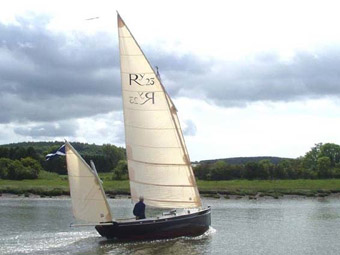
Notice the near-vertical yard and long luff. This boat is more like a bermudian rig with a kink in it. Below the waterline it has a deep iron drop-keel.

I regularly see Romilly on the Tamar and I've rarely seen anything pass it.

As for the short gaff or long top batten:

Pahi52-AC%2040%20bs.jpg

3644510460_b5ae2f9575.jpg


The long luff combines with a wider top section of the sail so it is more like a rectangular wing. A normal triangular sail has very little drive in its top 10% as the fat mast and short sail chord mean that the sail is operating in turbulent air and doing next to nothing. The main function of the top 2 or 3 feet of the sail is to support the rest of the sail.
 
Top