Windward ability

I wonder what the thinking was behind the three 'genoa' type rig of 'Club Mediterranee' when she took part in the Single/Handed Cross-Atlantic Race.
Was it solely for ease of singlehanded management or did the rig afford a better pointing/windward ability with the long luffs to the genoas.
I think she was well down the results at the end and didn't get line honours either.
Must look her up on Wiki for her underwater lines too. I believe she's been a charter yacht since then.

ianat182
 
Look at Nigel Irens's designs:
Ah. we have one of those on Windermere. Moored on the west shore in Lazy Bay.
Goes very well indeed.

June03sail_5.jpg
 
I wonder what the thinking was behind the three 'genoa' type rig of 'Club Mediterranee' when she took part in the Single/Handed Cross-Atlantic Race.
Was it solely for ease of singlehanded management or did the rig afford a better pointing/windward ability with the long luffs to the genoas.
I think she was well down the results at the end and didn't get line honours either.
Must look her up on Wiki for her underwater lines too. I believe she's been a charter yacht since then.

ianat182

You're mixing up 2 boats here.

Vendredi 13 was around 120 ft and had 3 masts each carrying a roller genoa for ease of handling. Club Med was 240 ft and had 4 masts each with a complete main/genoa.

Club Med took part in the 1976 OSTAR (as did 13, for the 2nd time). Colas had halliard problems and had to put into port for repairs. He was penalised for having a crew on board to help him out of harbour and went on to come second behind Eric Tabarly in a mere 80 footer. (Meanwhile another competitor had steering failure 600 miles out and had to get home with no rudder, an interesting experience).

Club med had a fin and skeg configuration. She was built through a very clever sponsorship deal with the French press and Club Med and it was always intended that her empty hull would be fitted out as a cruise ship.
 
It's funny that high performance boats like moths, skiffs and ac boats have gone to flat topped mainsails which are essentially a mini gaff to get more twist in the main because it's hard to get enough twist in a bermudan rig. Maybe the next step is a tall gaff rig with a flat gaff that acts as an end plate for the main.

It's nothing to do with twist, it's because of tip losses on the Bermudan rig, which forms a significant part of the drag. Aircraft wing tips have the same issue. IRC heavily penalises large roaches which is why cruiser-racers don't have similar mainsails. They would be more efficient on a cruiser but the backstay would cause a problem and make them more hassle than it was worth for a cruiser.

The book the OP wants is Sail Performance by CA Marchaj. It explains all about the ratio of lift and drag from various rigs and the tight link between the lift/drag ratio of the sail plan (really the entire above water part of the boat) and the lift/drag ratio of the keel (and the rset of the underbody) of the boat.
 
Going back to basics, one of the biggest factors detracting from windward ability on cruisers is the sheeting angle of the headsail. I was reminded forcibly when sailing a friend's Island Packet which has sheets outside the shrouds which were attached to the gunwales with a 14' beam on a 42' hull. There is no way that boat would ever go well to windward unless they set a headsail that could be sheeted inside the shrouds.
 
Going back to basics, one of the biggest factors detracting from windward ability on cruisers is the sheeting angle of the headsail. I was reminded forcibly when sailing a friend's Island Packet which has sheets outside the shrouds which were attached to the gunwales with a 14' beam on a 42' hull. There is no way that boat would ever go well to windward unless they set a headsail that could be sheeted inside the shrouds.

But you can't just move the tracks inboard to improve pointing as the windward ability is tightly linked to the keel configuration. Looks at the boats who have narrow sheeting angles, they almost all have very efficient keels too, whereas the Island Packet has a pretty traditional keel.
 
But you can't just move the tracks inboard to improve pointing as the windward ability is tightly linked to the keel configuration. Looks at the boats who have narrow sheeting angles, they almost all have very efficient keels too, whereas the Island Packet has a pretty traditional keel.

most new AWB have the sheet track on the rail as it is cheaper to secure + with shrouds taken out as well it lessens the rig loads hence smaller section masts & shrouds
This is my set up
080820097812.jpg


Designed to Go to windward ;);)
 
Last edited:
To be embayed in a gale was certain death for a sailing warship. Between inefficient square rig and no keel they could point perhaps 6 points off the wind but the leeway in any but the most benign conditions meant they were making virtually no VMG
 
most new AWB have the sheet track on the rail as it is cheaper to secure + with shrouds taken out as well it lessens the rig loads hence smaller section masts & shrouds
This is my set up
080820097812.jpg


Designed to Go to windward ;);)

What you sheet outside the shrouds!! - don't know how to get the shock/horror smiley :)

Even my pure cruiser has inboard sheeting (but she is mainsail driven with just a jib).

The thing is that it is the entire design that works to go to windward. No point an AWB having a tight sheeting angle if she has bluff bows, bloated midships and stern sections and a placebo keel - not to mention half-heated control of the mainsail.
 
>Ketch - would have thought the stern sail would push her up rather than the reverse

The mizzen doesn't push the boat up it's just a third in-line sail, although you can use it on its own to turn the boat. A ketch will always be beaten by a same size sloop going upwind or directly dowind because the main mast is smaller and thus less sail area. However ketches were not designed to do that, they are reaching machines. Add a mizzen staysail and a ketch will easily beat any same sized sloop on a reach. We bought one for tradewind sailing.
 
>Ketch - would have thought the stern sail would push her up rather than the reverse

The mizzen doesn't push the boat up it's just a third in-line sail, although you can use it on its own to turn the boat. A ketch will always be beaten by a same size sloop going upwind or directly dowind because the main mast is smaller and thus less sail area. However ketches were not designed to do that, they are reaching machines. Add a mizzen staysail and a ketch will easily beat any same sized sloop on a reach. We bought one for tradewind sailing.

Can't agree with your " a ketch will always be beaten by a same size sloop going upwind or directly downwind." My ketch goes faster than sloops once the wind pipes up - they roll their foresails and main inefficiently. I just remove a sail thus keeping a much more efficient unreefed sailplan.

As for downwind - not so sure either with goosewinging opportunities.
 
Can't agree with your " a ketch will always be beaten by a same size sloop going upwind or directly downwind." My ketch goes faster than sloops once the wind pipes up - they roll their foresails and main inefficiently. I just remove a sail thus keeping a much more efficient unreefed sailplan.

This just shows, as ever, that a well sailed boat can out perform a theoretically faster boat not sailed efficiently.
But it doesn't take much to allow a sloop rig to be reefed very efficiently - a slab reef mainsail reefs perfectly, and a foam luff furling genoa pretty good also - but swapping to a tall narrow "solent" jib even better, and virtually unbeatable (other than a wingsail cat!)
 
Snowleopard. Thanks for the information,got my boats mixed up obviously!
Would have replied more promptly but the forum was3 minutes just to get to the reply section and then hung as I finished.!!

ianat182
 
Must look her up on Wiki for her underwater lines too. I believe she's been a charter yacht since then.

ianat182

I would love to see what you find. I would not expect to see any lines found by google.

As another has posted, there were 2 yachts of interest in this discussion, V13 and Club Med.

Google turns up a few pictures of Club Med. Its four masts carry roached mains and tall narrow jibs/staysails call them what you will. They look optimal for pointing high.

I seem to remember pictures of Club Med being launched upside down. It had deep high aspect ratio keel with a huge bulb on the end, spent uranium according to the report.
 
As has been touched on:
The ratio of lift to drag is the key factor in rigs.
The more lift and less drag the higher a boat can point.

The drag that comes from the tip vortexes at the top (and to a lesser extent the bottom) of the sail and is known as induced drag, but drag also comes from the 'windage' of the rigging etc which is known as parasitic drag.

The best shape for low induced drag (low tip losses) is one that gives an elliptical lift distribution. A gaffer has too wide a 'tip' (head in boat speak) but a bermudan with no roach has too narrow a tip. That's why the large roach has come back into vogue with fully battened racing mains. This seeks to give the optimum lift distribution as well as low drag (parasite, profile) and easiest sail shape control.


Any rig will be more efficient with one mast than two. More tip vortexes come with more tips! Also the less cordage/spars aloft, the less parasitic drag. The reason for more mast's is usually practical - ie sail handling.

However the catboat/una-rig is not as good as the sloop - the foresail acts like a leading edge slot on a wing and improves lift and pointing angle. Modern jibs are more like 'trim tabs', power is coming from the main really.


The comments on luff length are telling. In actual fact mast height is more important than aspect ratio. The more air (mass flow) you can grab with the sail the better for induced drag. The fact that the aspect ratio also changes is coincidental - as a result of keeping the sail area the same. A bermudan rig of the same area as a gaffer is a taller rig and accessing more air, as it were.

All of this is true of foils also, deeper the better for efficiency. There is no inherent value in a short chord though. In reality there is a 'sweet spot' where low induced drag (long) meets low profile drag (wetted area).

Of course all these parameters have to come together in one boat - there are often to many variables to compare. For instance, a traditional hull with a bermudan sail (Vertue say) will be slower than a modern hull with a gaff rig (Alice III).

That said the high peaked gaffs found on Nigel Irens designs and the like, are close to the optimum elliptical loading - one reason why they perform so well.


Of course improving L/D is only one aspect of design so practical compromises are made with regard to easy sail handling, backstays, rig strength, draught etc etc etc...
 
Just for completeness....

I dont 100% agree with the comments about the the big head/high roach on some dinghy designs, like the Moth, having nothing to do with twist....

If you look at the way they are usually rigged, very much like a modern windsurfing sail, with collosal amounts of 'halyard' tension or downhaul, not that much outhaul and a very stiff sail with extensive use of battens to maintain shape... the result is a fairly loose leach.... this allows the sail in big gusts to twist off at the head or feather if you prefer, thus making the whole craft more manageable in windy and variable conditions.... you'll see that the Moth community progressively add more and more downhaul as the wind picks up specifically for this purpose... for the same reason, they have tapered masts with carefully designed bend characteristics that vary through its length

For the sake of avoiding an argument, I absolutely agree that the shape is there primarily to maximise performance from the given sail area vis a vi tip drag... no argument on that front... but the ability to twist is also intentionally designed in as a secondary, but still very important characteristic...

Perhaps all of this is not so relevant to a stayed yacht rig, but worth adding just to further the discussion.

(thus spake the ex Moth and skiff sailor who gave up after one too many bruises!)
 
Last edited:
...the ability to twist is also intentionally designed in as a secondary, but still very important characteristic...

Absolutely agree.

A sail is not operating in linear airflow like a wing.

The angle of attack and velocity varies substantially up and down the mast. And the difference increases as the wind speed rises.
 
Tall rigs are no good without well-setting sails; we all know that. But below the waterline it's not just the draft that counts, it's the shape. A well-shaped and reasonably deep bilge keel can be more efficient than a poorly shaped single keel. It has the advantage of being nearer vertical for a start. Other configurations have been shown to substitute for simple depth, notably wings/end foils.

Old gaffers with long keels are pretty poor at preventing leeway but when a modern gaff rig is combined with a modern underwater profile it can give the lie to conventional wisdom.

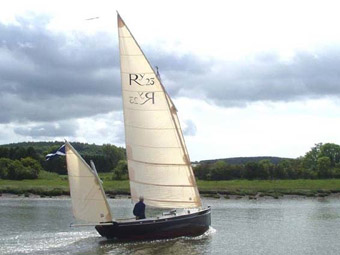
Look at Nigel Irens's designs:

3.jpg


Notice the near-vertical yard and long luff. This boat is more like a bermudian rig with a kink in it. Below the waterline it has a deep iron drop-keel.

I regularly see Romilly on the Tamar and I've rarely seen anything pass it.

As for the short gaff or long top batten:

Pahi52-AC%2040%20bs.jpg

3644510460_b5ae2f9575.jpg


The long luff combines with a wider top section of the sail so it is more like a rectangular wing. A normal triangular sail has very little drive in its top 10% as the fat mast and short sail chord mean that the sail is operating in turbulent air and doing next to nothing. The main function of the top 2 or 3 feet of the sail is to support the rest of the sail.

Top one looks more like a Gunter to me.
 
Top