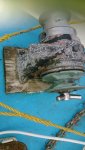
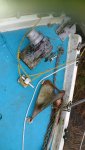
Windlass Deck Reinforcing Plate

Thanks for reply. I was hoping to fit the pad under the deck to spread the load, I don't want to raise the windlass any higher above deck, as its a good angle to the bow roller at the moment. Its a 1980 Westerly Griffon, solid deck, not cored.
Wrong, the deck will certainly be balsa cored over most of the flat deck and coachroof sections. Along the centreline of the foredeck will be a 10mm thick plywood stiffener. This is fiberglassed in place before the balsa core, so the fiberglass is the stiffener, not the plywood. The plywood is to stop any compression between the two layers of glassfibre. The plywood should be wide enough to fix an anchor winch through it. On my Fulmar, an extra plywood pad has been used to spread the load under the deck on the manual anchor winch. The main pull on an anchor winch is almost horizontal, and never as high you would expect. When anchored you should always use a rope to take the strain, rather than the winch.
 
Last edited:
Wrong, the deck will certainly be balsa cored over most of the flat deck and coachroof sections. Along the centreline of the foredeck will be a 10mm thick plywood stiffener. This is fiberglassed in place before the balsa core, so the fiberglass is the stiffener, not the plywood. The plywood is to stop any compression between the two layers of glassfibre. The plywood should be wide enough to fix an anchor winch through it. On my Fulmar, an extra plywood pad has been used to spread the load under the deck on the manual anchor winch. The main pull on an anchor winch is almost horizontal, and never as high you would expect. When anchored you should always use a rope to take the strain, rather than the winch.
Interesting! The only place ive seen the thickness of the foredeck was when I refitted the hawse pipe, and it looked solid. Anyway, I'm now forewarned in case! . Extra ply pad seems a good option then, I can epoxy it to seal it, perhaps just seal it to the deck, rather than bond it, in case it needs replacing, and big stainless washers under the 3 8mm studs. Sound ok?
 
What you probably saw is where core is removed and resin poured in to create a strong 'tube' through the deck.

The old way of creating a 'tube' through a cored deck :

Hole saw to cut the desired diameter right through ... you then have GRP - CORE - GRP exposed layers ...

Take a variable speed hand drill and a large nail. Bend the nail so you have an L shape to it ... put into the drill and you now have a 'tool' to gouge out the core .... take it relatively slow and grind away with the spinning nail.

Once core is gouged out ... then its matter of filling in. I like to use resin with fibre strands in .... gives far better strength and holds shape.
 
I was responding to HDPE.

But no, restricting it to engineering plastics doesn't really solve the problem. Many of those creep, to a lesser degree, unless reinforced, and most can crack without warning. Thus glass filled nylon could work, for example, but not nylon alone. And PTFE is consider to be an engineering plastic, and creeps fast (though you were certainly not thinking of that one).


There are all kinds of 'Engineering Plastic' with all different properties.

Yes HDPE can creap but does have and advantage as being soft enough to molds to uneven surfaces.

I have used HDPE in a sandwich between a stainless steel and the underside of a ferro cement deck.

A stronder PE is UHDPE but again I would use that as the meat in a sandwich backing plate.
 
Interesting! The only place ive seen the thickness of the foredeck was when I refitted the hawse pipe, and it looked solid. Anyway, I'm now forewarned in case! . Extra ply pad seems a good option then, I can epoxy it to seal it, perhaps just seal it to the deck, rather than bond it, in case it needs replacing, and big stainless washers under the 3 8mm studs. Sound ok?
I believe the plywood pad on my Fulmar has just been varnished, but epoxy would be a better job. I can no longer check it now as I have just replaced the fore cabin headling and covered the plywood, but left the nuts exposed in case of a problem in the future. There were just the bolts and penny washers on the underside.
 
I know this thread has served its purpose and OP is sorted .... but hought I would add photos of the deck plate on my SR ...

SA Anchor windlass (1).jpg

Yes I know - needs a good scrub off and protective varnish ....

SA Anchor windlass (3).jpg

Its winter and not suitable for painting .... so it will have to wait till end of winter.

Overall boat needs a good wash-down ! And clean up the sealant on pulpit hold down bolts.
 
Top