
wind vane on Laura Dekker's Guppy

BurnitBlue

Well-Known Member
Joined
22 Oct 2005
Messages
4,575
Location
In Transit
Visit site
I am intrigued by the self-steering wind vane system on guppy, her wheel steered Gin Fizz.

I think it is Hydrovane but it operates a mini tiller on the aft cabin coach roof. The video of her voyage at one point shows clearly that the wheel follows the mini tiller but with no connection in sight.

I guess that the connection is done somehow below decks probably by the emergency tiller boss on the main rudder quadrant.

Can anyone explain the system used? I have spent hours on Google but no useful info.

For instance, does the emergency tiller on a 38 foot Gin Fizz extend upwards through to the deck.

Thanks.
 
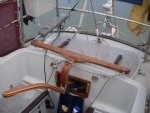
It's a Windpilot, I took this picture but it's not clear where the steering line goes to, the mini tiller is visible

P1060779.jpg
 
Yes, a Windpilot Pacific. Linking a Hydrovane to the ship's rudder would be...well, interesting.

I can't make it out from the photo but imagine the Windpilot has short lines linking it to a stubby emergency tiller or possibly a transverse yoke (so as not to intrude unnecessarily into the cockpit). The latter has the advantage of doing away with two turning blocks. This works fine with cable-steering.
 
Not sure where the mystery is supposed to be. The above-deck tiller is presumably connected to the top of the rudder stock, which protrudes through the aft deck either as standard from the factory (like my boat) or has been extended for the purpose. The wheel will have the conventional wire/chain/rod linkage to a quadrant or second tiller on the stock below decks, so naturally it turns when the rudder does.

My rudder stock passes from the bottom of the hull up to the deck for strength, since it's a spade rudder with no bearings to support it below that. The end that protrudes above the deck is machined to take the emergency tiller. If I ever installed a windvane (unlikely on this boat) then I'd probably do exactly the same as this lady.

Pete
 
More investigation :) This close-up shows the mini tiller, the circled fitting is the bronze fitting Windpilot provides to lock the steering lines on the tiller: the port/stb lines end at two extremes of a short length of chain, whose links are dropped on the fitting, giving the possibility to adjust the rudder angle

wvane_zpsg5t4fta9.jpg
 
Not sure where the mystery is supposed to be. The above-deck tiller is presumably connected to the top of the rudder stock, which protrudes through the aft deck either as standard from the factory (like my boat) or has been extended for the purpose. The wheel will have the conventional wire/chain/rod linkage to a quadrant or second tiller on the stock below decks, so naturally it turns when the rudder does.

My rudder stock passes from the bottom of the hull up to the deck for strength, since it's a spade rudder with no bearings to support it below that. The end that protrudes above the deck is machined to take the emergency tiller. If I ever installed a windvane (unlikely on this boat) then I'd probably do exactly the same as this lady.

Pete

Thanks. The mystery for me was that I have never seen an emergency tiller stock extend above the deck. Both my present Moody and my previous HR had the emergency tiller operated INSIDE the aft cabin with absolutely no way of operating the boat and the tiller single-handed. Stupid arrangement.

I am working on obtaining the bits to enable me to extend the emergency tiller to above deck. I need a stainless Rod and a bearing on deck.

I saw the video of Laura Dekkers Guppy and wondered if the emergency tiller was extended or built originally that way. It seems that it is original ... good on the French.

I wonder if I can source the bits from Jeaunue (sp) or wherever. My intention is to attach my Aries to the mini tiller instead of the cumbersome wheel drum supplied with my Aries. I used the wheel drum on my HR but it was a pain. My Moody would be an even worse pain.
 
Last edited:
I wonder if I can source the bits from Jeaunue (sp) or wherever.

Try a PM to Colin (colhel) on these forums. He's a professional machinist who's made various metal parts for people's boats, including the below-decks tiller for my autopilot (boat came with a wheelpilot, I upgraded to a proper linear drive).

I guess it would probably be easier to regard your extension as a mere driveshaft rather than a structural extension of the rudder stock itself - presumably Moody thought it was strong enough as it is, and a stock extension would be more demanding on the joint, the top bearing, and the alignment of the whole thing. So the joint from existing stock to new shaft should probably have a small degree of play in it rather than being rigidly connected - machining the end to fit over the existing emergency tiller square/splines/whatever, with a tiny amount of slack, would do nicely. Though it'll want a pin through it or some other arrangement (collar below the top bearing?) to stop it lifting up and falling off. Or alternatively, you could have a universal joint and divert the direction a bit, which might be less intrusive in the cabin but needs a bit more enclosed height over the existing stock unless you want to share a bunk with a bit of greasy machinery. All depends on the exact arrangement of your boat really.

For what it's worth, our stock passes through the deck in a simple plain bearing, with an automotive oil seal to keep the rain out (get the type with stainless spring). Col should have no trouble turning such an arrangement for you.

Pete
 
I will use a universal joint on an extension shaft from the square boss on the rudder stock then up through the deck. The universal joint will allow me more flexible choice to position the deck fitting which could be a normal through hull fitting to give a good position clear of the coach roof back as it angles down to the deck.
 
BurnitBlue,
prv gives good advice, particularly about bearings and seals. Having recently acquired a centre-cockpit boat, I may be fabricating such a set-up myself before too long.

This is what I meant by a transverse yoke:
WTFII_02 lo-res.jpg

Clearly this is on a tiller-steered boat (Rival 32), but the general principles would be identical to those on an emergency tiller. It may be that such a system would not easily fit on a particular boat, but if it does it liberates a useful amount of space. The tiller handle on the one pictured, by the way, simply plugs into the stainless steel box section and can be removed in seconds. Being able also to plug the tiller pilot into the yoke without its intruding into the cockpit was a bonus. The tiller pilot could also be deployed to directly guiding the Windpilot.
Note that the lines do not move through the sheaves at each end of the yoke: they operate mainly as guides. This takes two friction points out of the system.
 
Another solution I discussed with a Moody owner who lost the wheel steering on his boat during a race in the Ionian last year. He operated the emergency tiller from inside the aft cabin from instructions on deck. He finished the race but was highly critical of such a daft arrangement.

Anyway, we discussed using the emergency tiller as supplied but operated from deck via cables run through grommets in the aft cabin side decks attached to the emergency tiller and a wood thing on the deck. Couldn't come up with a suitable wood thing so had a beer instead.
 
Macd. Our posts crossed. I will add that suggestion to a serious attempt when I get back to Greece. Difficult for me to visualize the arrangement on my Moody from home. I took photographs but forgot to relate the rudder stock to a position on the deck so fabrication will have to done in Greece anyway.

Regarding your own attempt, I can only urge you to find a way to operate the emergency tiller from the deck. The cheap get out by the designer is in my opinion criminal stupidity.
 
Regarding your own attempt, I can only urge you to find a way to operate the emergency tiller from the deck. The cheap get out by the designer is in my opinion criminal stupidity.

I think we got our wires crossed a little. I think you thought I was referring to relocating my emergency tiller, whilst I only had in mind to mate it to a windvane system. My emergency tiller (on a Northwind 435) does operate from on deck. As you say, it's moronic to have it any other way.
 
Last edited:
I think we got our wires crossed a little. My emergency tiller (on a Northwind 435) does operate from on deck. As you say, it's moronic to have it any other way.

Interesting that the three boats I know to have aft cabin emergency steering were designed by Angus Primrose Moody 33, Ollie Enderlein Erasmus 35, and Bill King Moody 34/346. Top class yacht architects.

I live and learn. I really thought all were designed the same way. This on deck feature to operate the emergency tiller will definitely have a high priority on selecting my next boat. I wish I had known this before I bought the Moody. It leaves me wondering what other daft features Bill King implemented.

Thanks to all for the info and photographs.
 
Last edited:
Well ain't that odd: Angus designed my Northwind 435 (although he was long gone by the time they built it).
We'll never know, of course, how much of those sort of decisions is down to the designer and how much to the brief given by the manufacturer.
Then there's the fact that the shaft for our emergency tiller, when deployed, goes right between the pillows on the aft berth. But better that than steering blind...
 
Last edited:
I will use a universal joint on an extension shaft from the square boss on the rudder stock then up through the deck. The universal joint will allow me more flexible choice to position the deck fitting which could be a normal through hull fitting to give a good position clear of the coach roof back as it angles down to the deck.

The general idea sounds good, but I'm not convinced about using a conventional seacock through-hull as the deck fitting. How would it seal to keep rain and waves from coming in around the shaft? At first I thought "well, it would make a useful starting point, but you'd need to machine it to take a seal", but then I realised that the wall thickness would be nothing like enough for that.

I think you'll need a plain bearing specially machined, with a flange around it to screw down to the deck and a wider bore for a short distance at the top to take a lip seal. It's not a major project, I could make it myself if the lathe I recently inherited was set up rather than stored away in boxes, and I'm not much of a machinist.

Pete
 
I would prefer a professionally made bearing but I really think a seacock through-hull will be OK if i cannot find a fitting ready to bolt on.

If the seacock was installed upside down with the threaded part uppermost I could use a boot similar to the mast to seal against water quite effectively. Round bar with a diameter slightly less than the seacock through hull may squeak a bit

I really must avoid the bends an twists from the Aries to the Wheel drum via cables because the Aries is quite weak in light winds especially downwind. Nylon bearings you see.

If push comes to shove I can disconnect the wheel Morse cables at the quadrant and rely on the emergency tiller entirely. Hardly any friction at all.

It is all a compromise. I would like to be ready to leave Greece this year. Running out of time.
 
Top