
Wind/speed

There's no such thing as "ground wind", it's either true or apparent. The tidal stream (be it Solent or anywhere else) increases or decreases the apparent wind depending on which way you're heading (or no effect if you're perpendicular to the tide).
p54 of the i70 manual - i70 Manuals | Raymarine

Raymarine define ground wind and true wind differently. See post 7.

Edit - a better explanation here: Raymarine FAQs
 
  • Like
Reactions: DJE
p54 of the i70 manual - i70 Manuals | Raymarine

Raymarine define ground wind and true wind differently. See post 7.

Edit - a better explanation here: Raymarine FAQs
What can I say. They can call it what they like, but it’s useless info. The boat cares only about apparent wind, you should be caring about true wind. The actual wind that’s blowing, that's why it is ‘true’.
 
p54 of the i70 manual - i70 Manuals | Raymarine

Raymarine define ground wind and true wind differently. See post 7.

Edit - a better explanation here: Raymarine FAQs

Same with B&G. By default STW is used in the calculation of what the instruments call True.

This is a well trodden path hereabouts, see this contribution to an earlier thread from 2 years back

Post in thread 'What is more accurate for speed, navionics or nasa log?'
What is more accurate for speed, navionics or nasa log?
 
p54 of the i70 manual - i70 Manuals | Raymarine

Raymarine define ground wind and true wind differently. See post 7.

Edit - a better explanation here: Raymarine FAQs
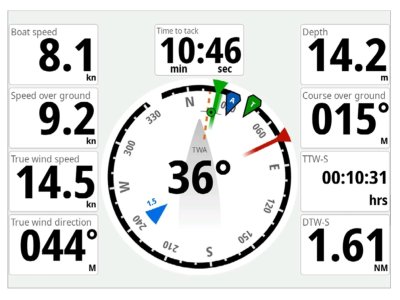
That instrument is around 10 years old and doesn't display a tide vector unlike more modern devices.

I think they made up the term "ground wind" to differentiate between their version of "true" which is affected by the motion of the vessel in a current vs the traditional version where true wind is the same as you'd measure if you were fixed to a point on the surface of the sea.

My B&G Zeus S (new model) shows the same true wind value whether you are going upstream or downstream in a strong current.

Screenshot_20250506_075922_Adobe Acrobat.jpg
On the Zeus S, the boat heading is where the grey outline points, the COG is the red dashed line. The true and apparent wind A & T. The active waypoint is the green dot and the tide is the blue arrow at 240, so it's running 060 at 1.5kts.

The tack lines widen and close depending on your speed towards the wind so as your apparent wind increases, the apparent wind angle moves forward as we know but the Zeus displays this very well.

Now if only I understood lee bowing!
 
Which is why, to a racer, or a cruiser who actually uses the wind to go somewhere, true wind is ground wind. Any other ‘true wind’ is useless. Of merely academic interest. You plan your tactics/passage to take advantage of the real true wind and of course the predicted changes in apparent wind ie tides, to maximise progress.
Oh Chiara.

I thought you were better than this!

In definition terms, exactly as DJE posted above.

Apparent - wind felt by boat as it sails.
True - wind felt by drifting boat - difference in velocity between air and water
Ground wind - wind as measured by anchored boat or bramblemet etc

I can absolutely assure you that as a racer, True is the most important read out. The reason for this is extremely simple. My boat only derives power as a result of the difference in velocity between the air and the water. When I am sailing, a 10 knot breeze over a lake makes my boat move at exactly the same rate through the water as a 5 knot breeze in the opposite direction to a 5 knot current.

As a racer, the primary use I have for wind instruments is to monitor my performance, so for this wind strength am I going as fast as I can?

Consider your home waters, the western Solent at springs. 3 knot tide. Light wind day - let's say 7 knots as measured by the Lymington platform. Nice SW, so lining up with the tide.

On the Ebb, i.e SW going tide, I am being shoved into the wind at 3 knots. So a wind instrument set to Ground wind would show 7 knots, but one set to true would show 10 knots.
On the Flood, i.e NE going tide, I am being shoved along with the tide at 3 knots. So a wind instrument set to Ground wind would show 7 knots, but one set to true wind would show 4 knots.

Now, we all agree that the motive power available to move my boat through the water is the difference between the velocity of the air and the water right?

So on the ebb I have 10 knots of motive power. So I can sail upwind at 6.6 knots though the water according to my polars.
But on the Flood I have 4 knots of motive power. So I can sail upwind at roughly 2.5 knots through the water according to my polars.

But if I had my instruments set to ground wind, they'd have said 7 all day. So how could I use that to asses my performance?
 
If B&G are now calling the ground wind true wind they are simply adding confusion where it didn’t exist previously. For me as a sailor, the ground wind is of no interest outside the situation where the tide is going to change and I may be able to calculate what the wind will then be. However, when I am actually sailing, I actually sail to the apparent wind, which is of course the wind after my boat speed and the current have taken effect.

There are occasions when I may want to know the true wind, where my boat speed is subtracted, and in my case this most often occurs when motoring or motor-sailing. A typical situation is when motor-sailing downwind at a time when the wind is expected to increase but at present is not enough to do without the engine. Typically, I will want around 15 kn wind from astern to want to stop the engine on a passage when I want to keep to six knots. The apparent wind wind will be varying around 5-10 kn and difficult to judge, and this is where the true wind can be helpful. I also find it much better when under power and manoeuvring as when entering a marina.
 
That instrument is around 10 years old and doesn't display a tide vector unlike more modern devices.

I think they made up the term "ground wind" to differentiate between their version of "true" which is affected by the motion of the vessel in a current vs the traditional version where true wind is the same as you'd measure if you were fixed to a point on the surface of the sea.

My B&G Zeus S (new model) shows the same true wind value whether you are going upstream or downstream in a strong current.

View attachment 193013
On the Zeus S, the boat heading is where the grey outline points, the COG is the red dashed line. The true and apparent wind A & T. The active waypoint is the green dot and the tide is the blue arrow at 240, so it's running 060 at 1.5kts.

The tack lines widen and close depending on your speed towards the wind so as your apparent wind increases, the apparent wind angle moves forward as we know but the Zeus displays this very well.

Now if only I understood lee bowing!
OP talks about Raymarine wind system not a B&G. The i70 is a current model, and is the way Raymarine display wind data - ie separately. I have no idea how other manufacturers currently define and use these terms.

Perhaps OP has a mix of manufacturers to display the information, but for Raymarine some of the information given in this thread is not correct.
 
What can I say. They can call it what they like, but it’s useless info. The boat cares only about apparent wind, you should be caring about true wind. The actual wind that’s blowing, that's why it is ‘true’.
Whether you consider the information worthwhile on not, for you, is up to you, but various of us are trying to correct the misinformation on how these instruments work.
 
That instrument is around 10 years old and doesn't display a tide vector unlike more modern devices.

I think they made up the term "ground wind" to differentiate between their version of "true" which is affected by the motion of the vessel in a current vs the traditional version where true wind is the same as you'd measure if you were fixed to a point on the surface of the sea.

My B&G Zeus S (new model) shows the same true wind value whether you are going upstream or downstream in a strong current.

View attachment 193013
On the Zeus S, the boat heading is where the grey outline points, the COG is the red dashed line. The true and apparent wind A & T. The active waypoint is the green dot and the tide is the blue arrow at 240, so it's running 060 at 1.5kts.

The tack lines widen and close depending on your speed towards the wind so as your apparent wind increases, the apparent wind angle moves forward as we know but the Zeus displays this very well.

Now if only I understood lee bowing!
I have B&G instruments.

That is showing true wind by my definition.

You seem to have a small confusion, in that the "True wind" as per my definition does not alter depending on if the vessel is going with or against the tide. It is simply the difference between the velocity of the wind and the water, aka the measure of power available to move your boat through the water.
 
My Raymarine ST60 only has an input from the Paddlewheel, and also the Anemometer atop the mast, measuring Apparent wind (Speed and Angle) It then calculates true Wind (Speed and Angle) and that's what's displayed.
There is no GPS Input.
As explained below, from the Raymarine Manual:

True Wind​

What Raymarine refers to as True Wind (TWA, TWS) is always wind-over-water, not wind-over-ground (more on this below.) We calculate this from AWA and AWS, plus speed-through-water (STW, from a paddle-wheel or equivalent.) It's not possible to calculate proper True Wind from GPS speed (SOG.) If you're looking at your wind instrument and you have AWA and AWS but TWS is showing as dashes (-.-kn) then you don't have Speed data coming in. In addition to TWA and TWS, our recent multifunction displays and i70/i70S instruments also offer TWD (true-wind referenced to north rather than the bow.) This requires compass Heading as well as STW. We can't use GPS COG for this because COG is the direction you're moving, not the direction you're facing (which is what Heading measures.) Lighthouse 2 MFDs also require Heading in order to display TWA/TWS.
 
Top