Wind/speed

Sneaky Pete

Well-Known Member
Joined
26 Nov 2009
Messages
919
Location
In the shadows of Faslane.
Visit site
The Raymarine wind/speed instrument has true wind and apparent wind and I understand the principles for each one. For true wind speed and direction it's from the the little cups that rotate on the wind/direction transducer at top of mast. Where and how is apparent wind calculated from. I've been told it's a mix of the speed transducer through the hull and the one at top of mast. Is it.
Thanks.
 
The Raymarine wind/speed instrument has true wind and apparent wind and I understand the principles for each one. For true wind speed and direction it's from the the little cups that rotate on the wind/direction transducer at top of mast. Where and how is apparent wind calculated from. I've been told it's a mix of the speed transducer through the hull and the one at top of mast. Is it.
Thanks.
In simple terms you have it correct.

@Snowgoose-1 has a good link.
 
The Raymarine wind/speed instrument has true wind and apparent wind and I understand the principles for each one. For true wind speed and direction it's from the the little cups that rotate on the wind/direction transducer at top of mast. Where and how is apparent wind calculated from. I've been told it's a mix of the speed transducer through the hull and the one at top of mast. Is it.
Thanks.
Other way round - the spinning cups and the pointy bit see apparent wind, I'm fairly sure true wind is calculated from there with heading and SoG
 
Other way round - the spinning cups and the pointy bit see apparent wind, I'm fairly sure true wind is calculated from there with heading and SoG
It would be the speed through the water. My Raymarine set will give true wind with no GPS, and in fact such displays were around long before GPS. It is the phrase ‘true wind’ that can be confusing, when it probably means ‘truer’. Many of us refer to the real wind as ground wind, but this is actually of little help to a boat on the water.
 
It would be the speed through the water. My Raymarine set will give true wind with no GPS, and in fact such displays were around long before GPS. It is the phrase ‘true wind’ that can be confusing, when it probably means ‘truer’. Many of us refer to the real wind as ground wind, but this is actually of little help to a boat on the water.
I remember them pre-gps too, which indeed must have used STW, but I'm 90% sure my current one takes GPS input from the network

Edit - you made me doubt myself, especially because I have pretty basic Nasa instruments - it can take either log or GPS data, but doesn't use heading data.
 
Last edited:
Apparent wind is that felt by a boat which is moving through the water. True wind is that felt by a boat which is not moving through the water. Ground wind is that felt by a moored or anchored boat.

So the masthead transducer measures apparent wind directly. The electronics then subtract speed and course through water to give true wind speed and angle. Alternatively they can subtract speed and course over ground to give ground wind speed and direction.
 
True wind is calculated "backwards" from apparent wind (the only wind the boat can ever measure) using SOG and COG (derived from GPS).

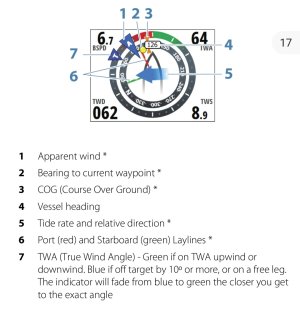
The boat speed through water and heading enable the chart plotter to then calculate tide/leeway.

If the boat is stationary over the ground (tied to the sea bed via anchor or pontoon) then apparent wind will be the same as true wind. Stick the boat in a tidal stream but not making way, ie speed log reads zero, then the COG/SOG can only be caused by tide or leeway.

Start the engine and turn the prop and/or hoist some sails, now you have apparent wind speed/direction from the anemometer, speed thru water from the log, heading from the compass (electronic feeding plotter), and a GPS provided speed and course over the ground.

Now your plotter can do some clever maths and provide a load of pretty lines, time to tack, ETA at a waypoint if you entered one etc etc.

Screenshot_20250505_213212_Adobe Acrobat.jpg
 
Last edited:
So the masthead transducer measures apparent wind directly. The electronics then subtract speed and course through water to give true wind speed and angle. Alternatively they can subtract speed and course over ground to give ground wind speed and direction.

I'm assuming that the speed transducer plays a part in the calculation of the wind/speed direction of true wind.
 
I'm assuming that the speed transducer plays a part in the calculation of the wind/speed direction of true wind.
No, it doesn't, see my post above.

Apparent wind needs SOG/COG (GPS supplied data) only to calculate true wind. If SOG/COG = zero then AWS=TWS.

Imagine your boat tied up in a marina. You know AWS=TWS. Now run a 5kt tidal stream through your berth. The speed log now reads 5kts STW but the AWS/TWS numbers don't (and shouldn't) change.
 
True wind in this context (calculated from SOG and COG) is the wind speed & direction over the land, not over the water. If there is 5 knots of tide and 5 knots of wind over the land in the same direction as the tidal stream then there will be zero wind over the water - flat calm but 5 knots true!
 
The classic example of how true and ground differ in practice is somewhere like the Western Solent where a weather going tide can add 3 knots to the true wind or knock the same off if wind with tide.

Thus 7 knots calculated via GPS could be either 10 knots or 4 knots using speed through the water. One is a decent sailing wind and the other not so much.
 
True wind in this context (calculated from SOG and COG) is the wind speed & direction over the land, not over the water. If there is 5 knots of tide and 5 knots of wind over the land in the same direction as the tidal stream then there will be zero wind over the water - flat calm but 5 knots true!
It doesn't matter if its wind over land or water, the air molecules don't know what's beneath them. In your example, the apparent wind will be zero (ie anemometer cups not turning, wind arm flopping around).

The GPS will detect a 5kt SOG and tell you there is a 5kt tide causing this as the speed log reads zero. If the speed log read 5kts then tidal stream indication would be zero and it would appear to the GPS that you were sailing/motoring at 5kts. The human interpretation would be you're motoring since there's no apparent wind to fill the sails.

In your example, AWS=0, STW=0, SOG=5kts therefore tide=5kts.
 
It doesn't matter if its wind over land or water, the air molecules don't know what's beneath them. In your example, the apparent wind will be zero (ie anemometer cups not turning, wind arm flopping around).

The GPS will detect a 5kt SOG and tell you there is a 5kt tide causing this as the speed log reads zero. If the speed log read 5kts then tidal stream indication would be zero and it would appear to the GPS that you were sailing/motoring at 5kts. The human interpretation would be you're motoring since there's no apparent wind to fill the sails.

In your example, AWS=0, STW=0, SOG=5kts therefore tide=5kts.
Sorry, misread your post and thought you were saying that True was calculated just from wind instruments and SOG/COG.
 
The classic example of how true and ground differ in practice is somewhere like the Western Solent where a weather going tide can add 3 knots to the true wind or knock the same off if wind with tide.

Thus 7 knots calculated via GPS could be either 10 knots or 4 knots using speed through the water. One is a decent sailing wind and the other not so much.
Which is why, to a racer, or a cruiser who actually uses the wind to go somewhere, true wind is ground wind. Any other ‘true wind’ is useless. Of merely academic interest. You plan your tactics/passage to take advantage of the real true wind and of course the predicted changes in apparent wind ie tides, to maximise progress.
 
I was, it is. The calculation of TWS/TWD is derived from AWS/AWD integrated with SOG/COG and has nothing to do with STW or the boats heading.
I’ve had a previous argument on here, with someone I assumed would know better about this. The only version of true wind that has any relevance is the one that Bramble is feeling when you are sailing past the gear. Ignoring the tide is leading down the path of madness. Only SOG/COG capital G give you true wind, just as you say.
 
The classic example of how true and ground differ in practice is somewhere like the Western Solent where a weather going tide can add 3 knots to the true wind or knock the same off if wind with tide.

Thus 7 knots calculated via GPS could be either 10 knots or 4 knots using speed through the water. One is a decent sailing wind and the other not so much.
There's no such thing as "ground wind", it's either true or apparent. The tidal stream (be it Solent or anywhere else) increases or decreases the apparent wind depending on which way you're heading (or no effect if you're perpendicular to the tide).

The wind blowing over the land does not change speed over the water because of the tide. There will generally be less surface friction than over land and other effects to take into account, eg sea or land breeze due to temperature differences and venturi effect near to coast lines but this isn't what we're talking about here.

Some chart plotters may abandon the calculation if the log source data is missing but if the paddle wheel is just dirty and turns more slowly, the plotter will assume you have some tide carrying you along. Wind calcs not affected by the speed log.
 
Top