Wind and weather

Mataji

Well-Known Member
Joined
3 Jul 2012
Messages
420
Location
Plymouth
Visit site
There has been much talk this year about the exceptionally hot weather and the lack of rain. It seems to me however that it has also been a lot more windy than usual. Is this my imagination or has it been so?

 
I tend to agree. Looking back at Met over the last six weeks a lot of days have been gusting 6 to 7. Here on the South Coast it certainly seems that way.
 
Whether its more than usual i couldn't say but in the three months we've been out its either too little to sail in or too much to go out. Almost every passage where we did get tge sails up was downwind so we could tolerate the higher speeds.
I tend to think a lot of it is just being annoyed that its not what we want though
 
I too cannot say with data, but my thoughts align; a lot more wind.

My barometer is looked at every day and often multiple times a day whether I am at sea or not, because I try to figure out what is going on (unsuccessfully).

Things are so crazy I find I have to stop thinking about them otherwise I get into a tisswas.
 
Despite the record breaking amount of sunshine, temperatures, etc the season so far has been quite poor particularly for those generally more limited to weekends and not fond of beating into gale force drizzle.

For example compare this weekend with the preceding five days.

Despite being a late Easter the weather wasn’t terrible helpful and the second May Bank Holiday was pretty dire.
 
Its quite annoying all this wind. Been out once so far this year and this weekend was penciled in too, but added to family stuff and limited tidal opportunity is I think going to see this year disappear over the horizon. Having said that the Solent this morning is looking quite busy, a fabulous sight everyone beating westwards.
 
Memories are notoriously unreliable. This what Google says, but try Chat GBT,


Why is the UK getting windier?


AI Overview

The UK is experiencing windier conditions due to a shift in the jet stream and increased frequency of low-pressure systems moving in from the Atlantic. This change is linked to a combination of natural weather variability and the effects of climate change, which can strengthen the jet stream and influence storm tracks.

Here's a more detailed explanation:
  • Jet Stream's Influence:
    The jet stream, a high-altitude wind current, plays a crucial role in steering weather systems. Its shift can bring more low-pressure systems, characterized by unsettled weather and strong winds, towards the UK.

  • Low Pressure Systems:
    Low-pressure systems are associated with wetter and windier conditions. An increase in the number of these systems passing over the UK contributes to the overall windier weather.

  • Climate Change:
    Climate change is believed to be a contributing factor. Warmer temperatures can intensify the jet stream and potentially alter storm tracks, leading to more frequent and intense wind and rain events.

  • Historical Trends:
    While there's year-to-year variability, some sources suggest that the UK is experiencing its windiest period in over 20 years. Additionally, research indicates a possible increase in the frequency and intensity of winter windstorms due to climate change.

  • Natural Variability:
    It's important to note that natural weather patterns also play a role, and the UK's location makes it susceptible to a variety of weather systems.


:
 
Although our memories, or at least mine, are rather dodgy, there are seasons when an unusual weather pattern seems to predominate. There have been fine summers when here on the East Coast we have had the choice of basking in the sun in our garden or attempting to go out against a steady onshore F6 all afternoon, often for weeks at a time. Other years have been persistently wet or cold. I imagine that all seasons depart from average to some degree, and this is what we remember.
 
Although our memories, or at least mine, are rather dodgy, there are seasons when an unusual weather pattern seems to predominate. There have been fine summers when here on the East Coast we have had the choice of basking in the sun in our garden or attempting to go out against a steady onshore F6 all afternoon, often for weeks at a time. Other years have been persistently wet or cold. I imagine that all seasons depart from average to some degree, and this is what we remember.
That would seem to align with the heatwave of 1970 that was many years ago obviously and the heatwave we have just had or perhaps will still be enduring for a while.

Would be interesting to see if there is a pattern or if these are ‘random’ events.
 
There are several non-synchronised repetitive cycles of behaviour that can interact, such as the Sun's 11 year cycle...
Thank you.

That would not support climate change though would it?

I know nothing of climate change and whether it is an actual thing or not.

I do think winters in the uk have been milder since my childhood but my memory is not good enough to tell if a pattern exists past 11 years from now.
 
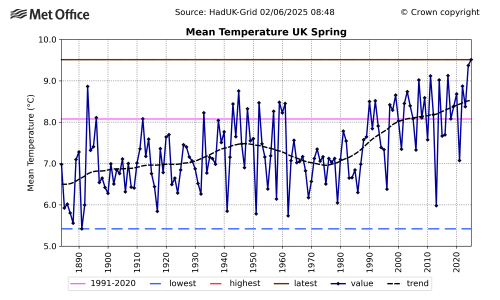
This shows data back to 1890. The variation from year to year is clear. Also clear is the climate change effect. Nobody has been able to detect any trends- of pattern of the variability that we fondly remember. The gloriously hot summers and the fiendishly cold winters.

The effect of man’s use of fossil fuels is clear. Don’t argue with me about, the Mods do not like it. Ask Chat GBT. I have not done so. I know the answers you will get.

We will still have extremes and some hot or cold years may be similar to those in the past. The trend will still be upwards. Heat deaths will increase, extreme events will become more frequent. Governments will pay lip service to action or just bury their heads in the sand until it becomes too hot by which time any possible action will be far too late.


1751745527918.png
 
This shows data back to 1890. The variation from year to year is clear. Also clear is the climate change effect. Nobody has been able to detect any trends- of pattern of the variability that we fondly remember. The gloriously hot summers and the fiendishly cold winters.

The effect of man’s use of fossil fuels is clear. Don’t argue with me about, the Mods do not like it. Ask Chat GBT. I have not done so. I know the answers you will get.

We will still have extremes and some hot or cold years may be similar to those in the past. The trend will still be upwards. Heat deaths will increase, extreme events will become more frequent. Governments will pay lip service to action or just bury their heads in the sand until it becomes too hot by which time any possible action will be far too late.


View attachment 195762
Thank you.

2000 onwards seems a point of change.

Sober reading indeed.
 
That would seem to align with the heatwave of 1970 that was many years ago obviously and the heatwave we have just had or perhaps will still be enduring for a while.

Would be interesting to see if there is a pattern or if these are ‘random’ events.
Possibly you are thinking of ‘76, actually ‘75 and ‘76, which was the renowned long hot summer. A similar pairing of hot summers has also happened on other occasions, I think the early 2000s was one. Random events can give rise to what appear to be examples of organisation too. I once read an essay by Stephen J Gould about this and he used the example of American baseball (or possibly football) teams’ runs of poor form. Someone did a statistical analysis of the sport in question and found that the idea of ‘form’ in this context was spurious. Basically, the teams needed to ignore the form book and just knuckle down and get on with the job.
 
Thank you.

2000 onwards seems a point of change.

Sober reading indeed.


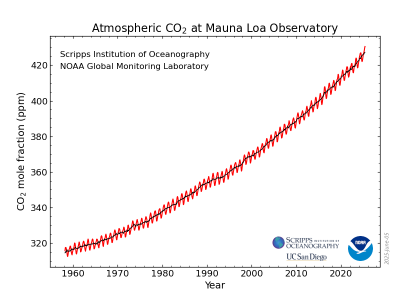
I doubt the significance of the rise beyond 2000. Since about 1960, there have been in situ observations of C02 concentrations, as below. Before then, concentrations were obtained using Antarctic ice cores sediments etc. for at least 800,000 tears before the Industrial Revolution, CO2 concentration were never above 300 ppm. In fact, going back anothe one or two million years, that was so. I think that the diagram in #13 indicates natural variability of the atmosphere superimposed on the CO2 warning effect.

Current values of CO2 were last seen some 3 million years ago. Take a look at global temperature estimates then.


1751879315288.png
 
I doubt the significance of the rise beyond 2000. Since about 1960, there have been in situ observations of C02 concentrations, as below. Before then, concentrations were obtained using Antarctic ice cores sediments etc. for at least 800,000 tears before the Industrial Revolution, CO2 concentration were never above 300 ppm. In fact, going back anothe one or two million years, that was so. I think that the diagram in #13 indicates natural variability of the atmosphere superimposed on the CO2 warning effect.

Current values of CO2 were last seen some 3 million years ago. Take a look at global temperature estimates then.


View attachment 195812
Antarctic ice cores also give a clear and very reliable picture - see Ice cores and climate change - British Antarctic Survey for an overview. I have contributed small pieces of the jigsaw, too; notably This
 
Beast from the east was pretty cold though, so probably a memory issue 😂
Imho modern tech, that has made boats, houses and cars far more "comfortable " has meant that climate extremes (in particular, temperature) are generally much more easily managed than in my past (65yo). This probably skews perceptions somewhat?

No ice on the inside of my (double glazed) sash windows these days....
 
Top